All species › Waders, gulls and terns › Sandpipers and allies › Hudsonian Whimbrel
Position in the tree Birds Aves › Birds with a flexible palate Neognathae › All other modern birds Neoaves › Birds of the elements Elementaves › Cranes and waders Gruimorphae
Hudsonian Whimbrel | Numenius hudsonicus
Amerikaanse regenwulp | Zarapito de Hudson
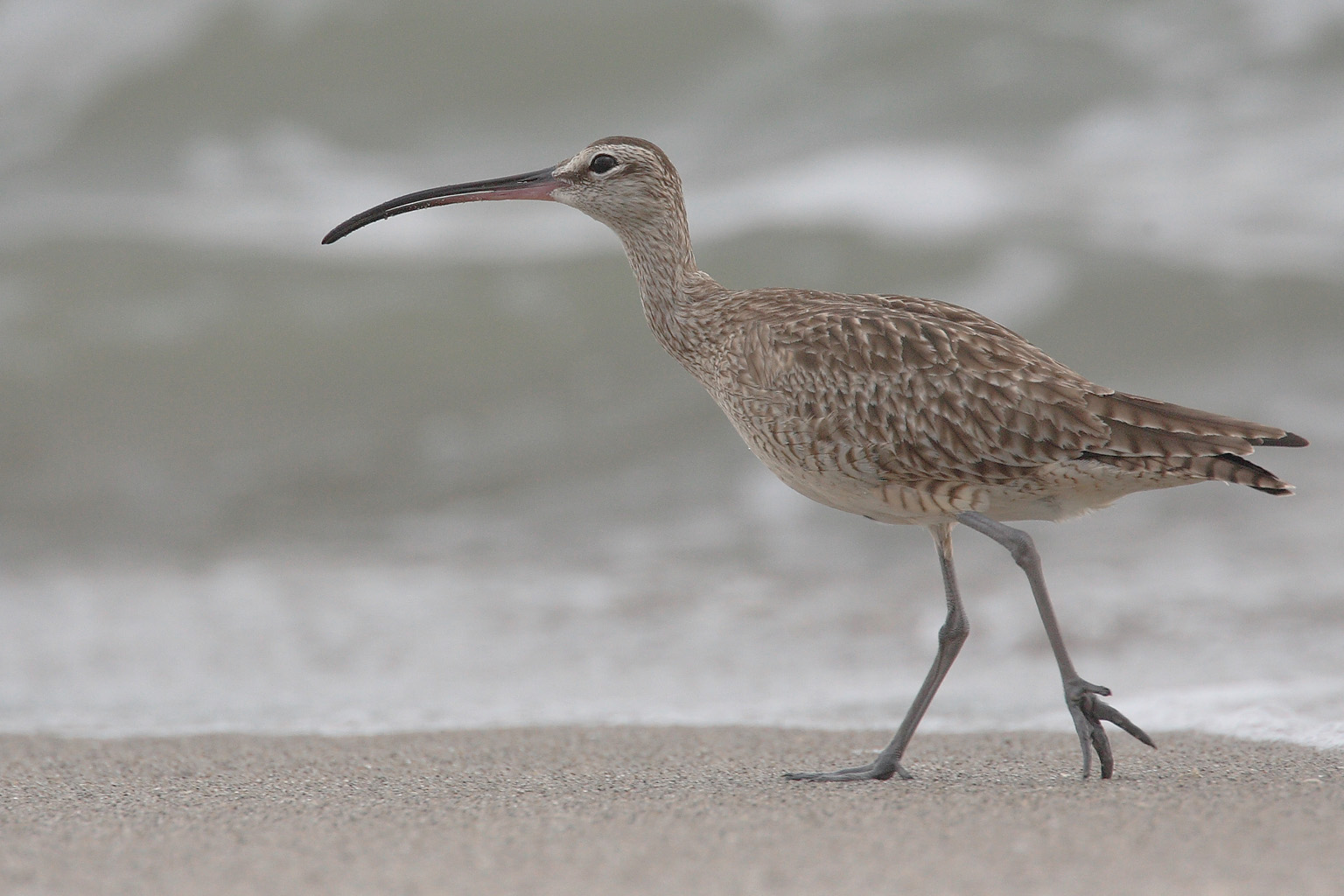
Hudsonian Whimbrel is a medium-sized curlew with a curved bill and a striped crown, a common winter visitor along both coasts of the guide area. On mudflats, rocky shores and in mangroves it is often seen singly or in small groups, at high-tide roosts sometimes in dozens. The species was long treated as a subspecies of the Eurasian Whimbrel.
Voice
A rapid, even series of clear whistles, pi-pi-pi-pi-pi-pi-pi, especially when flushed and in flight.
Recording: JAYRSON ARAUJO DE OLIVEIRA — CC BY-NC-SA 4.0 · converted to mono · xeno-canto
Identification
37–47 cm, of which 6–9 cm is bill. Greyish brown, with a long, dark bill curved down towards the tip and a pink base to the lower mandible. The head shows a dark crown with a pale central stripe, a pale supercilium and a dark eye-stripe. Upperparts grey-brown with pale spots, neck and breast finely streaked, belly paler. Back and rump are brown, without white; the underwing is grey-brown and barred. Legs blue-grey. The sexes are alike; females have a slightly longer bill.
Confusion species
Long-billed Curlew Numenius americanus is larger and cinnamon-brown, with a much longer bill, no crown stripes and a cinnamon underwing. Marbled Godwit Limosa fedoa is warm cinnamon-brown with a straight or slightly upturned bill with a pink base. Willet Tringa semipalmata is plain grey with a straight bill and shows a black-and-white wing in flight.
Habitat
Mudflats, sandy beaches, rocky shores, mangroves, estuaries and saline lagoons, sometimes coastal pasture and salt pans. Probes with its curved bill for crabs and other crustaceans, worms and molluscs; crabs are often pulled from burrows or from under mangrove roots.
Where the bird is most at home, classified by the vegetation units of Mexico and Central America.




Range and movements
Along the coasts of the whole guide area, from Baja California and the Gulf of California along the Pacific coast to Panama, and along the Gulf and Caribbean coasts from Mexico to Panama; most numerous on the Pacific side. Mainly a winter visitor and passage migrant; young birds partly stay through the summer. Outside the guide area the species breeds in Alaska and northern Canada and winters along coasts from the southern United States to Chile and Brazil.
- Winter visitor (c. Oct–Mar)
- dark = core range, pale = thinly spread
How and when to look
Rocky shores and mangrove edges at low tide, and high-tide roosts along the Pacific coast, are the best places. The rapid whistled series often gives the bird away before it is seen.
Conservation status
Not threatened. The global assessment covers Whimbrel in the broad sense; counts suggest the American populations have declined in parts of the range. Threats are loss of coastal habitat and hunting along the flyway.
Scientific name
Numenius hudsonicus | Latham, 1790
Latham described the species in 1790 and placed it straight away in the genus where it still stands. The genus Numenius was introduced in 1760 by Brisson. Numenius is Greek, from neos 'new' and mēnē 'moon', after the bill that recalls a crescent moon; noumēnios is the name of a bird in Hesychius. hudsonicus means 'of Hudson Bay' in Canada, the type locality. The specimen the first description was based on came from Hudson Bay, Canada.