All species › Waders, gulls and terns › Sandpipers and allies › Hudsonian Godwit
Position in the tree Birds Aves › Birds with a flexible palate Neognathae › All other modern birds Neoaves › Birds of the elements Elementaves › Cranes and waders Gruimorphae
Hudsonian Godwit | Limosa haemastica
Rode grutto | Aguja café
Hudsonian Godwit makes one of the longest migrations of any shorebird, between northern Canada and Alaska and the far south of South America. In autumn most birds fly non-stop over the Atlantic Ocean, so the guide area lies off the route. In spring they head north over Central America and the Gulf of Mexico, and that is when the species is seen here most often, though always in small numbers.
Voice
Usually silent on migration; sometimes a high, squeaky kwee-wit or god-wit.
Recording: Avery Bartels — CC BY-NC-SA 4.0 · converted to mono · xeno-canto
Identification
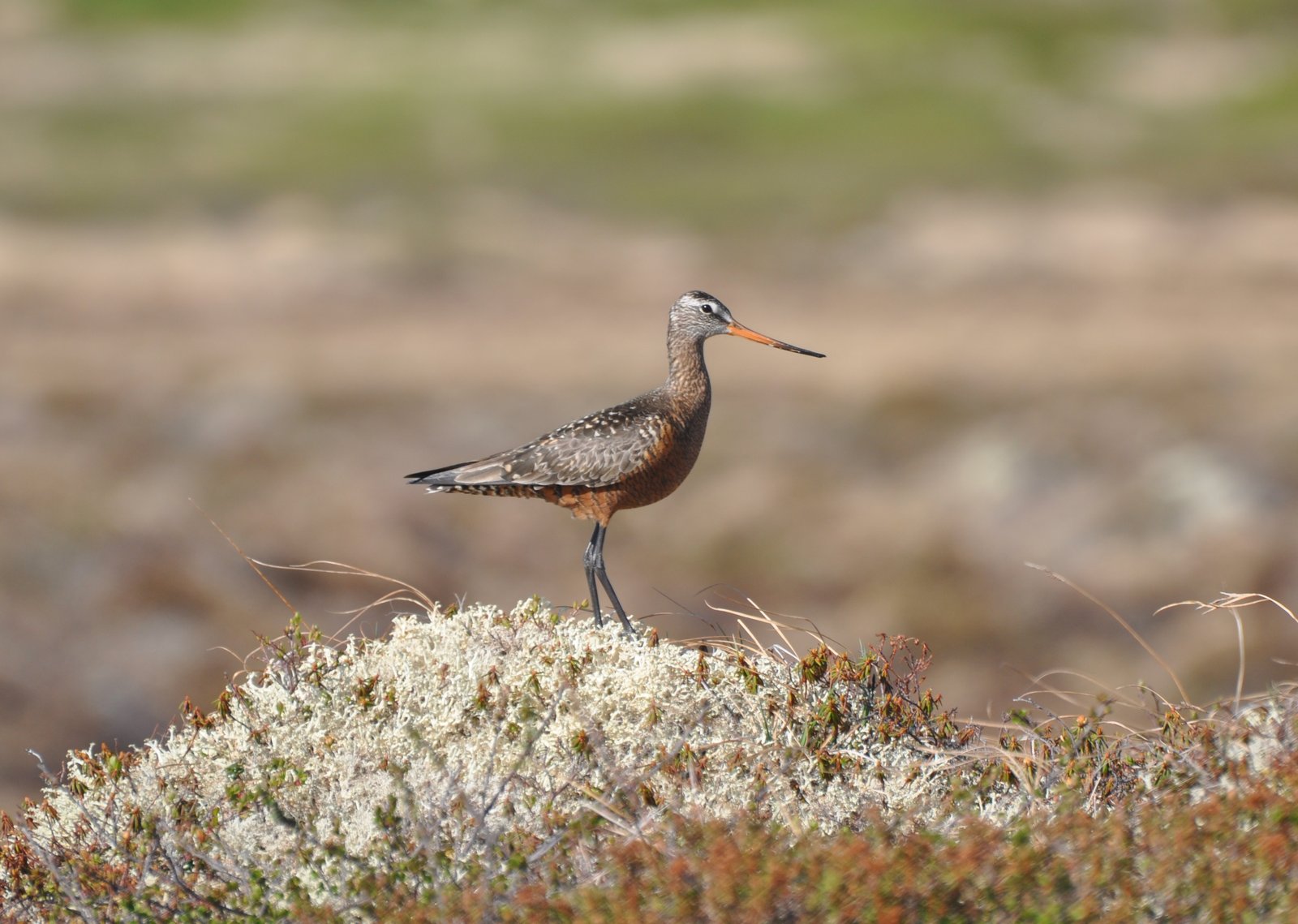
37–42 cm, with a long, slightly upturned bill, pink at the base and dark at the tip. In spring plumage the male is deep chestnut-red below, finely barred black, with a grey head and neck and dark upperparts; the female is larger and paler, with more white below. In non-breeding plumage plain grey above and pale grey below, with a white supercilium. In flight diagnostic in every plumage: a narrow white wing bar, black underwing coverts and a white rump with a black tail.
Confusion species
Marbled Godwit Limosa fedoa is larger and cinnamon-brown, without a white wing bar or white rump, and has a cinnamon underwing. Willet Tringa semipalmata has a shorter, straight bill and a broad black-and-white wing pattern. The dowitchers Limnodromus are smaller, with a straight bill and a white wedge on the back instead of a white rump and black tail.
Habitat
Shallow fresh and brackish lagoons, flooded pasture, rice fields and marsh edges, also mudflats and salt pans on the coast. Probes with its long bill in shallow water and soft mud for worms, insect larvae and small shellfish.
Where the bird is most at home, classified by the vegetation units of Mexico and Central America.


Range and movements
Scarce passage migrant through the guide area, with most records in spring along the Gulf coast of Mexico and on the Yucatán Peninsula; further scattered records in Guatemala, Belize, El Salvador, Honduras, Nicaragua, Costa Rica and Panama. Rarer in autumn. Outside the guide area the species breeds around Hudson Bay, in north-western Canada and in Alaska and winters in southern Chile and Argentina.
- Summer visitor (c. Apr–Sep)
- Passage (Mar–Apr, Oct–Nov)
- dark = core range, pale = thinly spread
How and when to look
Flooded rice fields and shallow lagoons along the Gulf coast in April and May offer the best chance. In flight the white rump with a black tail and the black underwing make the species instantly recognisable.
Conservation status
Vulnerable. The population is declining; a large share of the birds uses only a few stopover sites on migration and on the wintering grounds, which makes the species sensitive to the loss of those areas. Changes on the breeding grounds through climate change are also a threat.
Scientific name
Limosa haemastica | (Linnaeus, 1758)
Linnaeus described the species in 1758 as Scolopax Haemastica; because it was later moved to another genus, the author and year stand in brackets. The genus Limosa was introduced in 1760 by Brisson. Limosa is Latin for 'muddy', from limus 'mud'. haemastica comes from the Greek haimatikos, 'blood-red' — for the deep chestnut-red underparts in breeding plumage. The specimen the first description was based on came from Hudson Bay, Canada.