All species › Passerines › Snowfinches and Old World sparrows › House Sparrow
Position in the tree Birds Aves › Birds with a flexible palate Neognathae › All other modern birds Neoaves › Landbirds Telluraves › Falcons, parrots and passerines Australaves › Falcons and passerines Eufalconimorphae › Parrots and passerines Psittacopasserae
House Sparrow | Passer domesticus
Huismus | Gorrión común
The House Sparrow is an alien in the guide area: it does not occur here naturally. After its introduction to North America in the nineteenth century it spread south through Mexico and during the twentieth century reached Central America as far as Panama. It lives almost exclusively around human settlements.
Voice
A monotonous, repeated chilp, and in groups a continuous chirping; in alarm a rattling cherr.
Recording: Uku Paal — CC BY-NC-SA 4.0 · shortened to the first 60 s, mono · xeno-canto
Identification
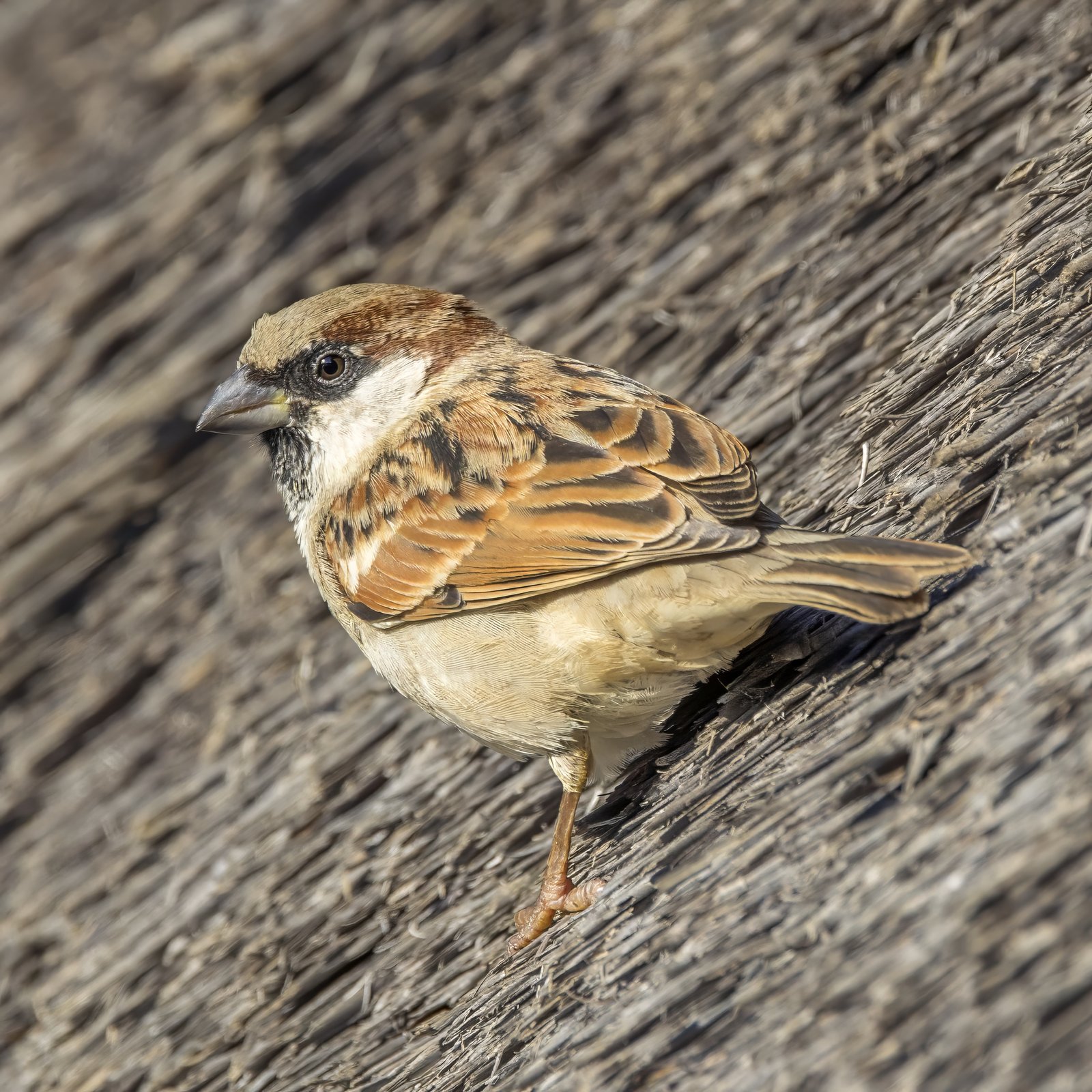
14–16 cm, stocky, with a stout conical bill. The male has a grey crown, a chestnut band from behind the eye to the nape, pale grey cheeks, a black bib and a brown, black-streaked back with a white wing bar. The female is plain greyish-brown, with a pale stripe behind the eye and a streaked back.
Confusion species
Female House Finch Haemorhous mexicanus has streaked underparts and no pale eye stripe. Rufous-collared Sparrow Zonotrichia capensis has a grey head with black stripes, a rufous collar and a short crest.
Habitat
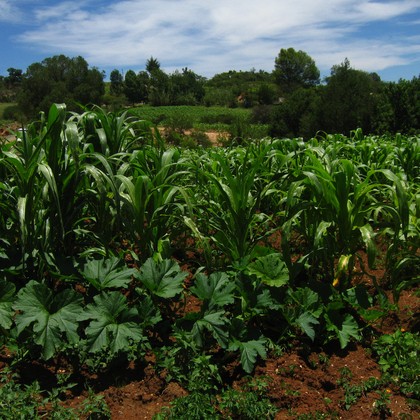
Towns, villages, petrol stations, markets, harbours and farms, and the fields and pasture around them. Absent from forest and from extensive natural areas. It eats seeds, grain and scraps, and feeds its young on insects. It nests in cavities in buildings, lamp posts and billboards.
Where the bird is most at home, classified by the vegetation units of Mexico and Central America.



Range and movements
Established throughout Mexico around towns and villages, and further south in Guatemala, Belize, El Salvador, Honduras, Nicaragua, Costa Rica and Panama, there mainly in towns and along the main roads; locally absent from remote areas on the Caribbean side. Native to Europe, North Africa and much of Asia; introduced to North and South America, southern Africa and Australia, among other places.
- Resident
- dark = core range, pale = thinly spread
How and when to look
At petrol stations, markets and squares in towns and villages; almost never in natural areas far from buildings.
Conservation status
Not threatened globally. In the guide area an alien. Around buildings it competes for nest sites with native species such as House Finch.
Scientific name
Passer domesticus | (Linnaeus, 1758)
Linnaeus described the species in 1758 as Fringilla domestica; because it was later moved to another genus, the author and year stand in brackets. The genus Passer was introduced in 1760 by Brisson. Passer is the Latin word for 'sparrow'. domesticus is Latin for 'belonging to the house', for the bird's life close to people. The specimen the first description was based on came from Sweden.