All species › Woodpeckers and allies › Woodpeckers › Grey-crowned Woodpecker
Position in the tree Birds Aves › Birds with a flexible palate Neognathae › All other modern birds Neoaves › Landbirds Telluraves › Raptors, owls, kingfishers and woodpeckers Afroaves › Mousebirds, rollers and woodpeckers Coraciimorphae › Trogons and cavity nesters Cavitaves › Hornbills, kingfishers and woodpeckers Picocoraciae › Kingfishers, bee-eaters and woodpeckers Picodynastornithes
Grey-crowned Woodpecker | Colaptes auricularis
Grijskruinspecht | Carpintero corona gris
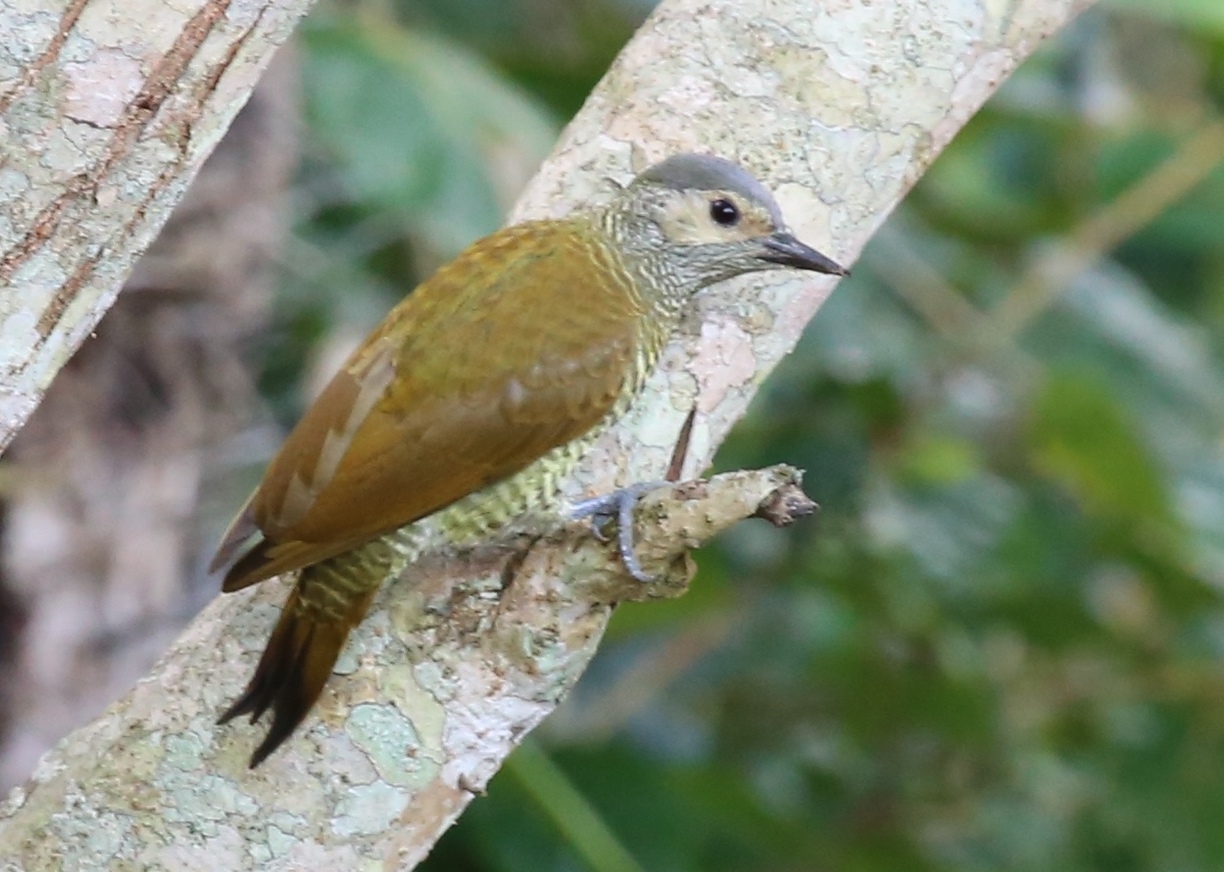
The Grey-crowned Woodpecker is a medium-sized, olive-green woodpecker found only in western Mexico, on the Pacific slope from southern Sonora to Oaxaca. It can be recognised by its plain grey crown without red on the nape and its finely barred, pale underparts.
Voice
A harsh, descending kyeew, a fast rattling series ki-ki-ki-ki and a soft wicka-wicka between partners. Drums in short rolls.
Recording: Richard E. Webster — CC BY-NC-SA 4.0 · shortened to the first 60 s, mono · xeno-canto
Identification
19–21 cm. Crown and hindcrown plain grey, the face dirty white to pale grey. The male has a red moustachial stripe, the female a grey or olive one. The upperparts are olive green with faint dark barring; the underparts are yellowish white with dense, narrow olive-black barring. The underwing and the tail shafts are yellowish. The bill is dark and fairly short.
Confusion species
Golden-olive Woodpecker Colaptes rubiginosus, which occurs in part of the same area, has a red band along the sides of the grey crown and a red nape; the male also has a red moustachial stripe. It is also slightly larger and has a more golden-green back. Grey-crowned Woodpecker lacks red on the nape in both sexes.
Habitat
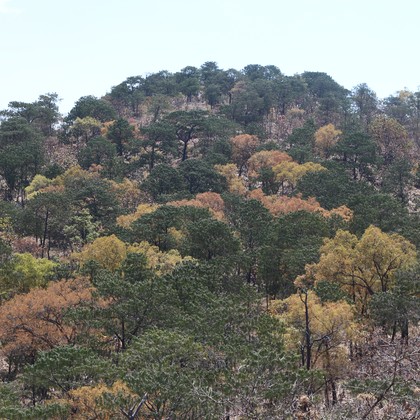
Oak and pine-oak woodland, dry deciduous forest and gallery forest on mountain slopes and in the foothills, mainly between about 500 and 2500 m, locally lower. It searches for insects on trunks and thick branches in the middle and upper tree layers and also visits coffee plantations and forest edges.
Where the bird is most at home, classified by the vegetation units of Mexico and Central America.




Range and movements
Endemic to Mexico: Pacific slope and adjacent sierras from southern Sonora and south-western Chihuahua through Sinaloa, Durango, Nayarit, Jalisco, Colima, Michoacán and Guerrero to Oaxaca.
- Resident
- dark = core range, pale = thinly spread
How and when to look
Regularly seen at the Reserva de la Chara Pinta on the Mazatlán–Durango road in Sinaloa and at Rancho Primavera near El Tuito in Jalisco.
Conservation status
Not threatened. Locally fairly common within its limited range, but sensitive to the clearing of oak and dry forest.
Scientific name
Colaptes auricularis | (Salvin & Godman, 1889)
Salvin & Godman described the species in 1889 as Chloronerpes auricularis; because it was later moved to another genus, the author and year stand in brackets. The genus Colaptes was introduced in 1825 by Vigors. Colaptes is Greek kolaptēs 'chiseller', from kolaptō 'to peck, to chisel', after the hacking into wood. auricularis is Latin for 'of the ear', from auris 'ear', after the ear-coverts and distinctive cheek pattern. The specimen the first description was based on came from Xautipa, Sierra Madre del Sur, Guerrero, Mexico.