All species › Passerines › Tityras, becards and allies › Grey-collared Becard
Position in the tree Birds Aves › Birds with a flexible palate Neognathae › All other modern birds Neoaves › Landbirds Telluraves › Falcons, parrots and passerines Australaves › Falcons and passerines Eufalconimorphae › Parrots and passerines Psittacopasserae
Grey-collared Becard | Pachyramphus major
Mexicaanse bekarde | Cabezón mexicano
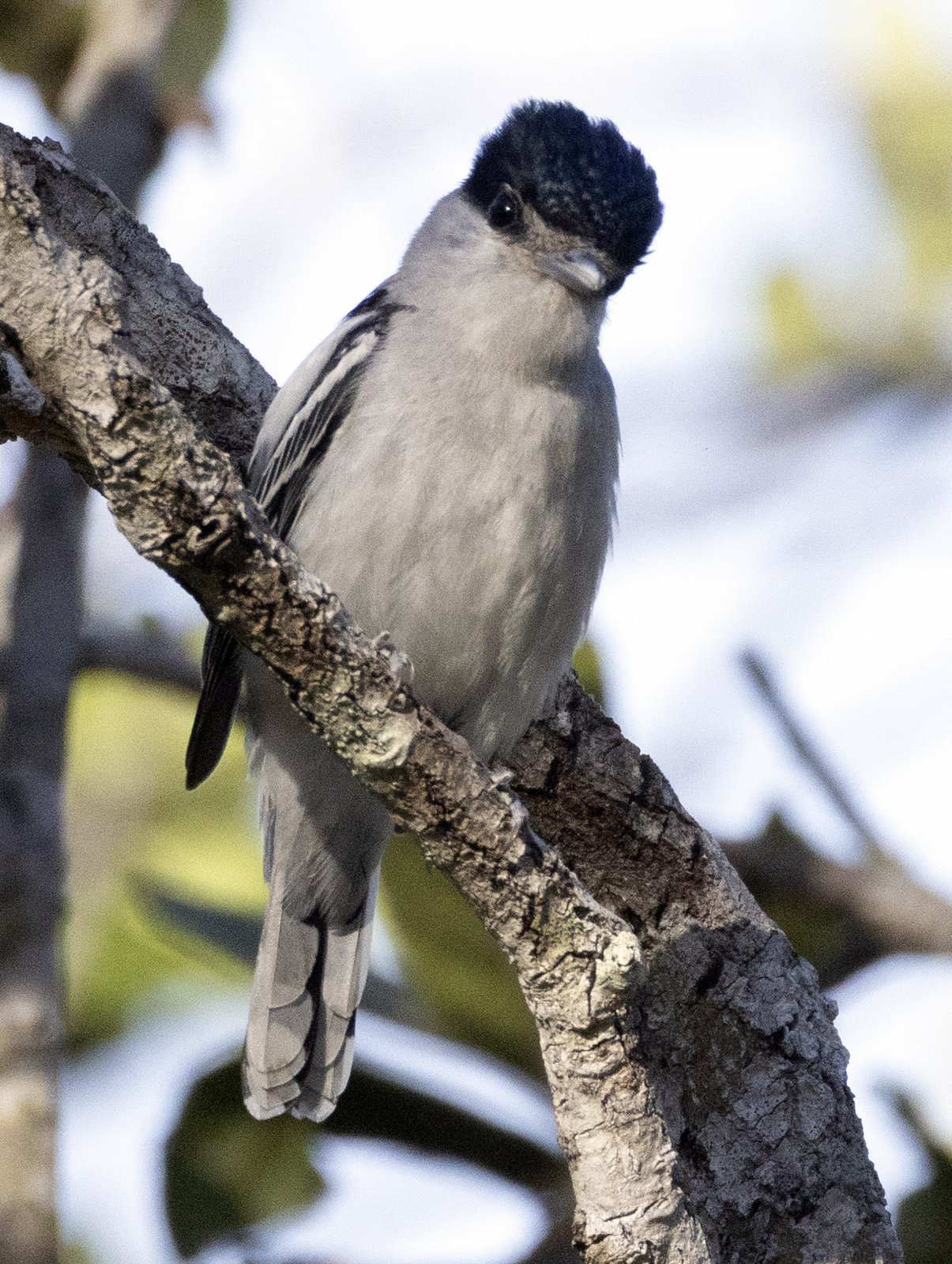
The Grey-collared Becard is a Pachyramphus becard of montane and slope forest. The male is black, grey and white with a grey nape collar; the female is rufous and ochre with a dark crown. It occurs only in the guide area, from Mexico to northern Nicaragua.
Voice
Soft, clear whistled notes and rapid twittering series, often rising and falling.
Recording: Richard E. Webster — CC BY-NC-SA 4.0 · shortened to the first 60 s, mono · xeno-canto
Identification
15–16 cm. Stocky, with a fairly large head and a short, broad bill. Male with a glossy black crown, a grey nape collar, white lores and dark upperparts; wing coverts and tertials edged white, tail black with white tips. Underparts pale grey to greyish white. Female with a blackish crown, rufous back and wings and ochre to cinnamon underparts.
Confusion species
The male Rose-throated Becard Pachyramphus aglaiae is larger and more uniformly grey, without white wing edgings, and often has a pink throat patch; the female is browner above, with a pale collar. White-winged Becard Pachyramphus polychopterus lives further south-east and lower down in the humid lowlands; the male lacks the grey nape collar.
Habitat
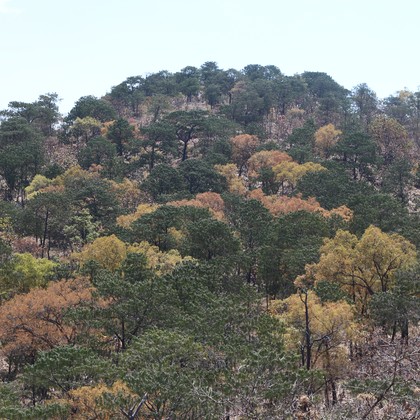
Pine-oak, oak, cloud and semi-humid forest on slopes and in the highlands; in western Mexico also in taller, dry tropical forest. It often keeps to the canopy and joins mixed flocks. It eats insects and small fruit. It builds a large, globular nest high in a tree.
Where the bird is most at home, classified by the vegetation units of Mexico and Central America.




Range and movements
Mexico, from southern Sonora and the north-east (Nuevo León and Tamaulipas) south along both slopes and through the highlands, through Guatemala, El Salvador and Honduras to northern Nicaragua. Does not occur outside the guide area.
- Resident
- dark = core range, pale = thinly spread
How and when to look
Best found in mixed flocks of tits, warblers and vireos in pine-oak and montane forest in Mexico and Guatemala. The male stands out by the combination of black cap, grey nape collar and white wing edgings.
Conservation status
Not threatened. Fairly scarce to locally common; dependent on slope and highland forest.
Scientific name
Pachyramphus major | (Cabanis, 1847)
Cabanis described the species in 1847 as Bathmidurus major; because it was later moved to another genus, the author and year stand in brackets. The genus Pachyramphus was introduced in 1840 by Gray. Pachyramphus is Greek, from pakhus 'thick' and rhamphos 'bill', after the stout, broad bill. major is Latin for 'larger', as this species is larger than related becards. The specimen the first description was based on came from Xalapa, Veracruz, Mexico.