All species › Swifts › Hummingbirds › Green-throated Mountaingem
Position in the tree Birds Aves › Birds with a flexible palate Neognathae › All other modern birds Neoaves › Birds of the elements Elementaves › Nightjars and swifts Strisores
Green-throated Mountaingem | Lampornis viridipallens
Groenkeeljuweelkolibrie | Colibrí garganta verde
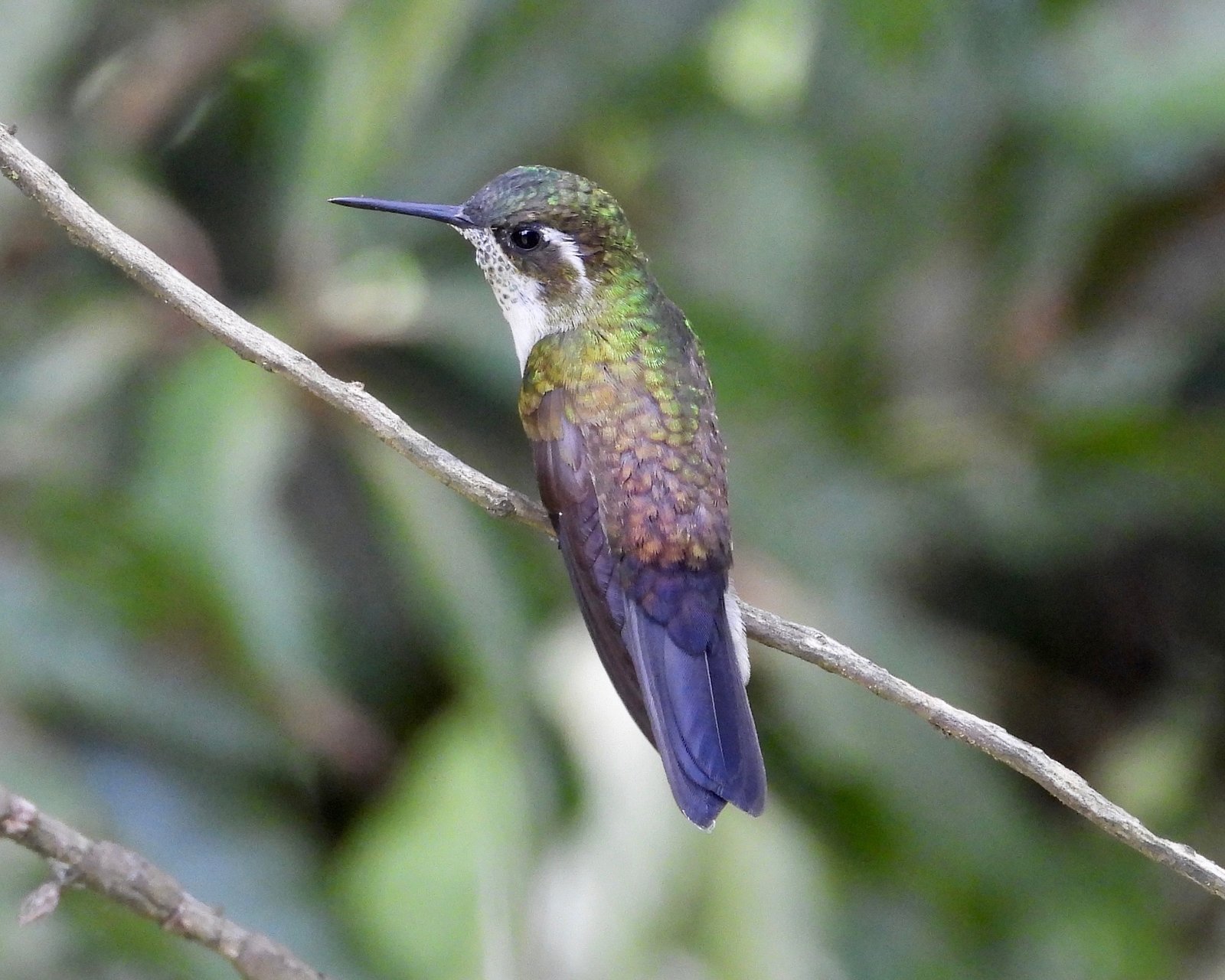
The Green-throated Mountaingem is a hummingbird of cloud forest in the highlands of Chiapas, Guatemala, El Salvador and western Honduras. It feeds mainly low in the understorey and along forest edges. Together with Green-breasted Mountaingem Lampornis sybillae of Honduras and Nicaragua it forms a pair that was formerly treated as a single species.
Voice
A dry, hard chik or chit, in chases sometimes in a rattling series. Also a high, soft, squeaky twittering.
Recording: Sasha Robinson — CC BY-NC-SA 4.0 · converted to mono · xeno-canto
Identification
10–11 cm, with a straight black bill of medium length. The upperparts are glittering green, with a white stripe behind the eye and a dark ear patch. The male has a white throat densely spotted with green, a white breast and belly with green spots on the flanks, and a dark, greyish-black tail. The female has a white throat with little or no green, pale underparts with greenish flanks and a dark tail with grey tips to the outer feathers.
Confusion species
Green-breasted Mountaingem Lampornis sybillae is very similar, but the male has more green on the breast and flanks and a greyer tail; the ranges meet in Honduras. Male Amethyst-throated Mountaingems Lampornis amethystinus have a pink to violet throat and dark grey underparts, the females a cinnamon throat. White-eared Hummingbird Basilinna leucotis also has a white eyestripe, but a red bill with a black tip and greenish or greyish-brown underparts.
Habitat
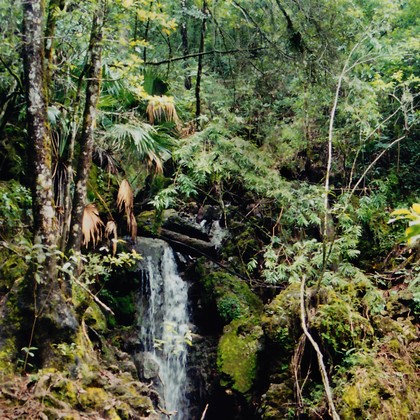
Humid montane and cloud forest and pine-oak forest, especially the understorey, forest edges and clearings with flowering shrubs, at about 1400 to 2500 m, locally higher. It visits mainly flowers in the lower strata, defends flowering shrubs against other hummingbirds and catches small insects. Outside the breeding season some birds move down to lower elevations.
Where the bird is most at home, classified by the vegetation units of Mexico and Central America.


Range and movements
Endemic to the guide area. In the highlands of Chiapas in southern Mexico, in Guatemala, north-western El Salvador and western Honduras.
- Resident
- dark = core range, pale = thinly spread
How and when to look
In the El Triunfo reserve in Chiapas, in the mountains around Lake Atitlán in Guatemala, at Montecristo in El Salvador and at Cusuco and Celaque in Honduras, especially at flowering shrubs in the understorey and along trails through the cloud forest.
Conservation status
Not threatened. Fairly common in suitable forest. The range is small and the cloud forest in which the species lives is being cleared locally.
Scientific name
Lampornis viridipallens | (Bourcier & Mulsant, 1846)
Bourcier & Mulsant described the species in 1846 as Trochilus Viridi-Pallens; because it was later moved to another genus, the author and year stand in brackets. The genus Lampornis was introduced in 1827 by Swainson. Lampornis is Greek, from lampē 'torch, light' and ornis 'bird': 'light-bird', after the glittering throat. viridipallens is Latin, from viridis 'green' and pallens 'pale', after the pale, green-spotted throat. The specimen the first description was based on came from Cobán, Alta Verapaz, Guatemala.