All species › Passerines › Antbirds › Great Antshrike
Position in the tree Birds Aves › Birds with a flexible palate Neognathae › All other modern birds Neoaves › Landbirds Telluraves › Falcons, parrots and passerines Australaves › Falcons and passerines Eufalconimorphae › Parrots and passerines Psittacopasserae
Great Antshrike | Taraba major
Grote mierklauwier | Batará mayor
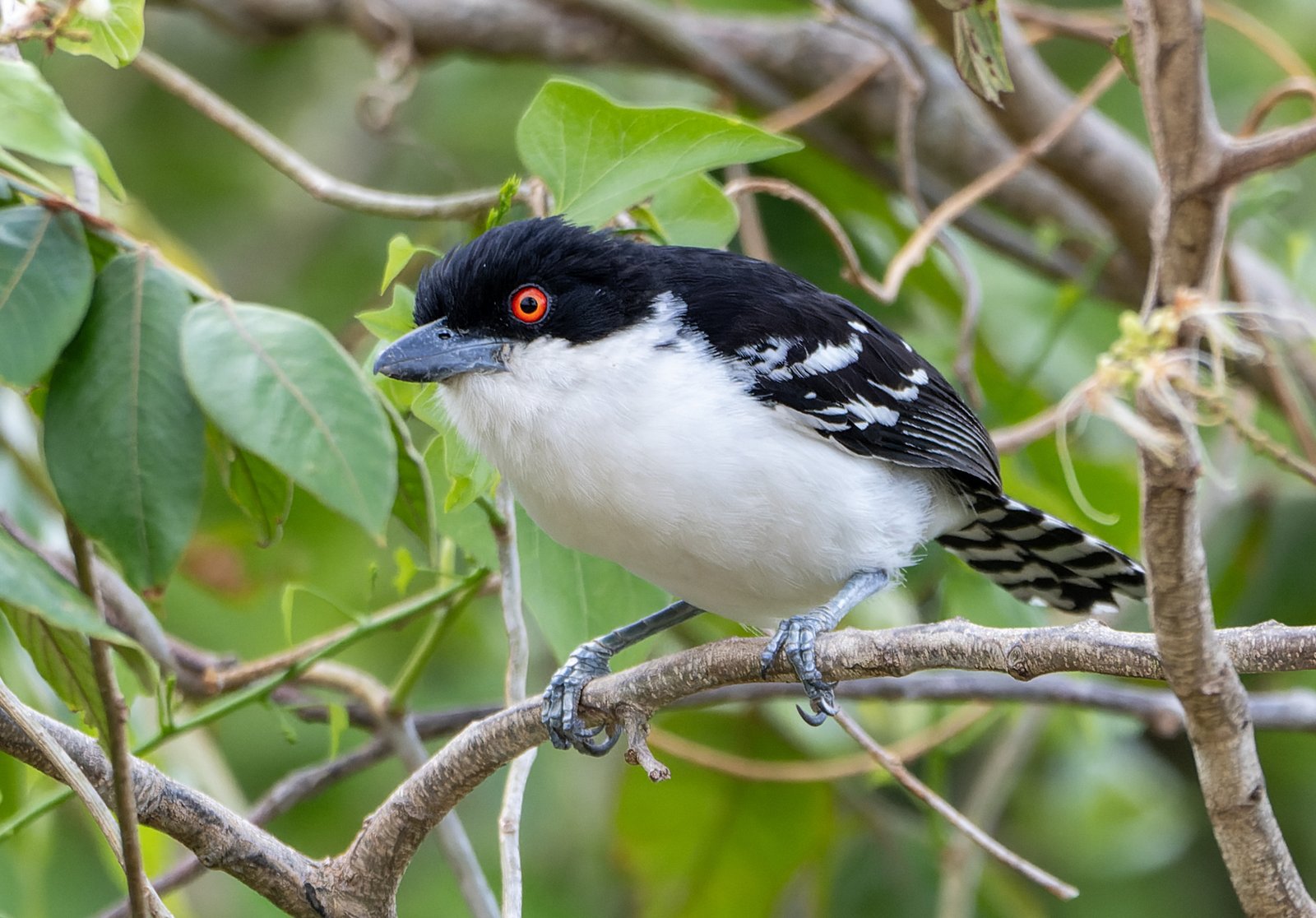
The Great Antshrike is the largest antshrike in the guide area: a big bird with a heavy hooked bill, a bushy crest and red eyes. The male is black with white underparts, the female rufous and white. It lives hidden in dense thickets and tangles at forest edges and is mostly detected by voice. In the guide area it occurs from south-eastern Mexico to Panama.
Voice
A long series of hollow, hooting notes that accelerates and ends in a nasal, snarling nyaah. Also a harsh scold.
Recording: Daan van der Hoeven — CC BY-NC-SA 4.0 · converted to mono · xeno-canto
Identification
19–20 cm, with a heavy black bill hooked at the tip, a bushy crest and red eyes. Male black above with white fringes to the wing coverts forming narrow wingbars, bright white below; flanks grey. Female warm rufous above without wingbars, white below.
Confusion species
Unlikely to be confused given its size, pattern and red eyes. Barred Antshrike Thamnophilus doliatus is smaller and has yellow eyes; the male is barred black and white, the female rufous with ochre underparts. Russet Antshrike Thamnistes anabatinus is smaller, with ochre underparts, and lives high in the forest.
Habitat
Dense thickets, tangles and vines at forest edges, in secondary forest, along rivers, in overgrown clearings and in hedgerows in farmland, in the lowlands and up to about 1000 m, locally higher. It searches low in the vegetation or on the ground for large insects and sometimes small vertebrates.
Where the bird is most at home, classified by the vegetation units of Mexico and Central America.





Range and movements
From south-eastern Mexico (from southern Veracruz and Oaxaca) through all of Central America to Panama. Outside the guide area in much of South America, to northern Argentina.
- Resident
- dark = core range, pale = thinly spread
How and when to look
Usually heard first. It often stays hidden in dense scrub, but sometimes comes briefly to the edge, especially early in the morning. Found in overgrown forest edges in the lowlands of Costa Rica and Panama.
Conservation status
Not threatened. Common and benefits in part from clearings and secondary growth that follow logging.
Scientific name
Taraba major | (Vieillot, 1816)
Vieillot described the species in 1816 as Thamnophilus major; because it was later moved to another genus, the author and year stand in brackets. The genus Taraba was introduced in 1831 by Lesson. According to Jobling, Taraba is an anagram of the genus Batara Lesson; the Tupí word tarabe (an Amazon parrot) may also play a part. major is Latin for 'greater', after its large size for an antshrike. The specimen the first description was based on came from Paraguay.