All species › Passerines › Tanagers and allies › Grassland Yellow Finch
Position in the tree Birds Aves › Birds with a flexible palate Neognathae › All other modern birds Neoaves › Landbirds Telluraves › Falcons, parrots and passerines Australaves › Falcons and passerines Eufalconimorphae › Parrots and passerines Psittacopasserae
Grassland Yellow Finch | Sicalis luteola
Graslandsaffraangors | Chirigüe sabanero
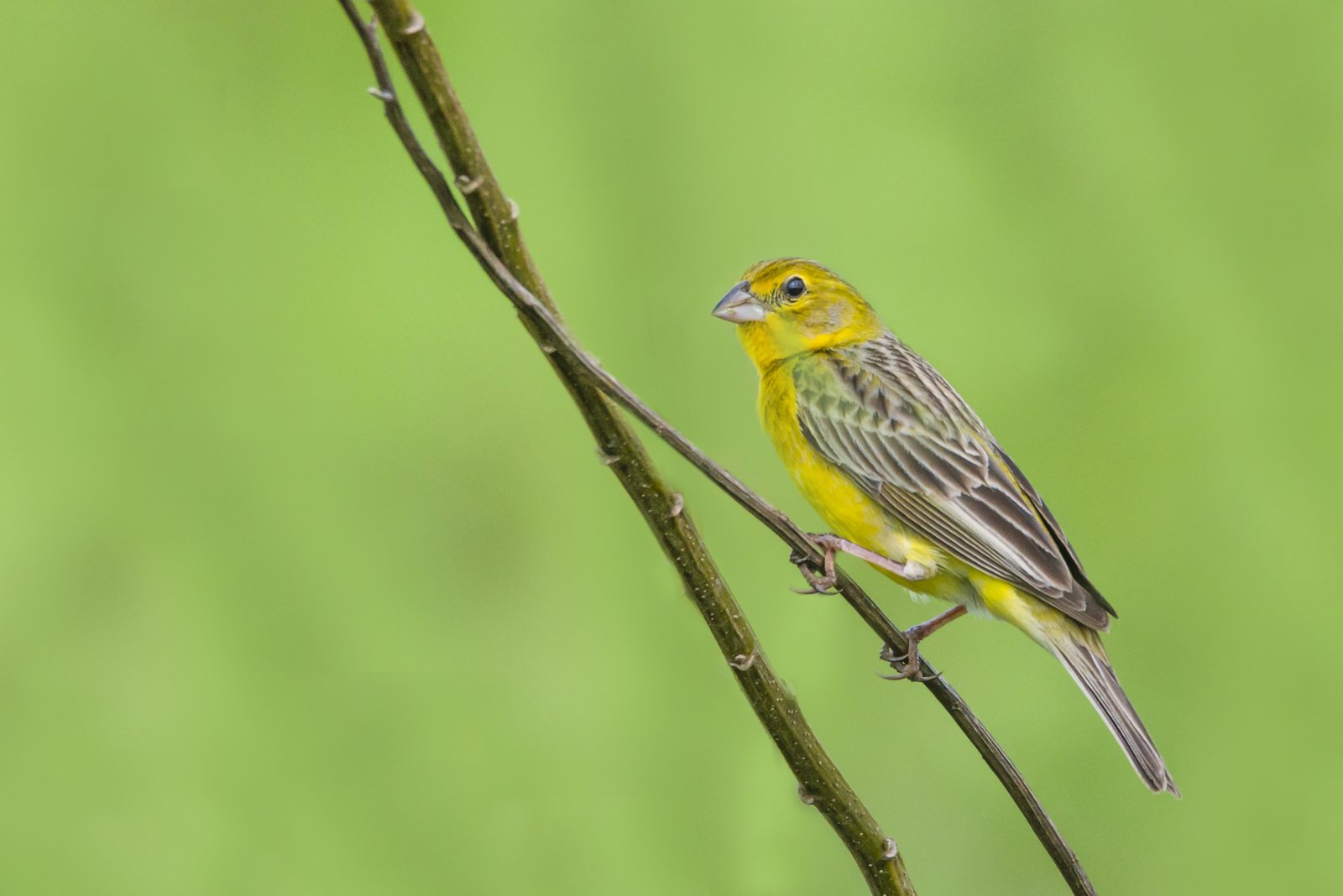
The Grassland Yellow-Finch is a small, yellow and streaked finch-like tanager of open grassland, wet meadows and rice fields. Males sing in a display flight, rising and then gliding down while singing. In the guide area it occurs very locally from southern Mexico to Panama.
Voice
Song a long, rapid series of buzzy trills and twitters, often given in display flight or from a grass stem or wire. Call a short tsip; groups give a dry chatter.
Recording: Mateus Gonçalves Santos — CC BY-NC-SA 4.0 · shortened to the first 60 s, mono · xeno-canto
Identification
12–13 cm. Male olive-brown above with clear dark streaks on crown, mantle and back; rump greener and unstreaked. Face yellow, especially around the eye and between eye and bill. Underparts bright yellow, washed olive on breast and flanks. Wings dark with pale edges. Short, conical, pale bill. The female is duller and browner, with pale yellowish underparts and little yellow on the face.
Confusion species
Saffron Finch Sicalis flaveola is larger; the male has an orange forecrown and an almost unstreaked yellow back. Grasshopper Sparrow Ammodramus savannarum is similar in posture and habitat but is pale buff below, not yellow. The female Dickcissel Spiza americana is larger and has a white throat with a dark malar stripe and rufous wing coverts. Yellow-faced Grassquit Tiaris olivaceus has an unstreaked olive-green back and a yellow-and-black face pattern.
Habitat
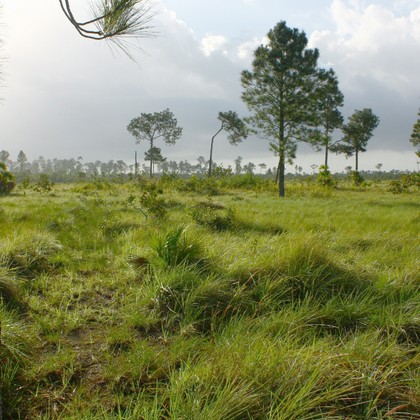
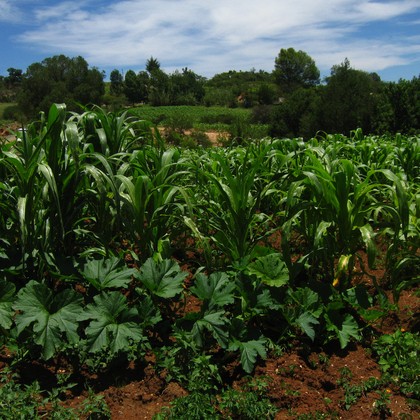
Open grassland, wet meadows, marsh edges, rice fields and other farmland, mainly in the lowlands, locally higher in open upland country. It eats mainly grass seeds and feeds on the ground or in the grass. Outside the breeding season it forms flocks, sometimes in large numbers in rice fields. The nest is placed low in a grass tussock.
Where the bird is most at home, classified by the vegetation units of Mexico and Central America.


Range and movements
Scattered and very local: in southern and eastern Mexico, mainly in the lowlands of Veracruz and Tabasco, and further in Guatemala, Belize, Honduras, Nicaragua, Costa Rica and Panama. It wanders and turns up at new sites where suitable grassland or rice cultivation appears. Outside the guide area over much of South America, from Colombia and Venezuela to Argentina and Chile.
- Resident
- dark = core range, pale = thinly spread
How and when to look
Best looked for in rice fields and wet meadows in the lowlands, in Panama for example in the Tocumen area east of Panama City. Singing males can be seen from afar in their display flight.
Conservation status
Not threatened (LC). Locally common; it benefits from deforestation and rice cultivation and is spreading in the guide area.
Scientific name
Sicalis luteola | (Sparrman, 1789)
Sparrman described the species in 1789 as Emberiza luteola; because it was later moved to another genus, the author and year stand in brackets. The genus Sicalis was introduced in 1828 by Boie. Sicalis comes from Greek sikalis, a small black-headed bird mentioned by Aristotle and Epicharmus, perhaps a Sylvia warbler. luteola is a diminutive of Latin luteus 'saffron-yellow', after the yellow plumage. The specimen the first description was based on came from not stated.