All species › Passerines › Shrike-babblers, Erpornis and vireos › Golden-fronted Greenlet
Position in the tree Birds Aves › Birds with a flexible palate Neognathae › All other modern birds Neoaves › Landbirds Telluraves › Falcons, parrots and passerines Australaves › Falcons and passerines Eufalconimorphae › Parrots and passerines Psittacopasserae
Golden-fronted Greenlet | Pachysylvia aurantiifrons
Goudvoorhoofdvireo | Verdillo luisucho
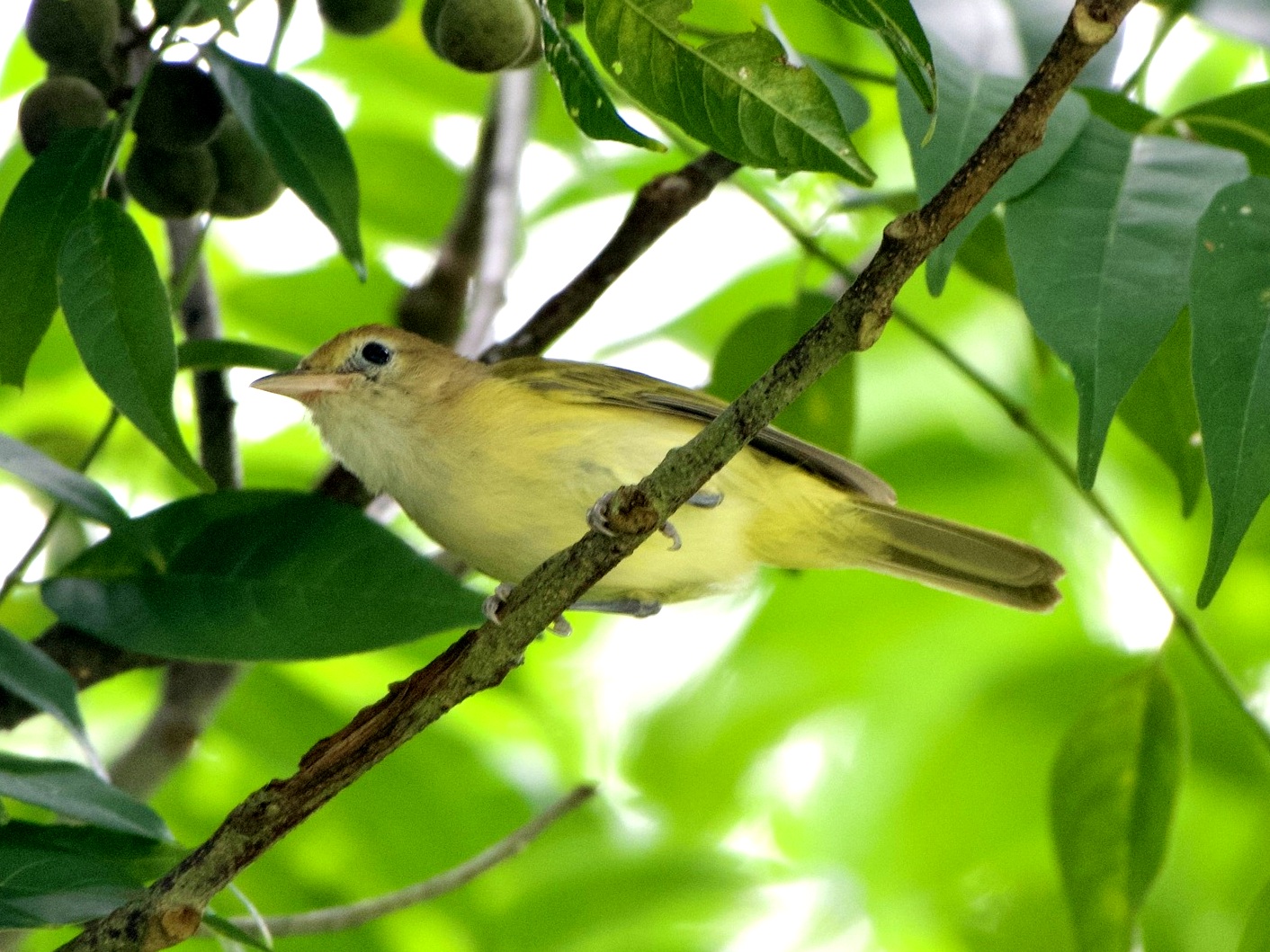
The Golden-fronted Greenlet is a small, olive vireo with a yellowish forehead that in the guide area occurs only in Panama. It lives in the canopy of forest edges, gallery forest and drier woodland.
Voice
The song is a rapidly repeated, clear series of short whistled notes.
Recording: Pedro Luis Castillo — CC BY-NC-SA 4.0 · converted to mono · xeno-canto
Identification
11–12 cm. Forehead yellowish to golden, crown brownish. Upperparts olive-green to olive-brown. Underparts dull yellowish to buffy yellow, throat paler. Eye dark. Bill fairly short and pale.
Confusion species
Lesser Greenlet Pachysylvia decurtata is more compact and shorter-tailed, with a white eye-ring and no yellow forehead. Scrub Greenlet Hylophilus flavipes has a pale eye and lives mainly low in scrub.
Habitat
Forest edges, secondary forest, gallery forest and dry to semi-humid woodland, also trees in pastures, in the lowlands. Forages in the canopy for insects, often in mixed flocks.
Where the bird is most at home, classified by the vegetation units of Mexico and Central America.




Range and movements
In the guide area only in Panama, mainly in the centre and east. Outside the guide area in northern Colombia, Venezuela and on Trinidad.
- Resident
- dark = core range, pale = thinly spread
How and when to look
Most likely at forest edges and in drier woodland in central and eastern Panama; look for the yellow forehead and dark eye.
Conservation status
Not threatened. Fairly common within its range.
Scientific name
Pachysylvia aurantiifrons | (Lawrence, 1861) (GBIF: Hylophilus aurantiifrons)
Lawrence described the species in 1861 as Hylophilus aurantiifrons; because it was later moved to another genus, the author and year stand in brackets. The genus Pachysylvia was introduced in 1850 by Bonaparte. Pachysylvia combines Greek pakhus 'thick, stout' with the genus Sylvia (warblers), after the stocky build. aurantiifrons is Latin, from aurantius 'orange' and frons 'forehead', after the golden forehead. The specimen the first description was based on came from along the Panama Railroad, Panama.