All species › Passerines › Tyrant flycatchers and allies › Forest Elaenia
Position in the tree Birds Aves › Birds with a flexible palate Neognathae › All other modern birds Neoaves › Landbirds Telluraves › Falcons, parrots and passerines Australaves › Falcons and passerines Eufalconimorphae › Parrots and passerines Psittacopasserae
Forest Elaenia | Myiopagis gaimardii
Boselenia | Fiofío selvático
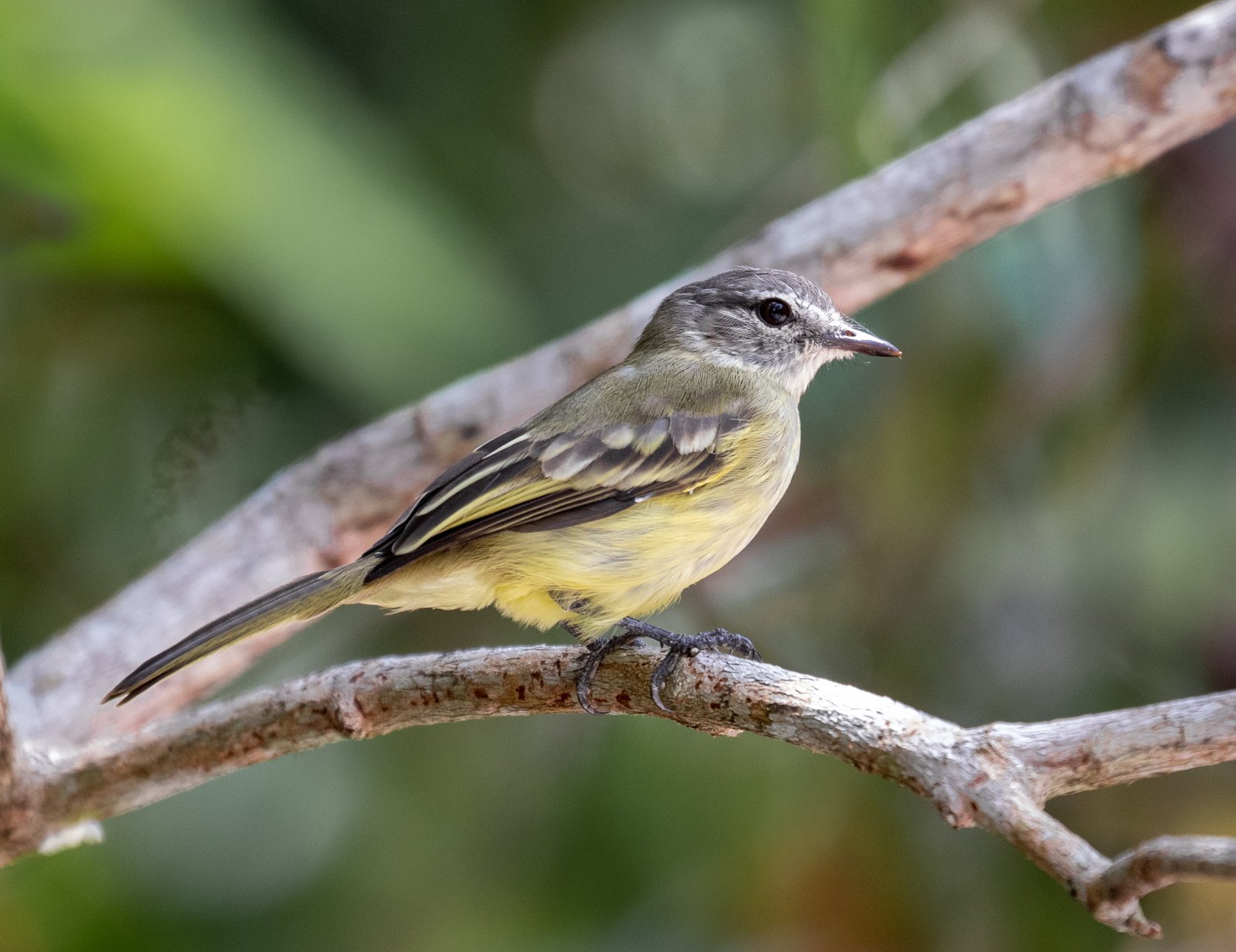
The Forest Elaenia is a small, slim elaenia of the canopy of humid lowland forest, olive-green above and pale yellow below, with a concealed yellow crown patch. It is identified mainly by voice, as it usually stays high in the foliage. In the guide area it lives only in Panama.
Voice
A sharp, short, two-syllabled chee-weet, repeated at intervals from the canopy; it is often the only sign of its presence.
Recording: JAYRSON ARAUJO DE OLIVEIRA — CC BY-NC-SA 4.0 · converted to mono · xeno-canto
Identification
12–13 cm. Crown dark olive-grey with a yellow central patch that is usually hidden; a narrow pale supraloral line and a dark eye-line. Upperparts olive-green. Wings dark with two distinct yellowish wing-bars and yellow edges to the tertials. Throat greyish white, breast yellowish olive with faint streaks, belly pale yellow. Bill slender, with a pale base to the lower mandible. Male and female are alike.
Confusion species
Greenish Elaenia Myiopagis viridicata has no or only faint wing-bars and lives mainly in drier forest. In Choco Elaenia Myiopagis parambae the male is grey with white wing-bars and the female has a grey head. Yellow-crowned Tyrannulet Tyrannulus elatus is smaller, with a short, stubby bill and a grey face. Yellow-olive Flatbill Tolmomyias sulphurescens has a broad, flat bill.
Habitat
Canopy and upper levels of humid lowland and foothill forest, also forest edges, mature secondary forest and gallery forest. It gleans insects from the foliage, often in mixed flocks with other canopy birds.
Where the bird is most at home, classified by the vegetation units of Mexico and Central America.





Range and movements
In the guide area in central and eastern Panama, from the Canal area eastwards. Outside the guide area over much of tropical South America, from Colombia and Venezuela to Amazonia and Bolivia, and on Trinidad.
- Resident
- dark = core range, pale = thinly spread
How and when to look
In the Canal area of Panama, including along Pipeline Road (Camino del Oleoducto), the call is regularly heard in the canopy. A tower or a spot with a view into the treetops improves the chance of seeing it.
Conservation status
Not threatened. Widespread in South America; in Panama fairly common in suitable forest, but seldom noticed because it lives in the canopy.
Scientific name
Myiopagis gaimardii | (d'Orbigny, ACVMD, 1840)
D'Orbigny, ACVMD described the species in 1840 as Muscicapara Gaimardii; because it was later moved to another genus, the author and year stand in brackets. The genus Myiopagis was introduced in 1888 by Salvin & Godman. Myiopagis is Greek, from muia 'fly' and pagis 'trap, snare': 'fly-trap'. gaimardii honours the French naval surgeon and naturalist Joseph Paul Gaimard (1793–1858). The specimen the first description was based on came from Yuracarés, Bolivia.