All species › Passerines › Tyrant flycatchers and allies › Flammulated Flycatcher
Position in the tree Birds Aves › Birds with a flexible palate Neognathae › All other modern birds Neoaves › Landbirds Telluraves › Falcons, parrots and passerines Australaves › Falcons and passerines Eufalconimorphae › Parrots and passerines Psittacopasserae
Flammulated Flycatcher | Ramphotrigon flammulatum
Deltasnaveltiran | Papamoscas jaspeado
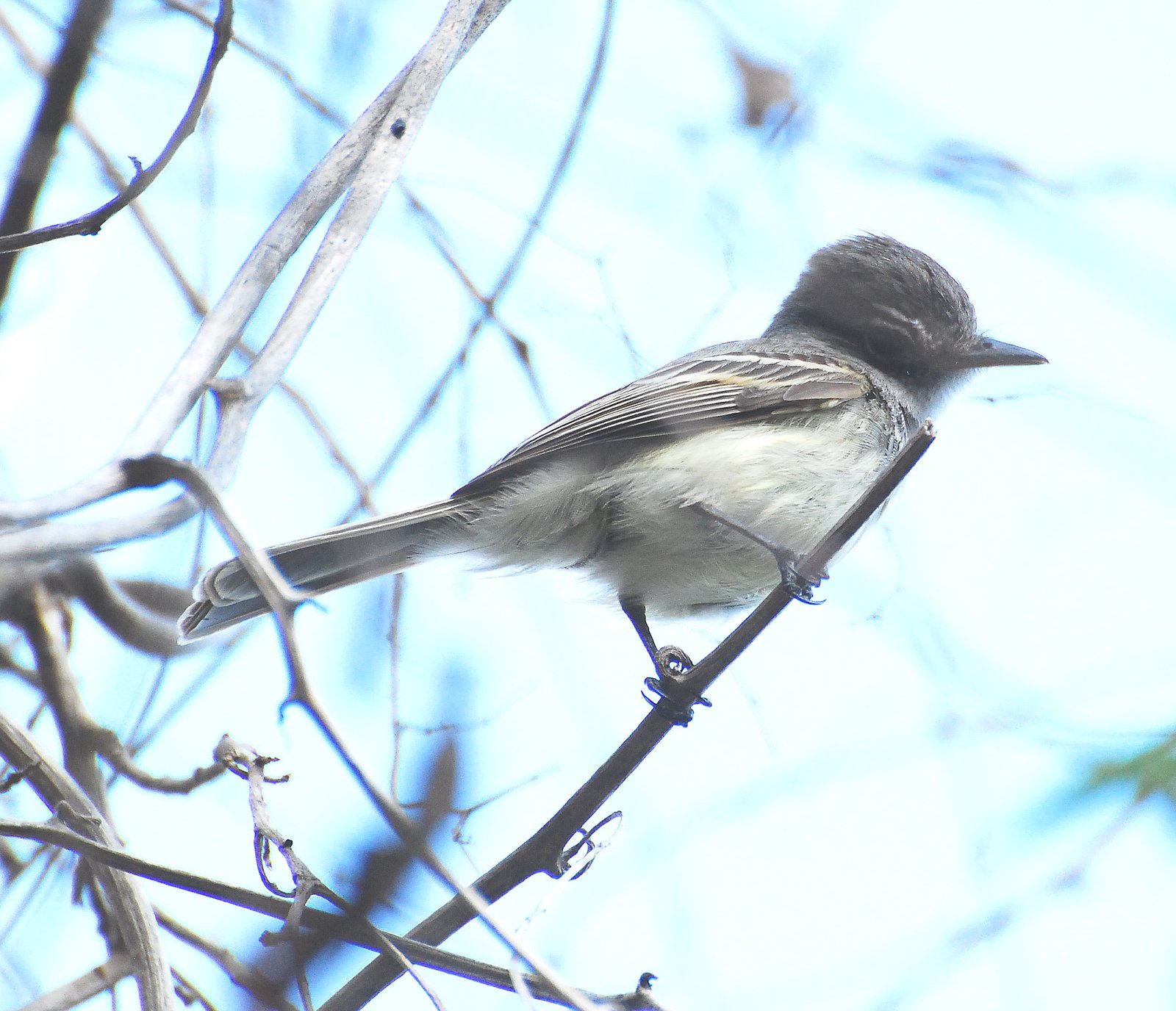
The Flammulated Flycatcher is a medium-sized, brownish tyrant flycatcher with a broad, flat bill and a finely streaked breast, found only in western and southern Mexico. It lives hidden in the dense undergrowth of dry forest and is mostly found by its call. It was formerly placed in its own genus Deltarhynchus.
Voice
A soft, rolling, rather plaintive whistle that is often repeated, sometimes followed by a short series of faster notes.
Recording: Manuel Grosselet — CC BY-NC-SA 4.0 · converted to mono · xeno-canto
Identification
16 cm, with a fairly large head and a broad, flat dark bill. Upperparts olive-brown, crown slightly darker and greyer. Pale lores and a narrow pale eye-ring. Wings dark with two cinnamon wing-bars and rufous edges to the inner flight feathers; tail brown with faint rufous edges. Throat whitish, breast pale grey with fine, faint dark streaks, belly pale yellow. Male and female are alike.
Confusion species
Myiarchus flycatchers such as Dusky-capped Flycatcher Myiarchus tuberculifer and Nutting's Flycatcher Myiarchus nuttingi are very similar in colour and posture but have a plain grey breast without streaks, a narrower bill and more rufous in the wings and tail. Yellow-olive Flatbill Tolmomyias sulphurescens is smaller and greener and has a grey head.
Habitat
Dense undergrowth and lower to middle levels of dry deciduous forest and thorn forest, also gallery forest and dense scrubby edges, from the lowlands into the foothills. It sits quietly in the foliage and takes insects from leaves and twigs with short sallies.
Where the bird is most at home, classified by the vegetation units of Mexico and Central America.



Range and movements
Endemic to Mexico: Pacific slope from southern Sinaloa south to Chiapas. Not found outside Mexico.
- Resident
- dark = core range, pale = thinly spread
How and when to look
Best found by listening for the call in dry forest on the Pacific slope, for example in Jalisco, Colima or Oaxaca, and then searching the undergrowth patiently.
Conservation status
Not threatened. Rather scarce and often overlooked. The dry forest of Mexico's Pacific slope is being cleared in many places, which affects the species locally.
Scientific name
Ramphotrigon flammulatum | (Lawrence, 1875) (GBIF: Deltarhynchus flammulatus)
Lawrence described the species in 1875 as Myiarchus flammulatus; because it was later moved to another genus, the author and year stand in brackets. The genus Ramphotrigon was introduced in 1855 by Gray. Ramphotrigon is Greek, from rhamphos 'bill' and trigōnon 'triangle', after the broad, triangular bill. flammulatum is Latin, from flammula 'little flame', after the flame-like streaking on the breast. The specimen the first description was based on came from Cacoprieto near Tehuantepec, Oaxaca, Mexico.