All species › Passerines › Finches, euphonias and allies › Evening Grosbeak
Position in the tree Birds Aves › Birds with a flexible palate Neognathae › All other modern birds Neoaves › Landbirds Telluraves › Falcons, parrots and passerines Australaves › Falcons and passerines Eufalconimorphae › Parrots and passerines Psittacopasserae
Evening Grosbeak | Hesperiphona vespertina
Avonddikbek | Picogordo vespertino
The Evening Grosbeak is a large, stocky finch with a very heavy, pale bill. It breeds in the conifer forests of Canada and the western United States; in the guide area a small, scattered population lives in the mountain forests of Mexico. Outside the breeding season flocks wander in search of seeds.
Voice
The call is loud and differs between populations: a clear, whistled cheer or peeer, or a more trilled prrr. Flocks call a great deal, also in flight. A true song is almost lacking.
Recording: Valerie Heemstra — CC BY-NC-SA 4.0 · shortened to the first 60 s, mono · xeno-canto
Identification
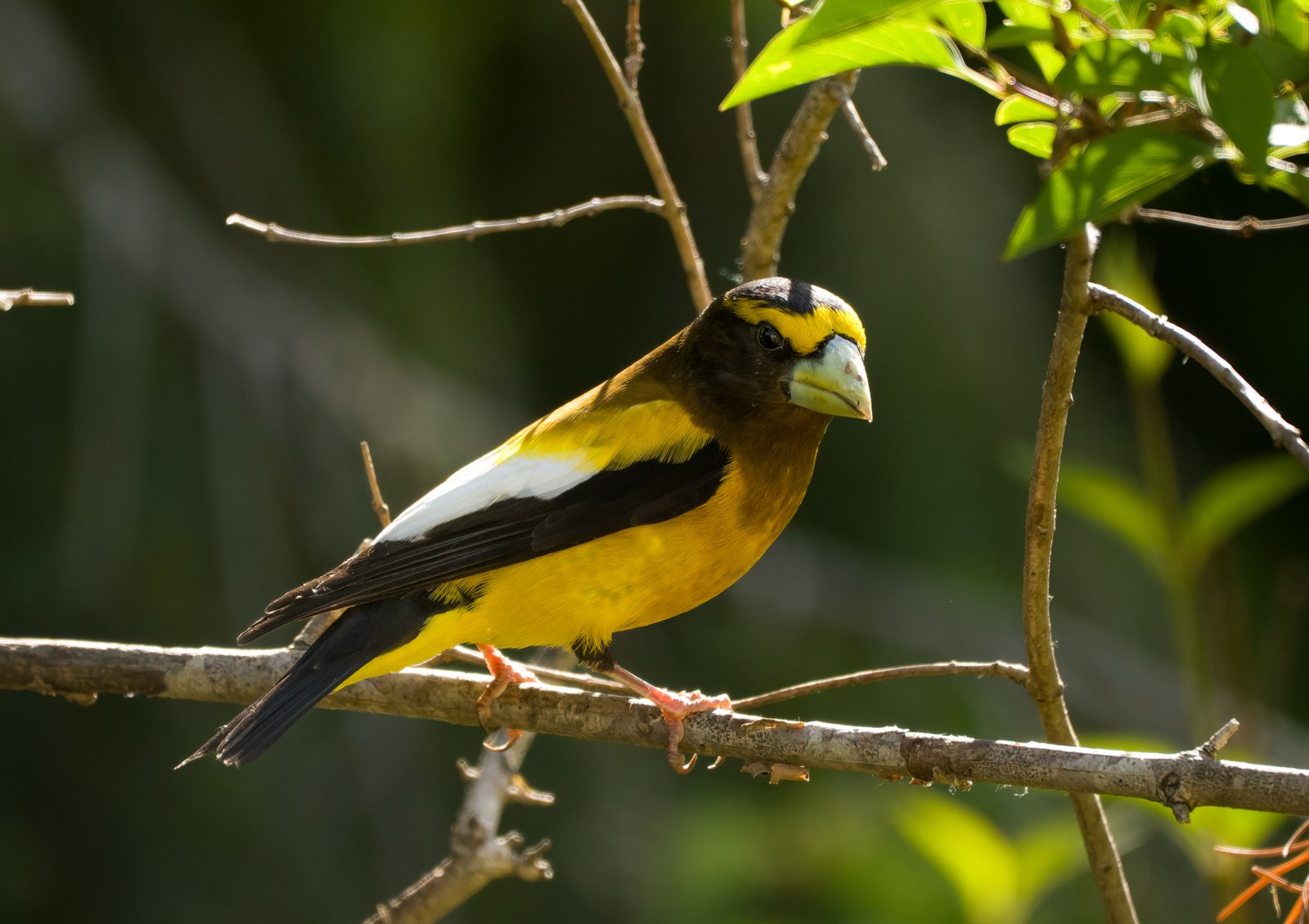
16–18 cm. Heavily built, with a large head, a conical, greenish ivory bill and a short, slightly forked tail. The male has a dark brown head with a bright yellow forehead band and supercilium; the brown grades through the back and breast into yellow on the rump and belly. The wings are black with a large white patch on the inner secondaries; the tail is black. The female is grey with a yellowish wash on the nape and flanks, a dark malar stripe, black-and-white wings and white spots at the tip of the tail.
Confusion species
Hooded Grosbeak Hesperiphona abeillei lives in the same mountains. The male has an entirely black head without a yellow forehead band and a brighter yellow body; the female has a black crown and a yellowish olive body instead of grey. Yellow Grosbeak Pheucticus chrysopeplus is yellower and has a dark bill and white wing bars.
Habitat
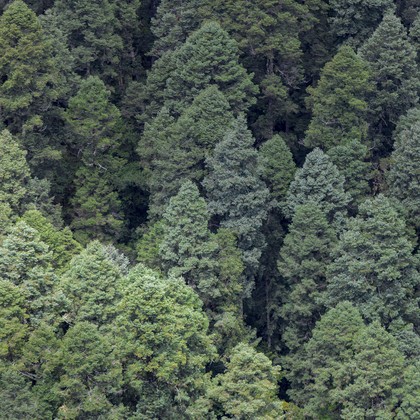
In the guide area pine forest, pine-oak forest and mixed montane forest with seed-rich trees, mostly above 1,800 m. It searches the canopy, and sometimes the ground, for seeds, buds and fruit, cracking hard seeds with its heavy bill. Outside the breeding season in flocks that wander unpredictably.
Where the bird is most at home, classified by the vegetation units of Mexico and Central America.



Range and movements
Breeds in Canada and in the mountains of the western and north-eastern United States; northern birds move south irregularly in winter. In the guide area a scarce resident in the Sierra Madre Occidental and in the mountains of central Mexico, with scattered records further south. Winter visitors from the north reach northern Mexico only exceptionally.
- Resident
- Summer visitor (c. Apr–Sep)
- Winter visitor (c. Oct–Mar)
- Passage (Mar–Apr, Oct–Nov)
- dark = core range, pale = thinly spread
How and when to look
Flocks are usually detected by their loud, far-carrying call; in pine-oak forest, watch for birds cracking seeds high in the canopy.
Conservation status
Vulnerable (VU). Numbers in North America have declined steeply since the 1970s; the causes are not fully known, but changes in forests and food supply play a part. The Mexican population is small and fragmented and suffers from logging in montane forests.
Scientific name
Hesperiphona vespertina | (Cooper, 1825)
Cooper described the species in 1825 as Fringilla vespertina; because it was later moved to another genus, the author and year stand in brackets. The genus Hesperiphona was introduced in 1850 by Bonaparte. Hesperiphona is Greek, from hesperos 'evening' and phōnē 'voice, sound', after the old belief that the Evening Grosbeak sings at dusk. vespertina is Latin for 'of the evening', after the old, mistaken belief that the bird sings only at dusk. The specimen the first description was based on came from Sault Ste. Marie, Michigan, USA.