All species › Passerines › Finches, euphonias and allies › Elegant Euphonia
Position in the tree Birds Aves › Birds with a flexible palate Neognathae › All other modern birds Neoaves › Landbirds Telluraves › Falcons, parrots and passerines Australaves › Falcons and passerines Eufalconimorphae › Parrots and passerines Psittacopasserae
Elegant Euphonia | Chlorophonia elegantissima
Blauwkaporganist | Eufonia capucha azul
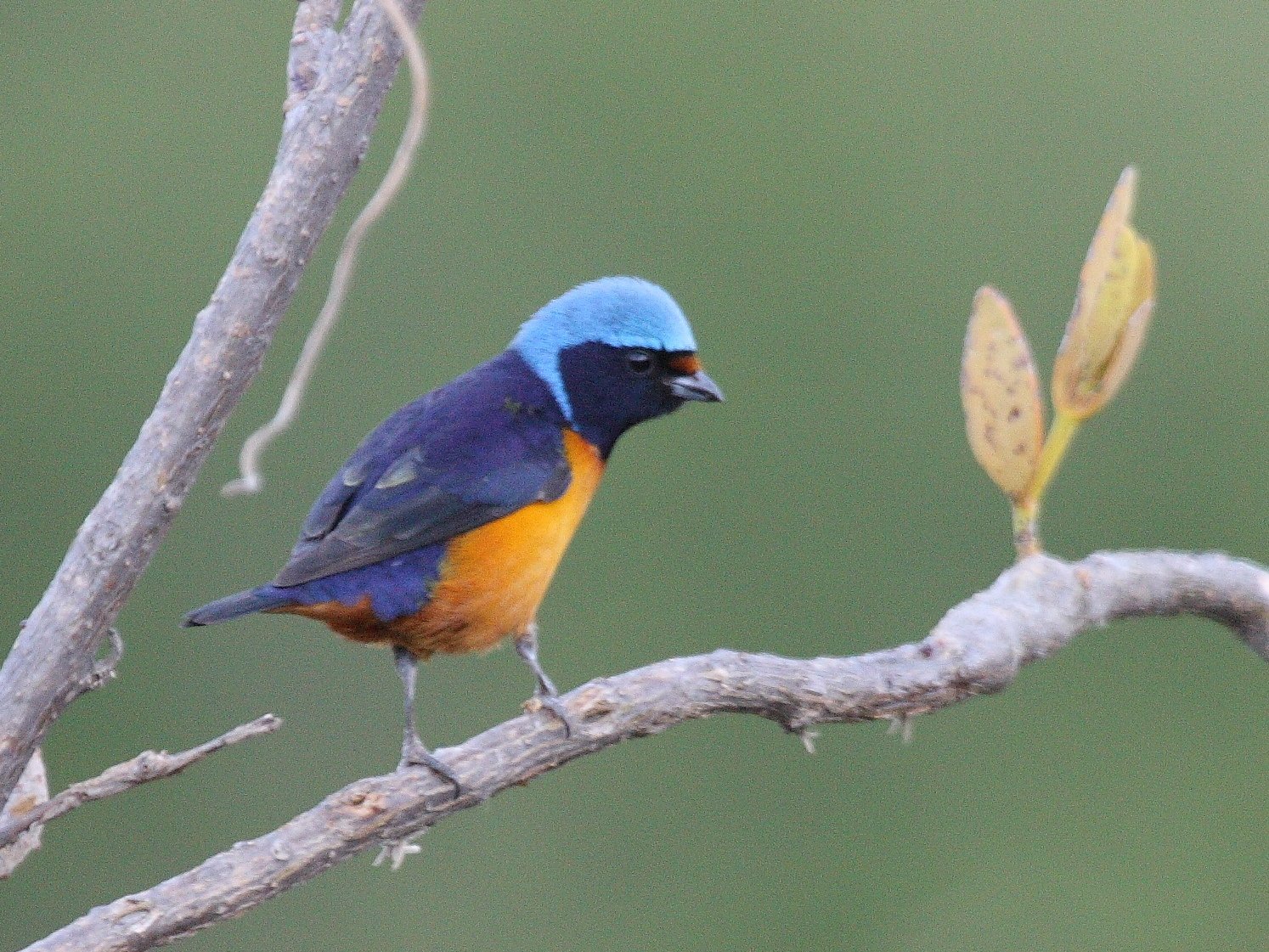
The Elegant Euphonia is a small, stocky euphonia of montane forest, recognised by the sky-blue cap on the crown and nape. It feeds mainly on the berries of mistletoe and other hemiparasitic plants and moves through the canopy in small groups. Although still called a euphonia, it is now placed in the genus Chlorophonia. In the guide area it lives from north-western and north-eastern Mexico to Nicaragua.
Voice
The call is a clear, plaintive chew or tew, often repeated, and a dry, slightly buzzy chatter. The song is a rambling series of twittering and whistled notes.
Recording: Richard E. Webster — CC BY-NC-SA 4.0 · shortened to the first 60 s, mono · xeno-canto
Identification
11–12 cm. The male has a turquoise-blue crown and nape and a narrow chestnut forehead. Face, throat, back, wings and tail are dark blue-black, the underparts warm orange-tawny. The female is olive-green above with the same blue cap and a rufous forehead; throat tawny, rest of the underparts yellowish green. Bill short and thick.
Confusion species
With its blue cap the male cannot be confused with any other euphonia in the guide area; other euphonias with dark upperparts have yellow underparts and yellow on the head. The female resembles that of Blue-crowned Chlorophonia Chlorophonia occipitalis, but that species is brighter grass-green, has a green throat and lacks the rufous forehead. Females of Euphonia species are olive-green or grey without a blue cap.
Habitat
Pine-oak forest, cloud forest, oak forest and their edges, mostly between about 600 and 3000 m; also semi-open country with scattered trees and orchards where mistletoe grows. Outside the breeding season it wanders and then also appears lower down. It eats mainly mistletoe berries and other small fruits. The nest is a domed structure with a side entrance, placed in moss or epiphytes.
Where the bird is most at home, classified by the vegetation units of Mexico and Central America.




Range and movements
In Mexico from south-eastern Sonora and Chihuahua along the Sierra Madre Occidental and from southern Nuevo León and Tamaulipas along the Sierra Madre Oriental southwards, through the highlands of central and southern Mexico; further in Guatemala, El Salvador and Honduras to northern and central Nicaragua. Does not occur outside the guide area; a rare vagrant to the southern United States.
- Resident
- dark = core range, pale = thinly spread
How and when to look
Mostly found at trees with dense clumps of mistletoe, where small groups come in briefly to feed and then move on. The plaintive chew often gives the birds away before they are seen.
Conservation status
Not threatened (LC). Fairly common in montane forest; tolerates semi-open country as long as trees with mistletoe remain.
Scientific name
Chlorophonia elegantissima | (Bonaparte, 1838) (GBIF: Euphonia elegantissima)
Bonaparte described the species in 1838 as Pipra elegantissima; because it was later moved to another genus, the author and year stand in brackets. The genus Chlorophonia was introduced in 1851 by Bonaparte. Chlorophonia combines Greek khlōros 'green' with the genus name Euphonia, after the green plumage. elegantissima is Latin for 'most elegant', superlative of elegans, after the colourful plumage. The specimen the first description was based on came from Mexico (not specified).