All species › Passerines › Thrushes and allies › Eastern Bluebird
Position in the tree Birds Aves › Birds with a flexible palate Neognathae › All other modern birds Neoaves › Landbirds Telluraves › Falcons, parrots and passerines Australaves › Falcons and passerines Eufalconimorphae › Parrots and passerines Psittacopasserae
Eastern Bluebird | Sialia sialis
Roodkeelsialia | Azulejo garganta canela
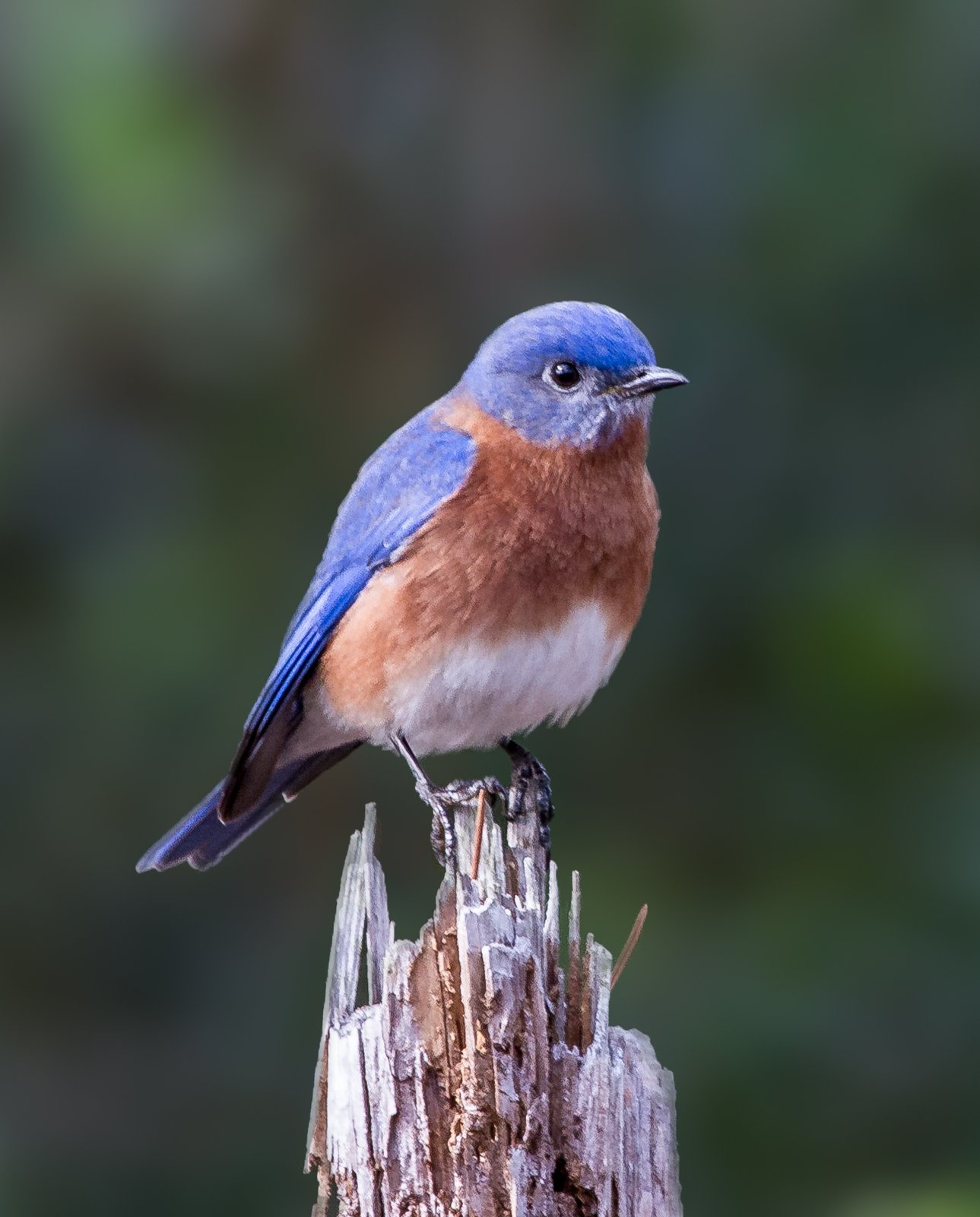
The Eastern Bluebird is a small thrush of open country with scattered trees. The male is bright blue above with a rusty-orange throat and breast. It often perches upright on a post, wire or low branch and drops from there onto insects on the ground. In the guide area it lives in the highlands of Mexico and northern Central America and in the pine savannas of Belize, Honduras and Nicaragua.
Voice
The song is a soft, burbling warble of short whistled notes, like chur-lee chur-lee. The call is a soft, falling tu-wee or chur-lee, often given in flight.
Recording: Stanislas Wroza — CC BY-NC-SA 4.0 · converted to mono · xeno-canto
Identification
16–20 cm. Compact, with a fairly large round head, a short thin bill and long wings. Male bright blue above; throat, breast and flanks rusty orange, belly and undertail coverts white. Female greyer, with blue mainly on the wings and tail, a thin white eye-ring and a paler orange breast. Juveniles grey-brown with white drop-shaped spots on the back and breast and blue edges to the wings and tail.
Confusion species
Western Bluebird Sialia mexicana has a blue throat in the male, often a chestnut patch on the back, and a greyish rather than white belly; the female has a grey, not orange, throat. Mountain Bluebird Sialia currucoides, a winter visitor to northern Mexico, has no orange below; the male is entirely sky-blue, the female grey-brown with blue wings. Indigo Bunting Passerina cyanea is smaller, has a thick conical bill and lacks the orange.
Habitat
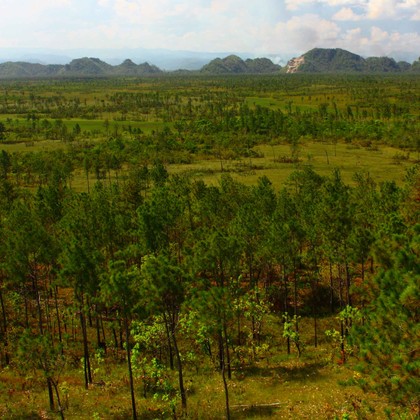
Open pine and pine-oak woodland, pine savanna, pasture with scattered trees, forest edges, clearings and orchards, in the highlands mostly between 1000 and 3000 m, in the pine savannas of Belize, Honduras and Nicaragua also at low elevations. It eats insects, caught mainly from a perch on the ground, and outside the breeding season also many berries. It nests in a tree cavity, often an old woodpecker hole, or in a post or nest box.
Where the bird is most at home, classified by the vegetation units of Mexico and Central America.



Range and movements
Breeds in eastern North America, from southern Canada to the Gulf Coast. In the guide area resident in the highlands of Mexico, from the north through the Sierra Madre Oriental and the central plateau to Chiapas, and further in the highlands of Guatemala, El Salvador, Honduras and northern Nicaragua; also in the pine savannas of Belize, eastern Honduras and north-eastern Nicaragua. In winter northern birds reach north-eastern Mexico.
- Resident
- dark = core range, pale = thinly spread
How and when to look
Regularly seen in the Mountain Pine Ridge in Belize and in the pine forests around San Cristóbal de las Casas in Chiapas. It is most conspicuous when perched on a post, wire or bare branch at a forest edge.
Conservation status
Not threatened. Locally common in open pine woodland and semi-open country; depends on cavities in old trees and posts for nesting.
Scientific name
Sialia sialis | (Linnaeus, 1758)
Linnaeus described the species in 1758 as Motacilla Sialis; because it was later moved to another genus, the author and year stand in brackets. The genus Sialia was introduced in 1827 by Swainson. Sialia comes from Greek sialis, an unidentified bird mentioned by Athenaeus and Hesychius, so called from its cry. sialis is Greek sialis, an unidentified bird mentioned by Athenaeus and Hesychius, so called from its cry. The specimen the first description was based on came from South Carolina, USA.