All species › Trogons › Trogons › Eared Quetzal
Position in the tree Birds Aves › Birds with a flexible palate Neognathae › All other modern birds Neoaves › Landbirds Telluraves › Raptors, owls, kingfishers and woodpeckers Afroaves › Mousebirds, rollers and woodpeckers Coraciimorphae › Trogons and cavity nesters Cavitaves
Eared Quetzal | Euptilotis neoxenus
Geoorde trogon | Trogón orejón
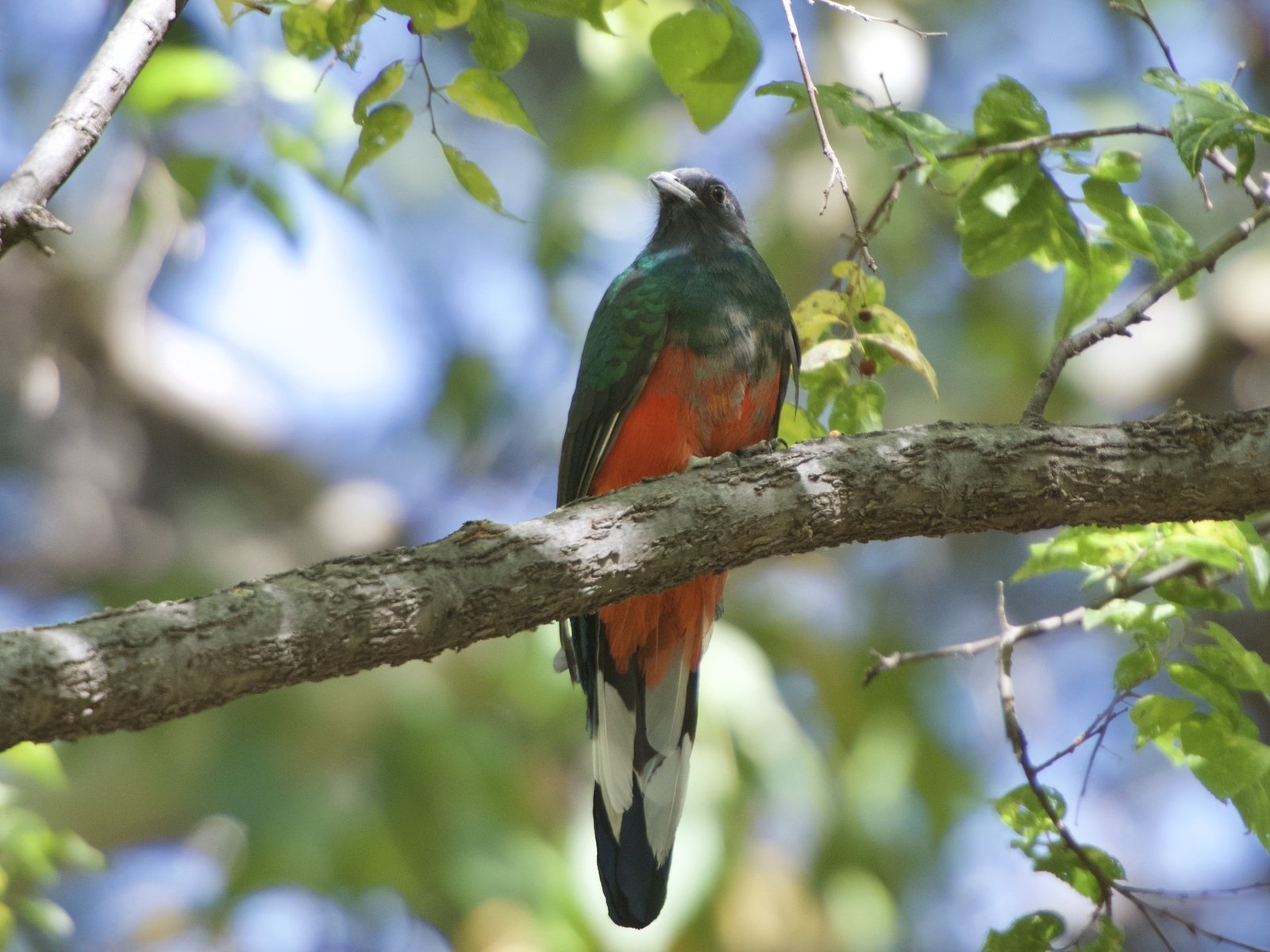
The Eared Quetzal is a large, long-tailed trogon of the pine and oak forests of the Sierra Madre Occidental in western Mexico. It is the only species in its genus and owes its name to a few narrow, elongated feathers behind the eye. Some birds in the north of the range move to lower or more southerly slopes in winter; elsewhere it is resident. Outside Mexico it appears only as a rare visitor in the mountains of Arizona and New Mexico.
Voice
The male's song is a series of high, squealing whistles that gradually rises and ends in a chattering cackle. The call is a shrill, squealing kwee-chik, often given in flight; this sound differs clearly from the clucking series of the other trogons.
Recording: Pat Goltz — CC BY-NC-SA 4.0 · converted to mono · xeno-canto
Identification
33–36 cm, with a long, broad, square-ended tail. The male has a blackish head, a metallic green back and breast, and a red belly and undertail coverts; there is no white breast band. The upper side of the tail is dark blue-green, the underside largely white with a dark centre. A few narrow, elongated feathers behind the eye are visible only at close range. The bill is dark grey. The female has a grey head and breast and less red on the belly.
Confusion species
Coppery-tailed Trogon Trogon ambiguus and Mountain Trogon Trogon mexicanus live in the same montane forest but are smaller, have a yellow bill (male) and a white band between the green breast and the red belly. Resplendent Quetzal Pharomachrus mocinno does not occur in the Sierra Madre Occidental.
Habitat
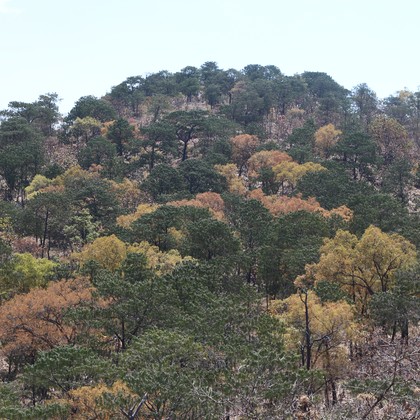
Pine-oak forest and mixed montane conifer forest, mostly between about 1800 and 3000 m, often in wooded canyons with a stream. It sits still for long periods in the middle and upper tree layers and eats mainly fruit and large insects, snatched from a branch or leaf in a short flight. It breeds late in the year, in the rainy season from July to October, in a tree cavity, often an old woodpecker hole.
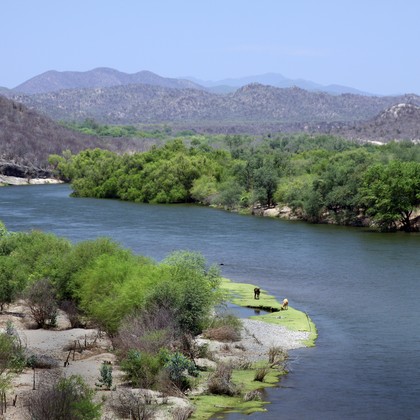
Where the bird is most at home, classified by the vegetation units of Mexico and Central America.

Range and movements
Sierra Madre Occidental from eastern Sonora and western Chihuahua south through Durango, Sinaloa, Nayarit, Zacatecas and Jalisco to Michoacán. In the north of the range it is present mainly in summer; in winter some birds move to lower or more southerly slopes. It does not occur south of Michoacán or elsewhere in the guide area. Outside the guide area only a rare visitor to south-eastern Arizona and south-western New Mexico.
- Resident
- Summer visitor (c. Apr–Sep)
- Winter visitor (c. Oct–Mar)
- Passage (Mar–Apr, Oct–Nov)
- dark = core range, pale = thinly spread
How and when to look
The chances are best from May to October, when males sing, in high pine-oak forest around Yécora in Sonora, near Basaseachi in Chihuahua and along the road from Durango to Mazatlán. The squealing call usually gives the bird away before its colours do.
Conservation status
Not threatened. The species has a limited range and depends on mature forest with old trees for nest cavities, which makes it sensitive to logging in the Sierra Madre Occidental.
Scientific name
Euptilotis neoxenus | (Gould, 1838)
Gould described the species in 1838 as Trogon neoxenus; because it was later moved to another genus, the author and year stand in brackets. The genus Euptilotis was introduced in 1858 by Gould. Euptilotis is Greek, from eu 'fine', ptilon 'feather' and -ōtis 'eared': 'with finely feathered ears', after the plumes behind the eye. neoxenus is Greek, from neos 'new' and xenos 'stranger, guest': 'new stranger'. The specimen the first description was based on came from Mexico.