All species › Cuckoos › Cuckoos › Dwarf Cuckoo
Position in the tree Birds Aves › Birds with a flexible palate Neognathae › All other modern birds Neoaves › Doves, turacos and allies Columbaves › Bustards, turacos and cuckoos Otidimorphae
Dwarf Cuckoo | Coccycua pumila
Dwergkoekoek | Cuclillo enano
The Dwarf Cuckoo is the smallest cuckoo in the guide area, a bird of open, shrubby country in northern South America. In Panama it has only been recorded since the mid-2010s, at a handful of sites in the east of the country. It is probably spreading from Colombia across deforested land.
Voice
A series of high, plaintive whistles, pree-pree-pree, rising slightly in pitch; also a dry, rattling chrr-r-r.
Recording: Cristian Rodas — CC BY-NC-SA 4.0 · converted to mono · xeno-canto
Identification
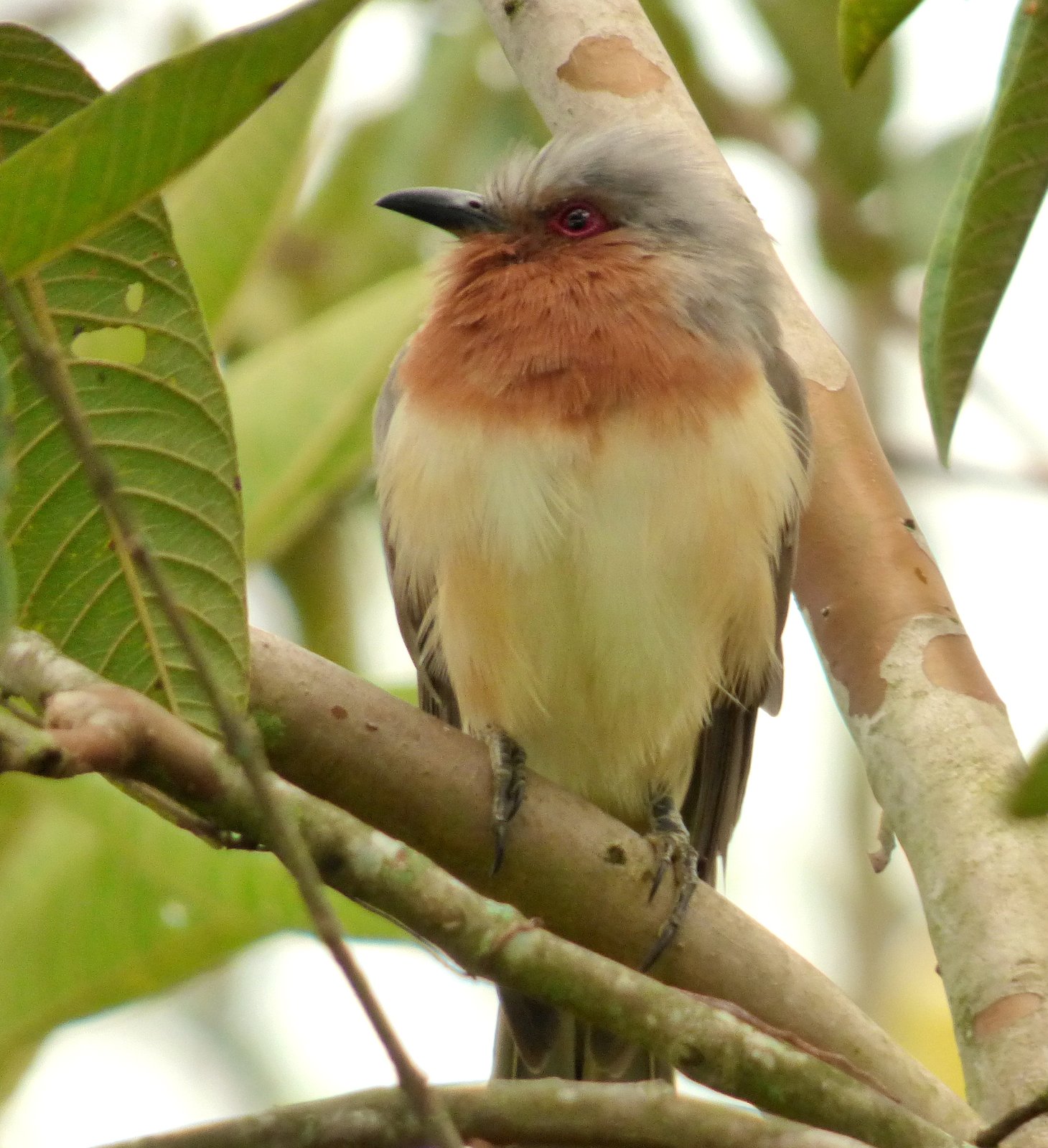
20–22 cm; a small, slender cuckoo with a fairly long tail. The crown and upperparts are plain grey-brown. The throat and upper breast are warm rufous, the rest of the underparts dirty white to pale grey. The eye is red, surrounded by a red bare eye-ring; the bill is short, curved and black. The tail is grey-brown with white tips to the feathers. The sexes are alike; young birds are duller, with less rufous on the throat.
Confusion species
Little Cuckoo Coccycua minuta is larger and entirely rufous, also on the upperparts. Black-billed Cuckoo Coccyzus erythropthalmus, a passage migrant, also has a dark bill and a red eye-ring, but is larger, with white underparts without rufous. Mangrove Cuckoo Coccyzus minor has a black eye mask, a yellow lower mandible and large white tail spots.
Habitat
Open country with scattered bushes and trees, pasture, scrub along rivers, gallery forest and gardens in the lowlands. It forages in the foliage of bushes and low trees for caterpillars and other insects. It incubates its own eggs, in a small nest of twigs.
Where the bird is most at home, classified by the vegetation units of Mexico and Central America.




Range and movements
In the guide area only a few records in eastern Panama since about 2016, including in the east of Panamá province (near Tortí) and in Darién (near Yaviza and the Lagunas de Aruza). Outside the guide area in northern and central Colombia and in Venezuela.
How and when to look
The best chance is in open, deforested pasture with bushes and trees along the Pan-American Highway in the east of Panamá province and in Darién. The species often sits still in a bush and is noticed only by its call.
Conservation status
Not threatened. Fairly common in Colombia and Venezuela and probably helped by deforestation. Rare in Panama; whether there is a settled breeding population is still unclear.
Scientific name
Coccycua pumila | (Strickland, 1852) (GBIF: Coccyzus pumilus)
Strickland described the species in 1852 as Coccyzus pumilus; because it was later moved to another genus, the author and year stand in brackets. The genus Coccycua was introduced in 1830 by Lesson. Coccycua is a blend of the genus names Coccyzus (cuckoo) and Coua (coua). pumila is from Latin pumilus 'dwarf, little', after its size: the smallest cuckoo of the region. The specimen the first description was based on came from Venezuela (originally given in error as Trinidad).