All species › Passerines › Ovenbirds and woodcreepers › Double-banded Greytail
Position in the tree Birds Aves › Birds with a flexible palate Neognathae › All other modern birds Neoaves › Landbirds Telluraves › Falcons, parrots and passerines Australaves › Falcons and passerines Eufalconimorphae › Parrots and passerines Psittacopasserae
Double-banded Greytail | Xenerpestes minlosi
Bandgrijsstaart | Colagrís norteño
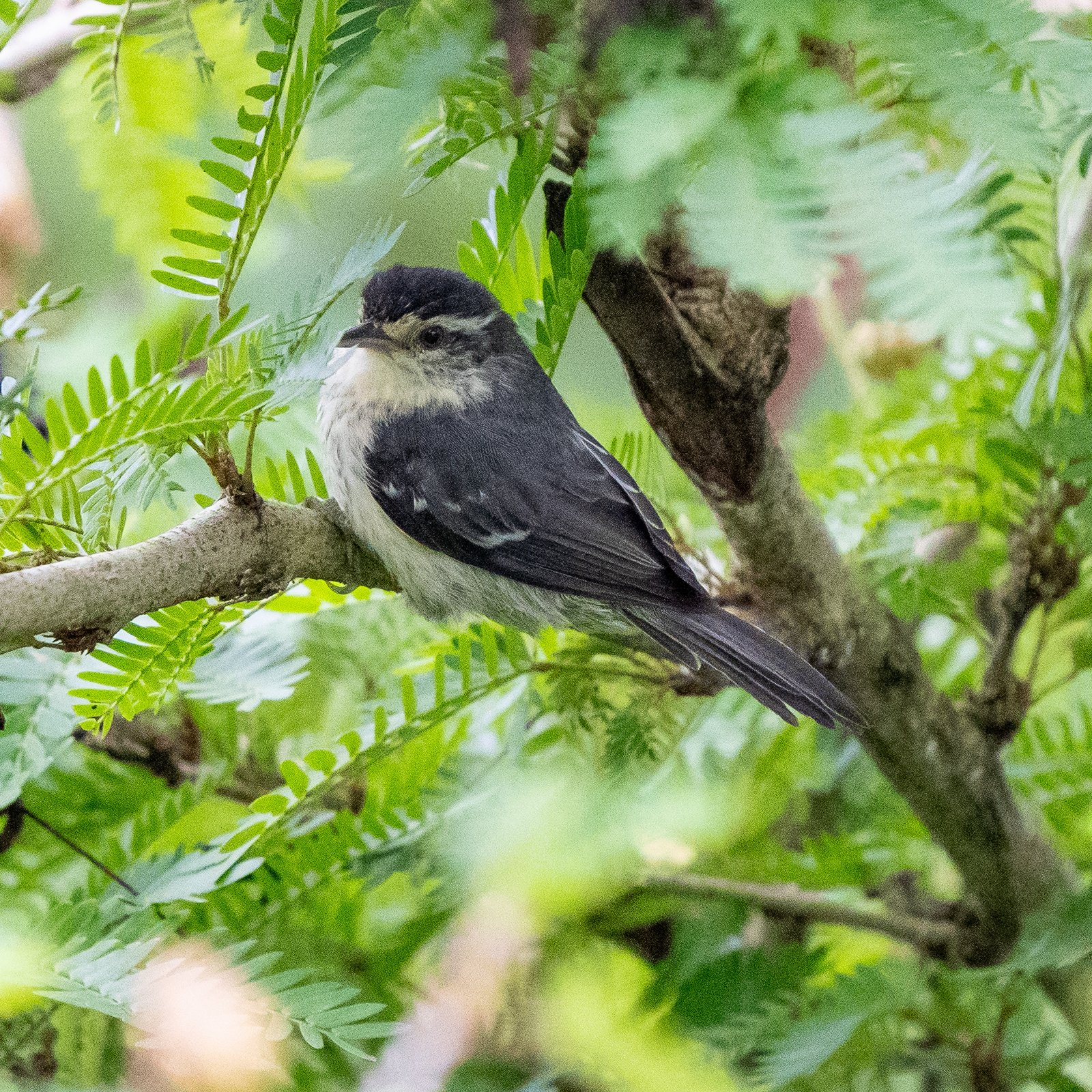
The Double-banded Greytail is a small, grey ovenbird of the canopy of humid forest that behaves more like a warbler than a typical ovenbird. Characteristic are the two white wing bars and the pale supercilium. In the guide area it lives only in eastern Panama.
Voice
A high, thin trill, often from the canopy.
Recording: Mitch Lysinger — CC BY-NC-SA 4.0 · converted to mono · xeno-canto
Identification
11 cm. Upperparts grey, crown and forehead darker. Narrow white supercilium. Wings dark with two distinct white wing bars. Underparts whitish to dull yellowish, with faint grey streaks. Bill thin and pointed. Tail grey.
Confusion species
Its wing bars and behaviour make it resemble a warbler or vireo; Lesser Greenlet Pachysylvia decurtata has a grey head and green back, without wing bars. Warblers with wing bars in this area are almost always more yellow or green.
Habitat
Canopy and middle storey of humid lowland and foothill forest, also forest edges. Searches actively among leaves and thin twigs for insects, often hanging from leaves, usually in canopy mixed flocks.
Where the bird is most at home, classified by the vegetation units of Mexico and Central America.



Range and movements
In the guide area only in eastern Panama. Outside the guide area in northern and western Colombia and north-western Ecuador.
- Resident
- dark = core range, pale = thinly spread
How and when to look
Best looked for in canopy mixed flocks in Darién; a small grey bird with white wing bars among the warblers and greenlets.
Conservation status
Not threatened. Inconspicuous and local; sensitive to deforestation.
Scientific name
Xenerpestes minlosi | Berlepsch, 1886
Berlepsch described the species in 1886 and placed it straight away in the genus where it still stands. He introduced the genus Xenerpestes in that same work. Xenerpestes is Greek, from xenos 'stranger' and herpēstēs 'creeper': a 'strange creeper'. minlosi honours Emilio José Minlos (1856–1901), a German-Venezuelan merchant and collector in Bucaramanga, Colombia. The specimen the first description was based on came from near Bucaramanga, Colombia.