All species › Passerines › Shrike-babblers, Erpornis and vireos › Chestnut-sided Shrike-Vireo
Position in the tree Birds Aves › Birds with a flexible palate Neognathae › All other modern birds Neoaves › Landbirds Telluraves › Falcons, parrots and passerines Australaves › Falcons and passerines Eufalconimorphae › Parrots and passerines Psittacopasserae
Chestnut-sided Shrike-Vireo | Vireolanius melitophrys
Bruinflankklauwiervireo | Vireón pecho castaño
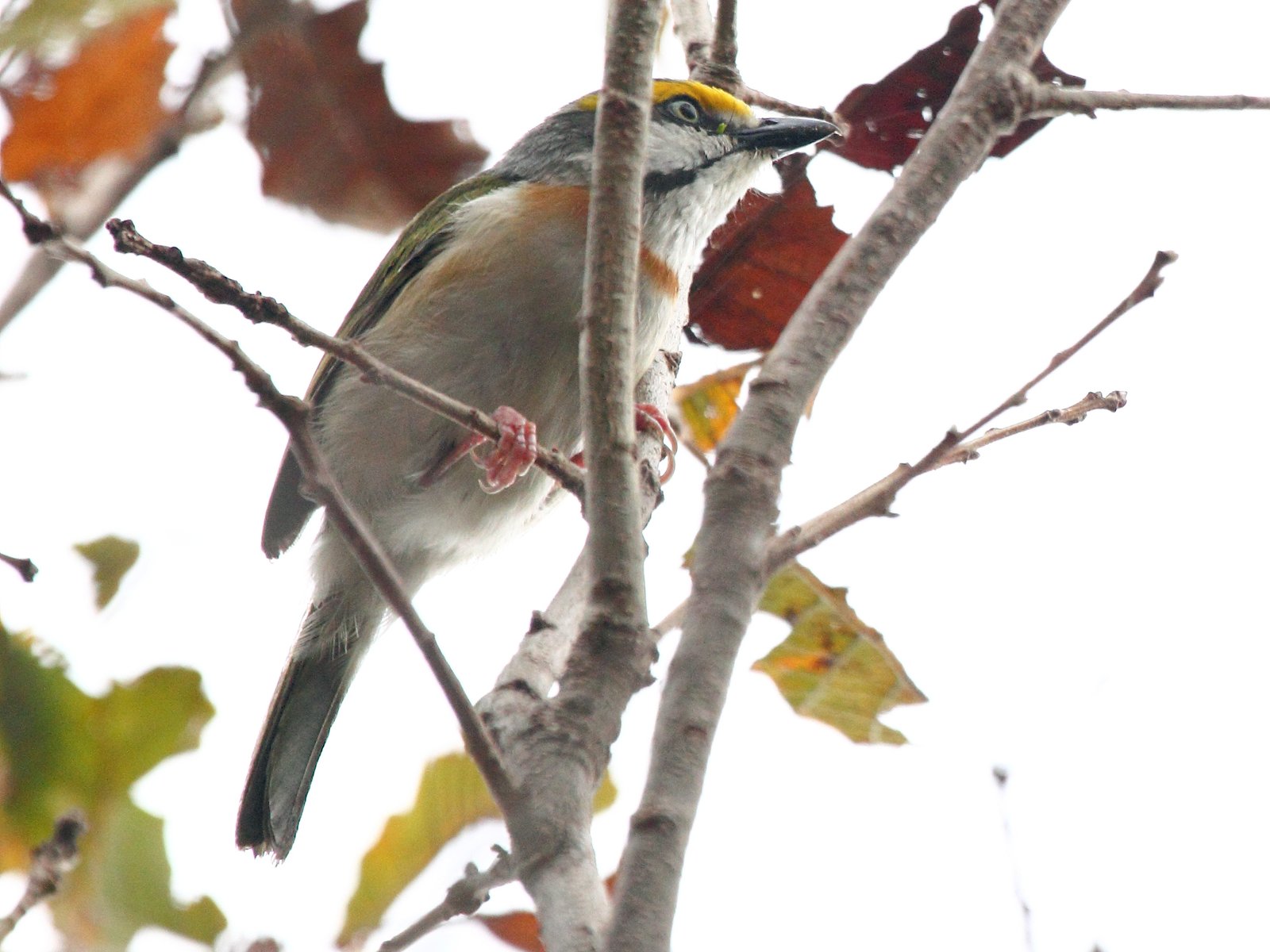
The Chestnut-sided Shrike-Vireo is the largest vireo in the guide area: a hefty, heavy-billed species of montane forest in Mexico and Guatemala. It keeps high in the canopy and often stays out of view.
Voice
The song is a loud, somewhat plaintive whistle repeated at intervals; often the first sign of its presence.
Recording: Manuel Grosselet — CC BY-NC-SA 4.0 · converted to mono · xeno-canto
Identification
16–18 cm. Crown and nape grey, long yellow supercilium and a black eye-stripe; throat white with a black malar stripe. Upperparts olive-green. Underparts white with a broad chestnut band across the breast sides and flanks. Eye pale. Bill heavy with a hooked tip.
Confusion species
Rufous-browed Peppershrike Cyclarhis gujanensis also has a heavy bill but has a rufous brow, no black eye-stripe or malar stripe, a yellow breast and no chestnut flanks. Other vireos in montane forest are much smaller and thinner-billed.
Habitat
Pine-oak forest, oak forest and cloud forest in the mountains, mostly between about 1500 and 3000 m. Forages slowly in the canopy for large insects, sometimes in mixed flocks.
Where the bird is most at home, classified by the vegetation units of Mexico and Central America.


Range and movements
Endemic to the guide area: the mountains of western, central and southern Mexico and the highlands of Guatemala.
- Resident
- dark = core range, pale = thinly spread
How and when to look
Best found by its song; the bird often sits still in the canopy for long periods.
Conservation status
Not threatened. Rather scarce and local; dependent on montane forest with tall trees.
Scientific name
Vireolanius melitophrys | Bonaparte, 1850
Bonaparte described the species in 1850 and placed it straight away in the genus where it still stands. He introduced the genus Vireolanius in that same work. Vireolanius combines Vireo with Lanius, the shrike genus, after the stout, hook-tipped, shrike-like bill. melitophrys is Greek, from meli, melitos 'honey' and ophrus 'eyebrow', after the yellow supercilium. The specimen the first description was based on came from Mexico; later restricted to Xico near Xalapa, Veracruz.