All species › Woodpeckers and allies › Woodpeckers › Chestnut-colored Woodpecker
Position in the tree Birds Aves › Birds with a flexible palate Neognathae › All other modern birds Neoaves › Landbirds Telluraves › Raptors, owls, kingfishers and woodpeckers Afroaves › Mousebirds, rollers and woodpeckers Coraciimorphae › Trogons and cavity nesters Cavitaves › Hornbills, kingfishers and woodpeckers Picocoraciae › Kingfishers, bee-eaters and woodpeckers Picodynastornithes
Chestnut-colored Woodpecker | Celeus castaneus
Kastanjespecht | Carpintero castaño
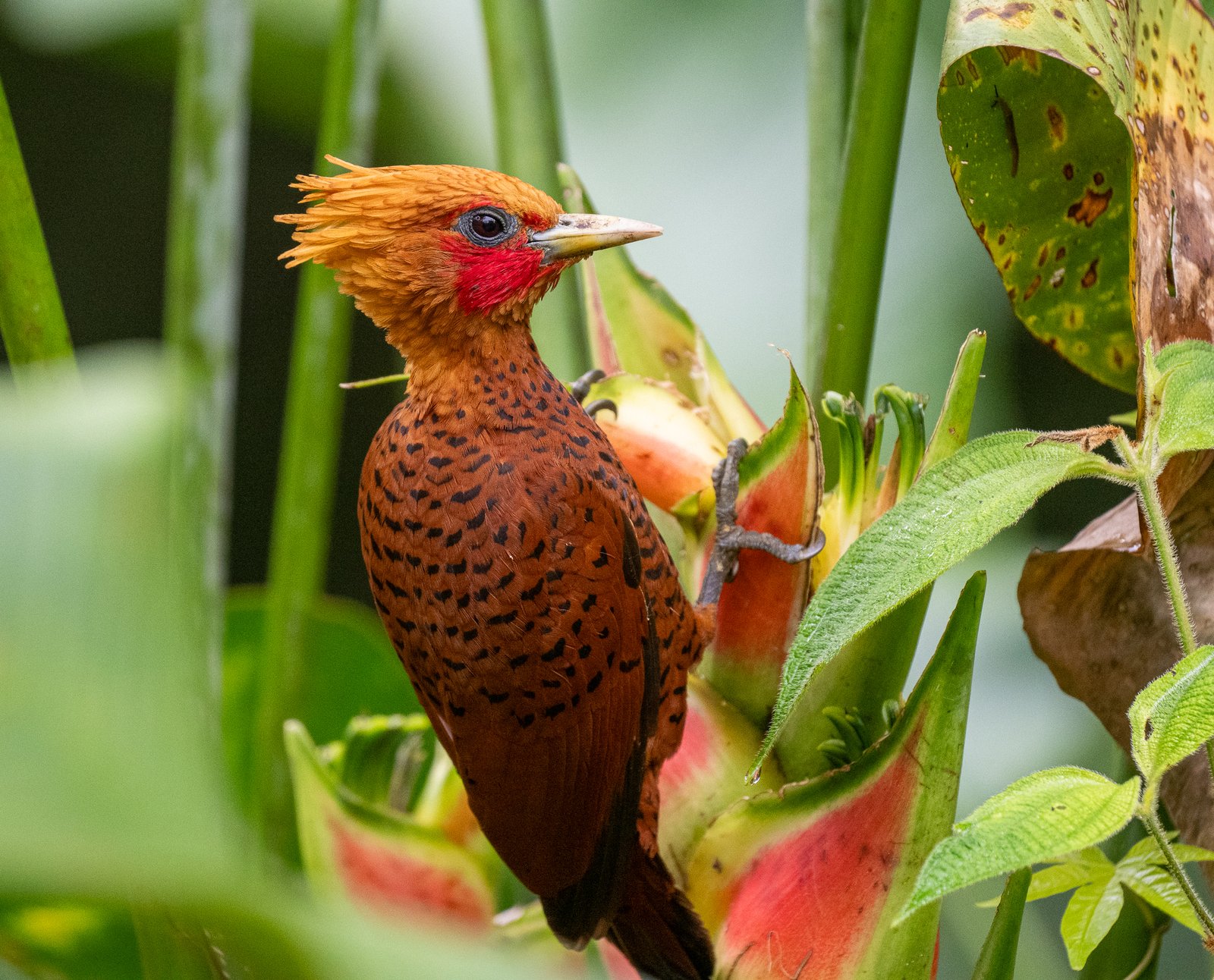
The Chestnut-colored Woodpecker is a medium-sized, dark chestnut woodpecker with a strikingly pale, yellowish to cinnamon head and a long, shaggy crest. The species occurs only in the guide area, from south-eastern Mexico to western Panama. It lives in humid lowland forest and is more often heard than seen.
Voice
A loud, hollow, slightly nasal kwah or kee-wah, often followed by a series of lower, rasping notes. Drums in short, fairly slow rolls.
Recording: Paul Driver — CC BY-NC-SA 4.0 · converted to mono · xeno-canto
Identification
23–25 cm. The body is deep chestnut with black, V-shaped marks on the back, wings and underparts. The head is clearly paler, yellowish cinnamon to light brown, with a long, shaggy crest. The rump is pale yellow to cinnamon. The male has a red patch on the cheek below and behind the eye; the female lacks it. The bill is pale yellow.
Confusion species
Cinnamon Woodpecker Celeus loricatus (from Nicaragua southwards) is smaller and paler cinnamon-brown, without a contrastingly pale head, with a short crest and black scaling mainly on the underparts; the male has red on the throat. Lineated Woodpecker Dryocopus lineatus is black with white stripes and a red crest.
Habitat
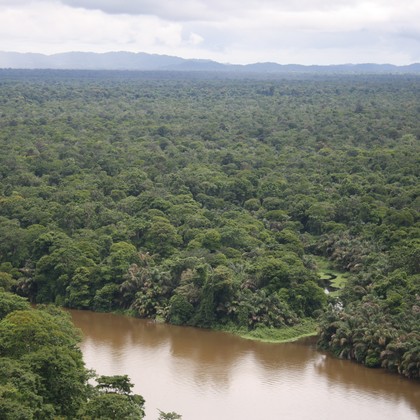
Middle layer and canopy of humid lowland and foothill forest up to about 750 m, also tall secondary forest, swamp forest, forest edges and, in Yucatán, semi-evergreen seasonal forest. It feeds mainly on ants and termites, which it digs from trunks, branches and nests, and also eats fruit. It excavates a nest hole in a dead tree.
Where the bird is most at home, classified by the vegetation units of Mexico and Central America.




Range and movements
From south-eastern Mexico (southern Veracruz and Oaxaca, Tabasco, Chiapas and the south of the Yucatán Peninsula) through Belize, Guatemala, Honduras and Nicaragua to Costa Rica and western Panama (Bocas del Toro), almost exclusively on the Caribbean slope. It does not occur outside the guide area.
- Resident
- dark = core range, pale = thinly spread
How and when to look
Regularly seen at Tikal in Guatemala, at Cockscomb in Belize, near Palenque in Mexico and at La Selva in Costa Rica. The hollow kwah gives the bird away; the pale head stands out well in the dim forest interior.
Conservation status
Not threatened. Fairly common in continuous humid forest, but disappears where forest is fragmented or cleared.
Scientific name
Celeus castaneus | (Wagler, 1829)
Wagler described the species in 1829 as Picus castaneus; because it was later moved to another genus, the author and year stand in brackets. The genus Celeus was introduced in 1831 by Boie. Celeus comes from Greek keleos, a name for a green woodpecker. castaneus is Latin for 'chestnut', after the warm brown plumage. The specimen the first description was based on came from Veracruz, Mexico.