All species › Passerines › Wrens › Canebrake Wren
Position in the tree Birds Aves › Birds with a flexible palate Neognathae › All other modern birds Neoaves › Landbirds Telluraves › Falcons, parrots and passerines Australaves › Falcons and passerines Eufalconimorphae › Parrots and passerines Psittacopasserae
Canebrake Wren | Cantorchilus zeledoni
Zeledons winterkoning | Soterrey de Zeledón
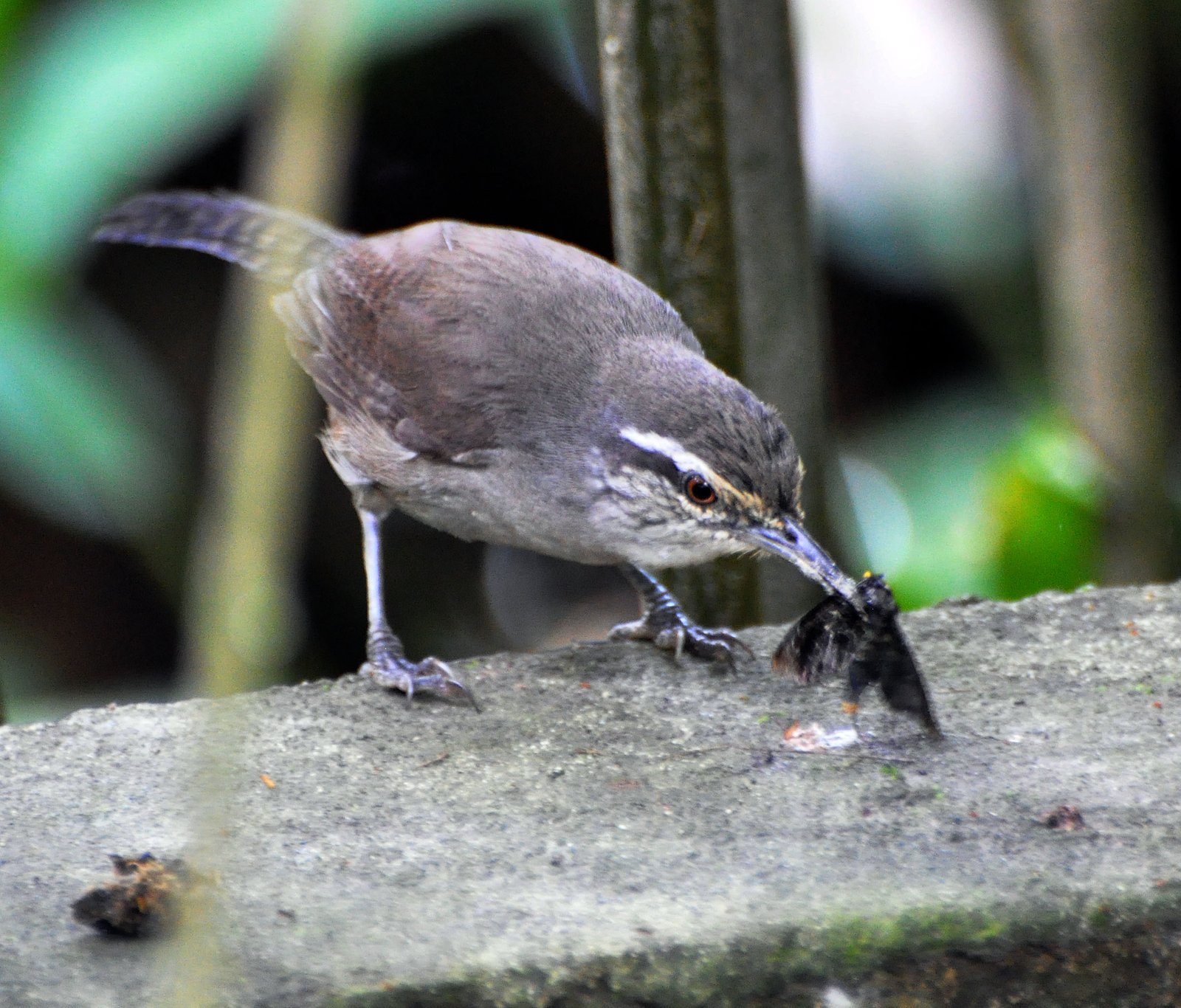
The Canebrake Wren is a fairly large, greyish-brown Cantorchilus wren of dense thickets in the Caribbean lowlands of southern Central America. It was long included in Cabanis's Wren (formerly Plain Wren), but is larger and greyer and has its own song. It usually lives in pairs that stay hidden in dense vegetation.
Voice
Pairs sing loud, rhythmic duets of clear whistled phrases, each repeated many times. Fuller and lower than Cabanis's Wren. Also dry, rattling calls.
Recording: Guy Kirwan — CC BY-NC-SA 4.0 · shortened to the first 60 s, mono · xeno-canto
Identification
14–15 cm. Upperparts greyish olive-brown with little rufous, rump and tail slightly warmer brown, tail with narrow black bars. White supercilium, cheeks grey with fine dark streaks. Throat and breast white to greyish white, flanks and lower belly greyish brown. Bill fairly long and strong. Sexes alike.
Confusion species
Cabanis's Wren Cantorchilus modestus is smaller, warmer brown above and has rusty flanks; it lives mainly on the Pacific slope and in the central highlands of Costa Rica and Nicaragua. Isthmian Wren Cantorchilus elutus is also similar but occurs further south and on the Pacific slope. Buff-breasted Wren Cantorchilus leucotis is buff throughout below.
Habitat
Dense tall thickets, cane-like grassland, overgrown fields, riverside scrub and the edges of humid lowland forest. It forages low in the vegetation for insects and spiders. The nest is a domed structure with a side entrance placed in shrubbery.
Where the bird is most at home, classified by the vegetation units of Mexico and Central America.





Range and movements
Caribbean slope of southern Central America, from south-eastern Nicaragua through Costa Rica to north-western Panama (Bocas del Toro). Does not occur outside the guide area.
- Resident
- dark = core range, pale = thinly spread
How and when to look
Found by listening for the loud duets in thickets along roads and rivers in the Caribbean lowlands of Costa Rica. It often stays hidden; waiting patiently near a singing pair usually gives a view.
Conservation status
Not threatened. It benefits from the thickets and scrub that develop after forest clearance and is fairly common in suitable habitat.
Scientific name
Cantorchilus zeledoni | (Ridgway, 1878) (GBIF: Cantorchilus modestus)
Ridgway described the species in 1878 as Thryophilus zeledoni; because it was later moved to another genus, the author and year stand in brackets. The genus Cantorchilus was introduced in 2006 by Mann, Barker, Graves, Dingess-Mann & Slater. Cantorchilus combines Latin cantus 'song' with Greek orkhilos 'wren': 'song wren'. zeledoni honours the Costa Rican ornithologist José Castulo Zeledón (1846–1923). The specimen the first description was based on came from Talamanca, Caribbean lowlands of Costa Rica.