All species › Passerines › Ovenbirds and woodcreepers › Buffy Tuftedcheek
Position in the tree Birds Aves › Birds with a flexible palate Neognathae › All other modern birds Neoaves › Landbirds Telluraves › Falcons, parrots and passerines Australaves › Falcons and passerines Eufalconimorphae › Parrots and passerines Psittacopasserae
Buffy Tuftedcheek | Pseudocolaptes lawrencii
Panamese pluimoor | Trepamusgo cachetón
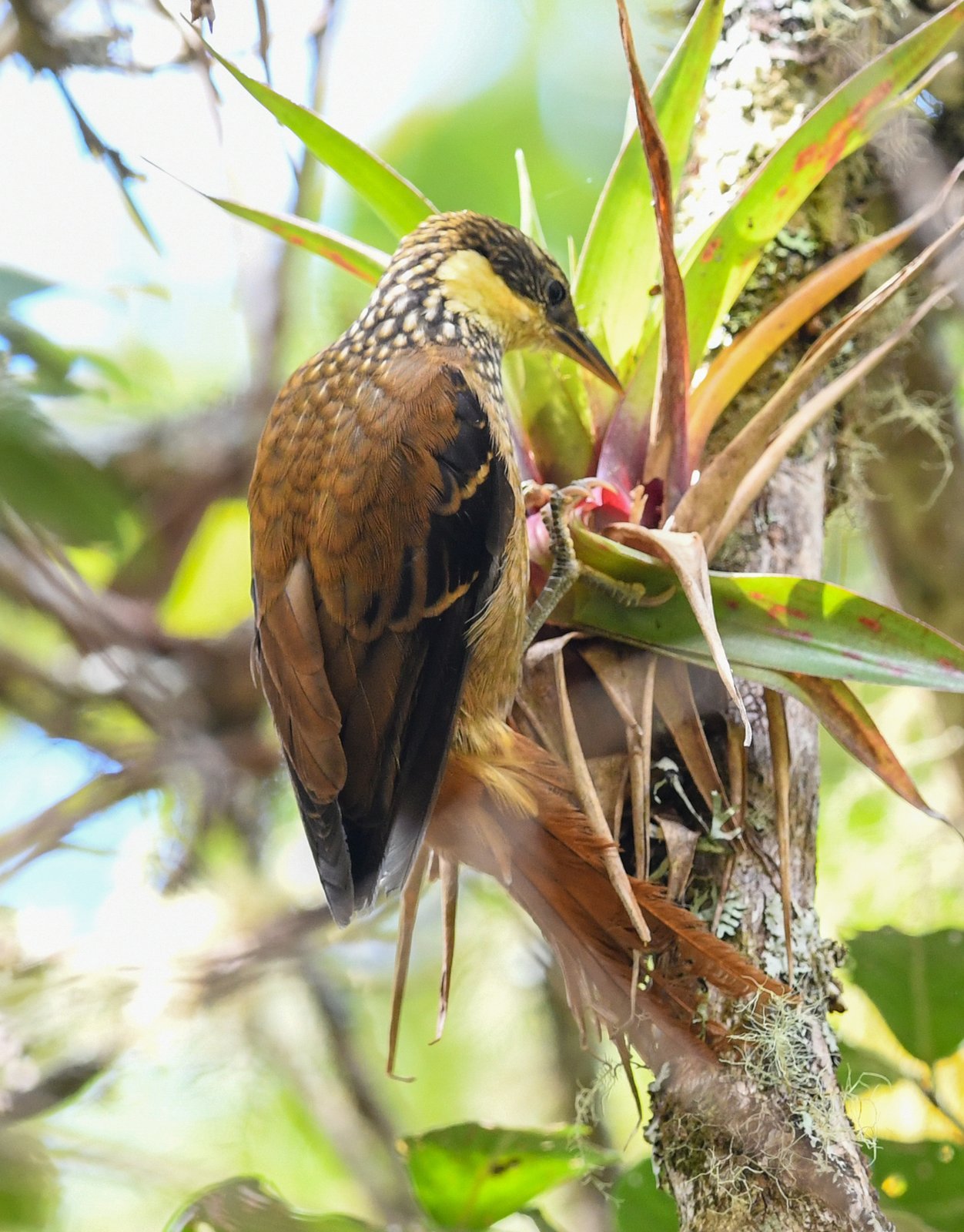
The Buffy Tuftedcheek is a large ovenbird of the montane forest of Costa Rica and western Panama, with conspicuous, flared buffy tufts on the sides of the neck. It searches bromeliads and other epiphytes high in the trees for insects. Its range lies almost entirely within the guide area.
Voice
Mainly loud, sharp calls; also a short series of rattling notes.
Recording: Francisco Sornoza — CC BY-NC-SA 4.0 · converted to mono · xeno-canto
Identification
20–21 cm. Crown dark with fine pale streaks, back warm brown, rump and tail rufous. Throat whitish, with large, fluffy buffy tufts on either side of the neck. Breast buffy with dark scaling, belly warm ochre. Bill fairly long and straight.
Confusion species
Lineated Foliage-gleaner Syndactyla subalaris and Streak-breasted Treehunter Thripadectes rufobrunneus lack the neck tufts. Ruddy Treerunner Margarornis rubiginosus and Spotted Barbtail Premnoplex brunnescens are much smaller and climb along trunks and branches.
Habitat
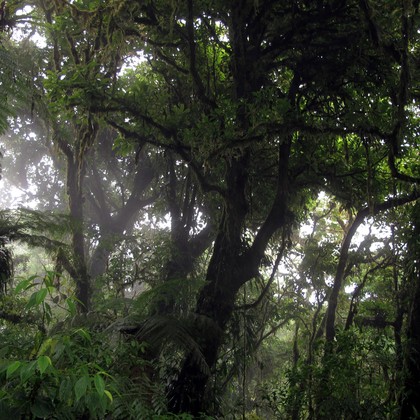
Montane and cloud forest rich in epiphytes, mainly above about 1500 m, also at forest edges and in tall trees in open country next to forest. Probes forcefully into bromeliads, moss and loose bark for insects and other invertebrates, often in mixed flocks. Nests in a tree cavity.
Where the bird is most at home, classified by the vegetation units of Mexico and Central America.
Range and movements
Highlands of Costa Rica (Cordillera Central and Cordillera de Talamanca) and western Panama. Not known outside the guide area.
- Resident
- dark = core range, pale = thinly spread
How and when to look
In the Costa Rican highlands regularly seen around Cerro de la Muerte and in the San Gerardo de Dota valley, and in Panama on the slopes of Volcán Barú. The sound of bromeliads being torn apart often gives the bird away.
Conservation status
Not threatened. Fairly common in continuous montane forest; much of its habitat lies in protected areas.
Scientific name
Pseudocolaptes lawrencii | Ridgway, 1878
Ridgway described the species in 1878 and placed it straight away in the genus where it still stands. The genus Pseudocolaptes was introduced in 1853 by Reichenbach. Pseudocolaptes is Greek, from pseudos 'false' and the woodpecker genus Colaptes: a 'false woodpecker', after its woodpecker-like foraging. lawrencii honours George Newbold Lawrence (1806–1895), an American businessman and ornithologist who described many birds from Central America. The specimen the first description was based on came from La Palma and Navarro, Costa Rica (1050–1500 m).