All species › Passerines › Tyrant flycatchers and allies › Bronze-olive Pygmy Tyrant
Position in the tree Birds Aves › Birds with a flexible palate Neognathae › All other modern birds Neoaves › Landbirds Telluraves › Falcons, parrots and passerines Australaves › Falcons and passerines Eufalconimorphae › Parrots and passerines Psittacopasserae
Bronze-olive Pygmy Tyrant | Pseudotriccus pelzelni
Bronzen dwergtiran | Tiranuelo bronceado
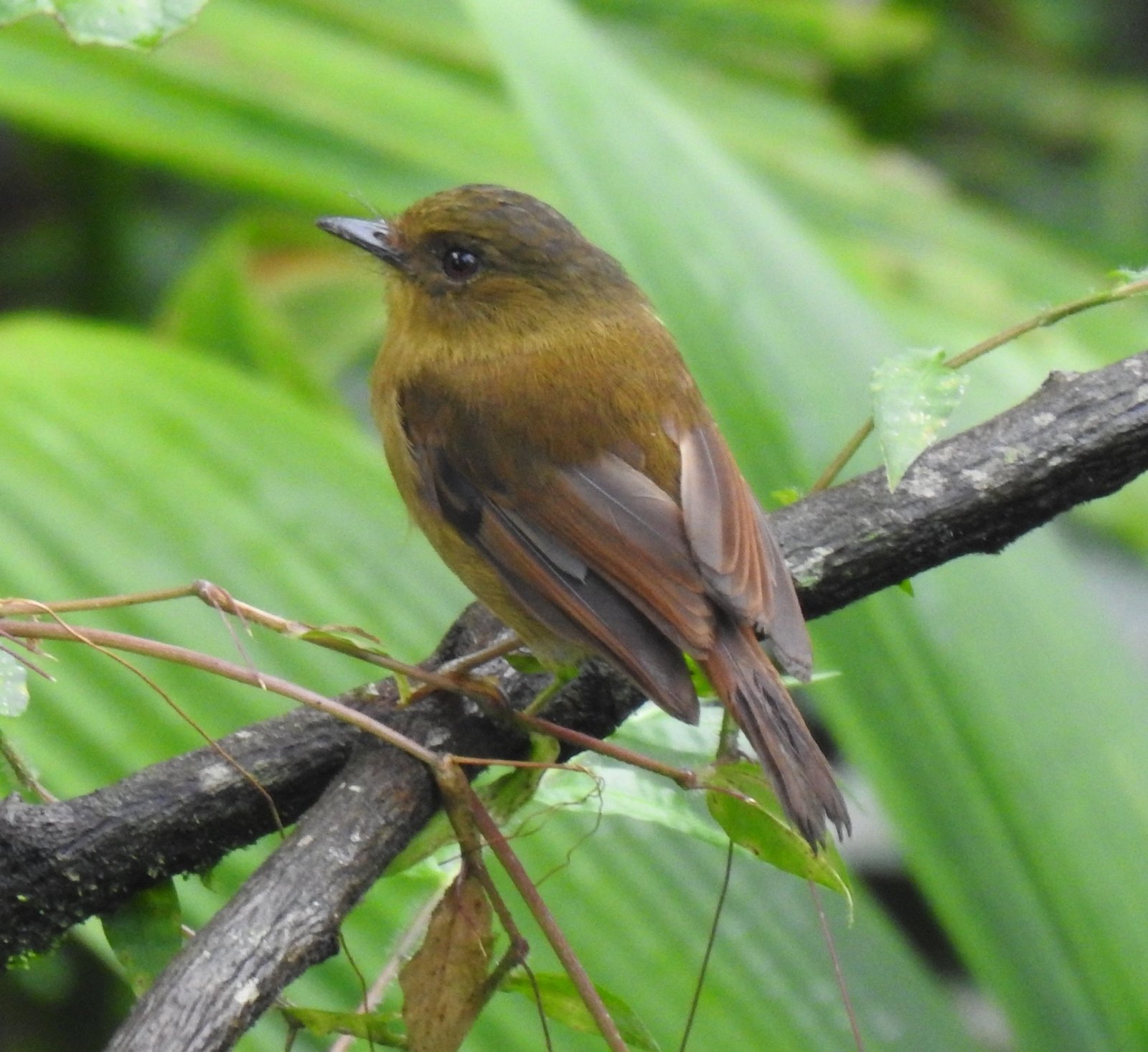
The Bronze-olive Pygmy Tyrant is a small, dark olive-brown Pseudotriccus flycatcher of the understorey of montane forest. In the guide area it occurs only in the mountains of eastern Darién, the northernmost outlier of the Andean region. It is inconspicuous and seldom seen.
Voice
Mainly high, thin calls and a short, high trill; the species is more often detected by sound than by sight.
Recording: Juan Freile — CC BY-NC-SA 4.0 · converted to mono · xeno-canto
Identification
11 cm. Small and fairly compact, with a thin bill and a medium-length tail. Upperparts dark olive-brown with a bronzy sheen, flight feathers and tail edged rufous-brown. Throat and breast olive, belly dingy yellowish. No wing bars and no striking face pattern. Sexes alike.
Confusion species
Ochre-bellied Flycatcher Mionectes oleagineus is larger, with a greyish head and an ochre belly. Olive-striped Flycatcher Mionectes olivaceus has a streaked breast and a white spot behind the eye. Female manakins are greener and rounder and have a shorter, broader bill.
Habitat
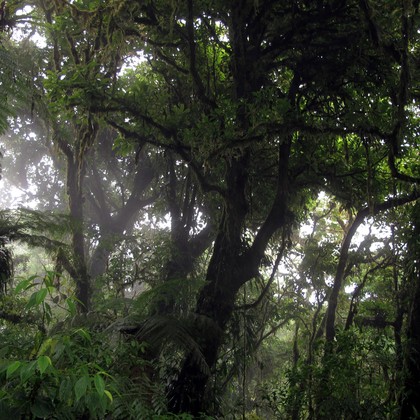
Understorey of humid montane and cloud forest, in Panama mainly above about 600 m. It keeps low in dense undergrowth and makes short sallies to leaves and twigs to take insects; usually alone.
Where the bird is most at home, classified by the vegetation units of Mexico and Central America.

Range and movements
In the guide area only in the mountains of eastern Darién in Panama, including Cerro Pirre and Cerro Tacarcuna. Outside the guide area in the Andes of Colombia, Ecuador and Peru.
- Resident
- dark = core range, pale = thinly spread
How and when to look
The Darién mountains can only be reached on an organised trip; on Cerro Pirre the species can be looked for in the understorey of the montane forest.
Conservation status
Not threatened. In the guide area restricted to a small, remote mountain region where the forest is largely intact.
Scientific name
Pseudotriccus pelzelni | Taczanowski & Berlepsch, 1885
Taczanowski & Berlepsch described the species in 1885 and placed it straight away in the genus where it still stands. He introduced the genus Pseudotriccus in that same work. Pseudotriccus is Greek, from pseudos 'false' and trikkos, an unidentified small bird used in ornithology for tyrant flycatchers: 'false tyrant'. pelzelni honours the Austrian ornithologist August von Pelzeln (1825–1891) of Vienna. The specimen the first description was based on came from Machay and Mapoto, Tungurahua, Ecuador.