All species › Passerines › Tits, chickadees and titmice › Bridled Titmouse
Position in the tree Birds Aves › Birds with a flexible palate Neognathae › All other modern birds Neoaves › Landbirds Telluraves › Falcons, parrots and passerines Australaves › Falcons and passerines Eufalconimorphae › Parrots and passerines Psittacopasserae
Bridled Titmouse | Baeolophus wollweberi
Harlekijnmees | Carbonero embridado
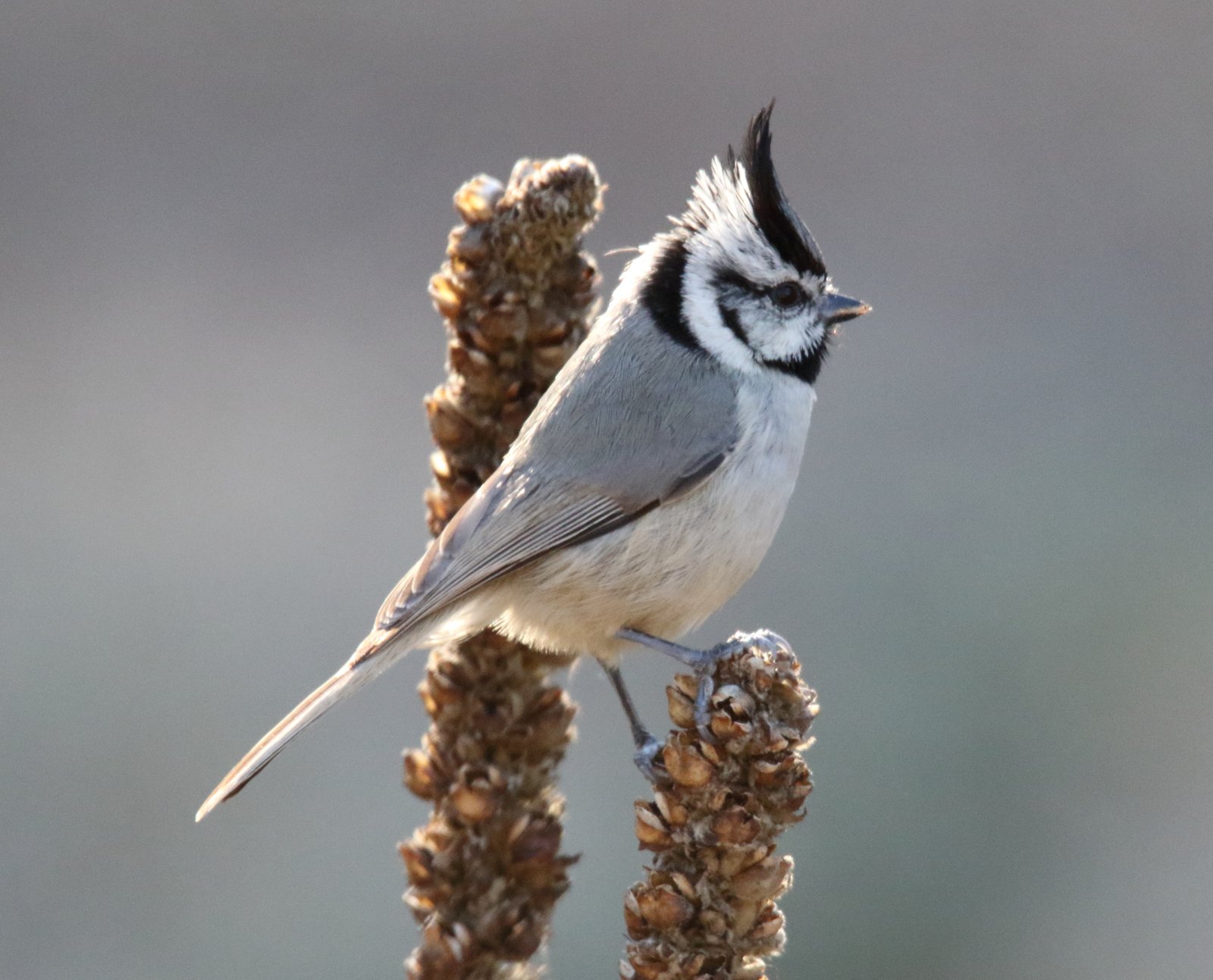
The Bridled Titmouse is a small grey titmouse with a striking black-and-white face pattern. It lives in oak and pine-oak woodland in the mountains, from the south-western United States to southern Mexico, and outside the breeding season often moves around in mixed flocks with other small songbirds.
Voice
A rapid series of short, clear whistles, faster and higher than in other titmice. The call is a hoarse, hurried tsi-ka-dee-dee, somewhat like a chickadee.
Recording: Barry Edmonston — CC BY-NC-SA 4.0 · converted to mono · xeno-canto
Identification
12–13 cm. Upperparts grey with an olive tinge, underparts pale grey. Pointed grey crest edged with black. Face white with a black line through the eye that curves down behind the cheek, and a black throat patch. Sexes alike.
Confusion species
Black-crested Titmouse Baeolophus atricristatus has a black crest, a plain face without black lines and rusty flanks. Mexican Chickadee Poecile sclateri also has a black throat but lacks a crest and has a black cap.
Habitat
Oak and pine-oak woodland at middle elevations in the mountains, also riparian woodland with sycamores and oaks in canyons. It searches for insects and spiders among leaves and twigs and also eats seeds and acorns. It nests in a tree cavity or an old woodpecker hole.
Where the bird is most at home, classified by the vegetation units of Mexico and Central America.



Range and movements
In the guide area in the mountains of north-western Mexico along the Sierra Madre Occidental and further south through the mountains of central Mexico to Oaxaca. Outside the guide area in south-eastern Arizona and south-western New Mexico.
- Resident
- dark = core range, pale = thinly spread
How and when to look
Outside the breeding season it joins flocks of other chickadees, nuthatches and warblers moving through the oaks; its hoarse calls often reveal such a flock first.
Conservation status
Not threatened. Locally common in oak and pine-oak woodland in the mountains.
Scientific name
Baeolophus wollweberi | (Bonaparte, 1850)
Bonaparte described the species in 1850 as Lophophanes wollweberi; because it was later moved to another genus, the author and year stand in brackets. The genus Baeolophus was introduced in 1851 by Cabanis. Baeolophus is Greek, from baios 'small' and lophos 'crest': 'small crest', after the crest of these tits. wollweberi honours Wollweber (active around 1850), a German traveller who collected in Mexico for the Darmstadt museum. The specimen the first description was based on came from State of Zacatecas, Mexico.