All species › Passerines › New World sparrows › Bridled Sparrow
Position in the tree Birds Aves › Birds with a flexible palate Neognathae › All other modern birds Neoaves › Landbirds Telluraves › Falcons, parrots and passerines Australaves › Falcons and passerines Eufalconimorphae › Parrots and passerines Psittacopasserae
Bridled Sparrow | Peucaea mystacalis
Baardgors | Zacatonero embridado
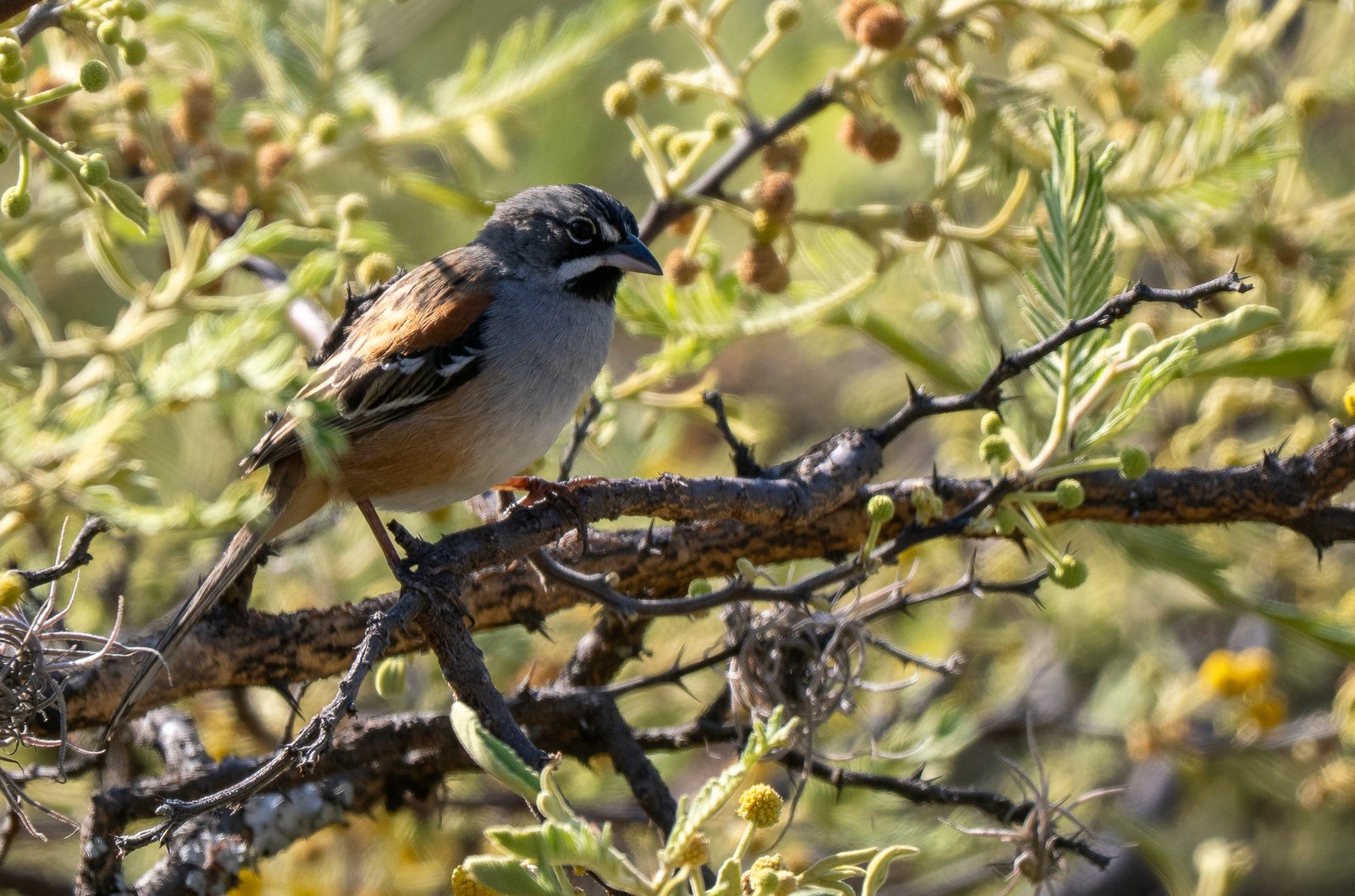
The Bridled Sparrow is a Peucaea sparrow of dry scrub in south-central Mexico, recognised by the black throat bordered by a white moustachial stripe and the grey head. It occurs only in the guide area and lives in thorn scrub and cactus growth in the dry interior valleys.
Voice
The song begins with a few high, dry ticks that accelerate into a bouncing trill. The call is a high, thin tsip.
Recording: Manuel Grosselet — CC BY-NC-SA 4.0 · converted to mono · xeno-canto
Identification
15–16 cm. Head grey with a white spot in front of the eye. Throat black, bordered on each side by a conspicuous white moustachial stripe. Back cinnamon-brown with black streaks, rump rufous. Wings dark with pale edges and narrow white wingbars. Breast grey, belly white, flanks and undertail coverts warm cinnamon. Tail fairly long and dark. Bill conical, upper mandible dark and lower mandible paler. The sexes are alike.
Confusion species
Black-chested Sparrow Peucaea humeralis lives further west in the Pacific lowlands and has a white throat with a black breast band. Stripe-headed Sparrow Peucaea ruficauda has a black-and-white striped head and a white throat. Oaxaca Sparrow Aimophila notosticta has a rufous crown and a white throat with a narrow black malar stripe.
Habitat
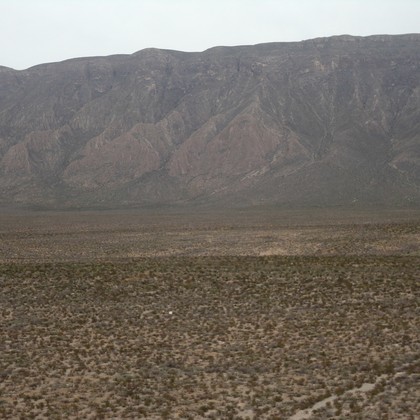
Dry thorn scrub, cactus growth, scrub with agaves and open dry woodland in the interior valleys, roughly from 600 to 2000 m. It takes seeds and insects on the ground and low in bushes, often in pairs or small groups.
Where the bird is most at home, classified by the vegetation units of Mexico and Central America.


Range and movements
Endemic to south-central Mexico: Morelos, Puebla, western Veracruz, Oaxaca and adjacent parts of Guerrero.
- Resident
- dark = core range, pale = thinly spread
How and when to look
Regularly seen in the Tehuacán-Cuicatlán valley and in the dry hills around the city of Oaxaca. It sings mainly in the rainy season from the top of a bush or a columnar cactus.
Conservation status
Not threatened (LC). Locally fairly common within a small range. Vulnerable to the conversion of scrub into farmland and to overgrazing.
Scientific name
Peucaea mystacalis | (Hartlaub, 1852)
Hartlaub described the species in 1852 as Zonotrichia mystacalis; because it was later moved to another genus, the author and year stand in brackets. The genus Peucaea was introduced in 1839 by Audubon. Peucaea is Greek, from peukē 'pine tree'; Audubon called the type species the 'Pinewood-Finch', after the pine woods it inhabits. mystacalis is Modern Latin for 'moustached', from Greek mustax 'upper lip, moustache', after the conspicuous white moustachial stripe. The specimen the first description was based on came from Río Frío, between Puebla and Mexico City, Mexico.