All species › Waders, gulls and terns › Skimmers, noddies, terns and gulls › Bonaparte's Gull
Position in the tree Birds Aves › Birds with a flexible palate Neognathae › All other modern birds Neoaves › Birds of the elements Elementaves › Cranes and waders Gruimorphae
Bonaparte's Gull | Chroicocephalus philadelphia
Kleine kokmeeuw | Gaviota de Bonaparte
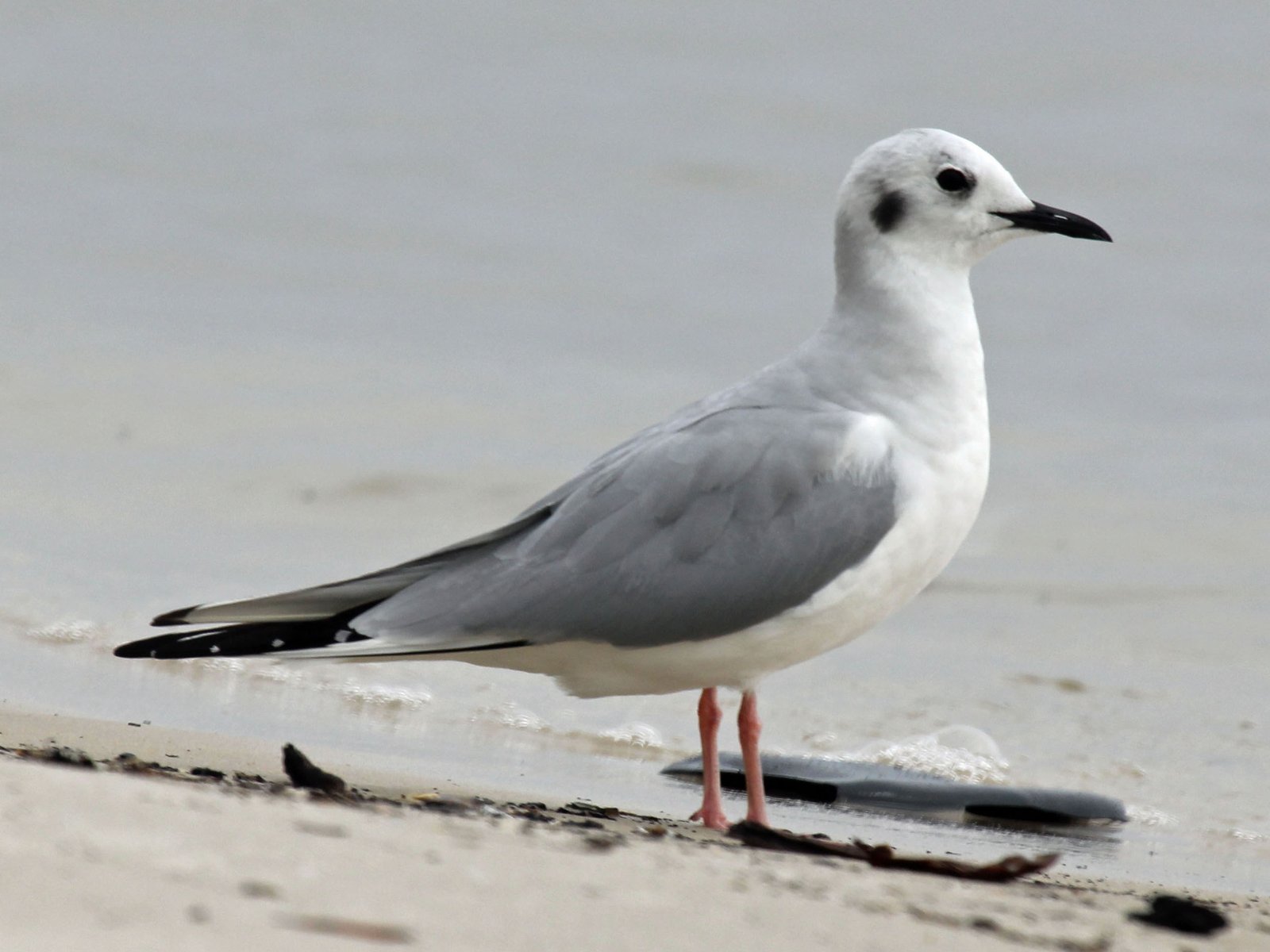
Bonaparte's Gull is a small, buoyant gull of North America that nests in trees in the boreal forest, which is exceptional among gulls. In the guide area it is a winter visitor, common in north-western Mexico and increasingly scarce towards the south. Birds often feed in flocks, together with terns.
Voice
A nasal, grating cherr or cheeer, also in flocks; calls little outside the breeding season.
Recording: Stanislas Wroza — CC BY-NC-SA 4.0 · converted to mono · xeno-canto
Identification
28–34 cm, one of the smallest gulls in the guide area, with a fine black bill and pink to orange-red legs. Adults have a pale grey mantle and a white wedge on the leading edge of the outer primaries, with a narrow black trailing edge; from below the primaries are pale and translucent. In breeding plumage the head is black with a broken white eye-ring; in non-breeding plumage, the one most seen here, white with a dark ear spot. First-year birds have a dark bar across the wing coverts, a black trailing edge to the wing and a narrow black terminal tail band.
Confusion species
Laughing Gull Leucophaeus atricilla and Franklin's Gull Leucophaeus pipixcan are larger and darker grey, with a heavier bill and without a white leading edge to the primaries. Sabine's Gull Xema sabini has a white triangle on the rear of the wing and a forked tail. Juvenile Black-legged Kittiwakes Rissa tridactyla have a black collar and a crisp black M across the upperwing.
Habitat
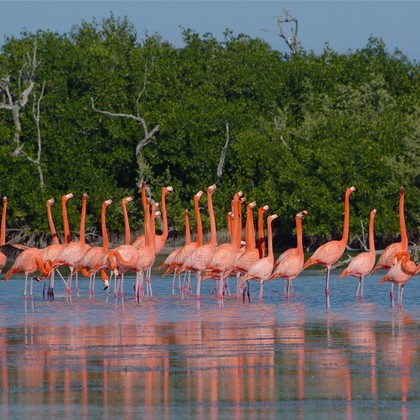
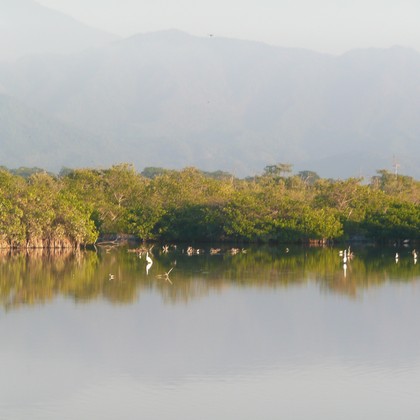
Sheltered bays, harbours, lagoons, salt pans, estuaries and mudflats, and in northern Mexico also inland lakes and reservoirs. It feeds in flight by picking from the surface or making shallow dives, often with terns, and sometimes follows fishing boats.
Where the bird is most at home, classified by the vegetation units of Mexico and Central America.




Range and movements
In winter common along the coasts of Baja California, Sonora, Sinaloa and Nayarit, and less common south to Jalisco and along the Gulf coast from Tamaulipas to the Yucatán Peninsula; also on lakes in northern Mexico. Further south, from Belize and Honduras to Costa Rica and Panama, scarce to rare. Outside the guide area the species breeds from Alaska to eastern Canada and winters along the coasts of the United States and on the Great Lakes.
- Winter visitor (c. Oct–Mar)
- dark = core range, pale = thinly spread
How and when to look
Flocks of gulls and terns in lagoons, harbours and estuaries of Baja California and Sonora in winter offer the best chance. In flight the white leading edge of the wing stands out, and the small, slender bird flies lightly, like a tern.
Conservation status
Not threatened globally. The population is large and probably stable. In the guide area a winter visitor with no breeding population.
Scientific name
Chroicocephalus philadelphia | (Ord, 1815)
Ord described the species in 1815 as Sterna Philadelphia; because it was later moved to another genus, the author and year stand in brackets. The genus Chroicocephalus was introduced in 1836 by Eyton. Chroicocephalus combines the Ancient Greek khrōikos 'coloured' with -kephalos '-headed'. philadelphia is a Latinised adjective meaning 'from Philadelphia', after the place where the type specimen was collected. The specimen the first description was based on came from near Philadelphia, Pennsylvania.