All species › Waterfowl › Ducks, swans and geese › Blue-winged Teal
Position in the tree Birds Aves › Birds with a flexible palate Neognathae › Fowl Galloanserae
Blue-winged Teal | Spatula discors
Blauwvleugeltaling | Cerceta aliazul
The Blue-winged Teal is a small dabbling duck and in most of the guide area the most numerous wintering duck, from the marshes of Tamaulipas to the rice fields of Panama. It arrives early in autumn and leaves late in spring, and part of the population continues to South America.
Voice
The male has a thin, high, whistled tsee-ee or peep, the female a soft, high quack. Flocks in flight often give these whistles.
Recording: Stanislas Wroza — CC BY-NC-SA 4.0 · converted to mono · xeno-canto
Identification
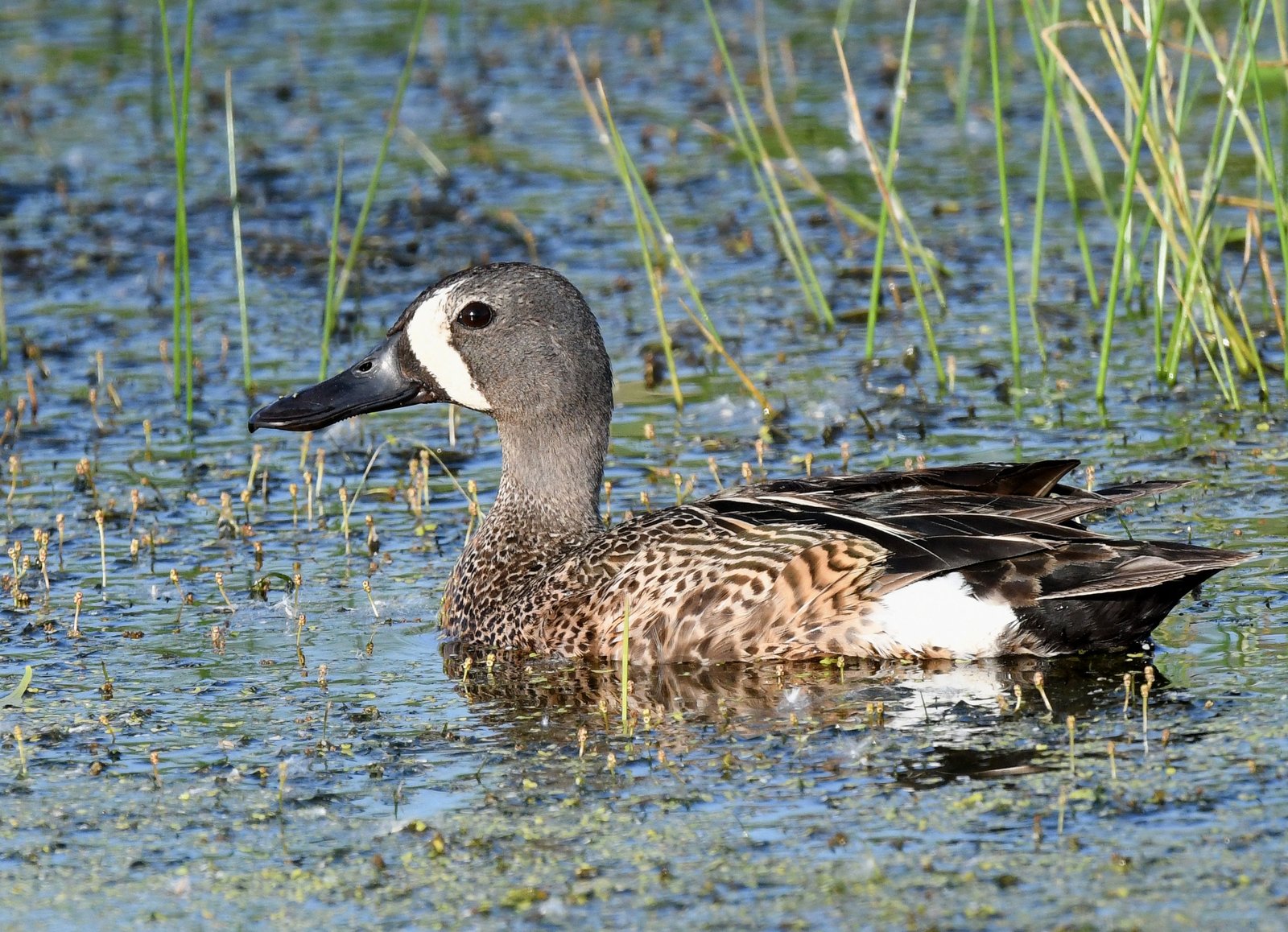
38–41 cm, a small dabbling duck with a fairly long, dark bill. The male has a slate-grey to blue-grey head with a white crescent in front of the eye, a brown body with black spots, a white patch in front of the black stern and yellowish legs. In autumn the male still resembles the female and acquires breeding plumage during the winter. The female is mottled brown, with a greyish-brown head, a dark eyestripe, a broken pale eye-ring and a pale spot at the base of the bill. In flight a pale blue forewing, bordered in the male by a white band, and a green speculum.
Confusion species
The female Cinnamon Teal Spatula cyanoptera is warmer and more uniform brown, with a plainer face and a longer bill slightly broader at the tip; often it cannot be told apart with certainty. Eurasian Teal Anas crecca is smaller, with a shorter bill and no pale blue forewing. Northern Shoveler Spatula clypeata has the same blue forewing, but is larger and has a much bigger, spoon-shaped bill.
Habitat
Freshwater marshes, shallow lakes and ponds with vegetated margins, rice fields, flooded pasture, fish ponds, coastal lagoons, brackish marshes and shallow waters near mangroves. It dabbles in shallow water for seeds, water plants and small invertebrates.
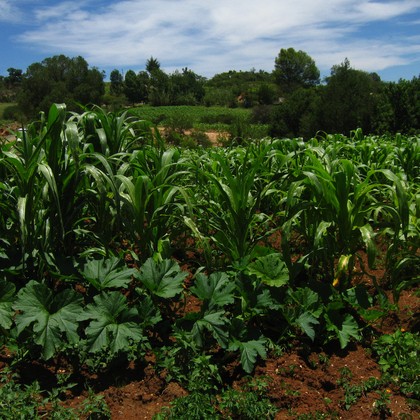
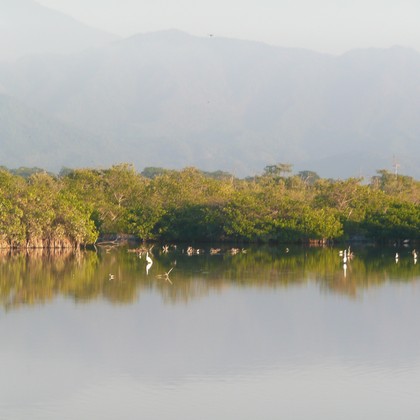
Where the bird is most at home, classified by the vegetation units of Mexico and Central America.




Range and movements
Winter visitor throughout the guide area, from Baja California, Sonora, Chihuahua and Tamaulipas across all of Mexico to the Yucatán Peninsula and Chiapas, and further in Guatemala, Belize, El Salvador, Honduras, Nicaragua, Costa Rica and Panama; common to very common in the lowlands on both coasts, scarcer on the plateau. On migration, mainly in September and October and in March and April, large numbers pass through to and from South America. A few birds stay through the summer. Breeds in Canada and the United States.
- Winter visitor (c. Oct–Mar)
- dark = core range, pale = thinly spread
How and when to look
The marshes and rice fields of the Gulf coast of Mexico and of the Central American lowlands in the winter months; in flocks of hundreds of birds every group that takes off shows the pale blue forewings.
Conservation status
Not threatened globally and one of the most numerous ducks of North America. In the guide area a very common winter visitor that is hunted in many places; drainage of marshes and the use of pesticides in rice growing affect its habitats.
Scientific name
Spatula discors | (Linnaeus, 1766)
Linnaeus described the species in 1766 as Anas discors; because it was later moved to another genus, the author and year stand in brackets. The genus Spatula was introduced in 1822 by Boie. Spatula is Latin for 'spoon' or 'spatula', after the broad, spoon-shaped bill of the shoveler. discors is Latin for 'discordant, differing', literally 'not of one heart'. The specimen the first description was based on came from Virginia or Carolina.