All species › Swifts › Hummingbirds › Blue-throated Sapphire
Position in the tree Birds Aves › Birds with a flexible palate Neognathae › All other modern birds Neoaves › Birds of the elements Elementaves › Nightjars and swifts Strisores
Blue-throated Sapphire | Chlorestes eliciae
Goudstaartsaffierkolibrie | Zafiro garganta azul
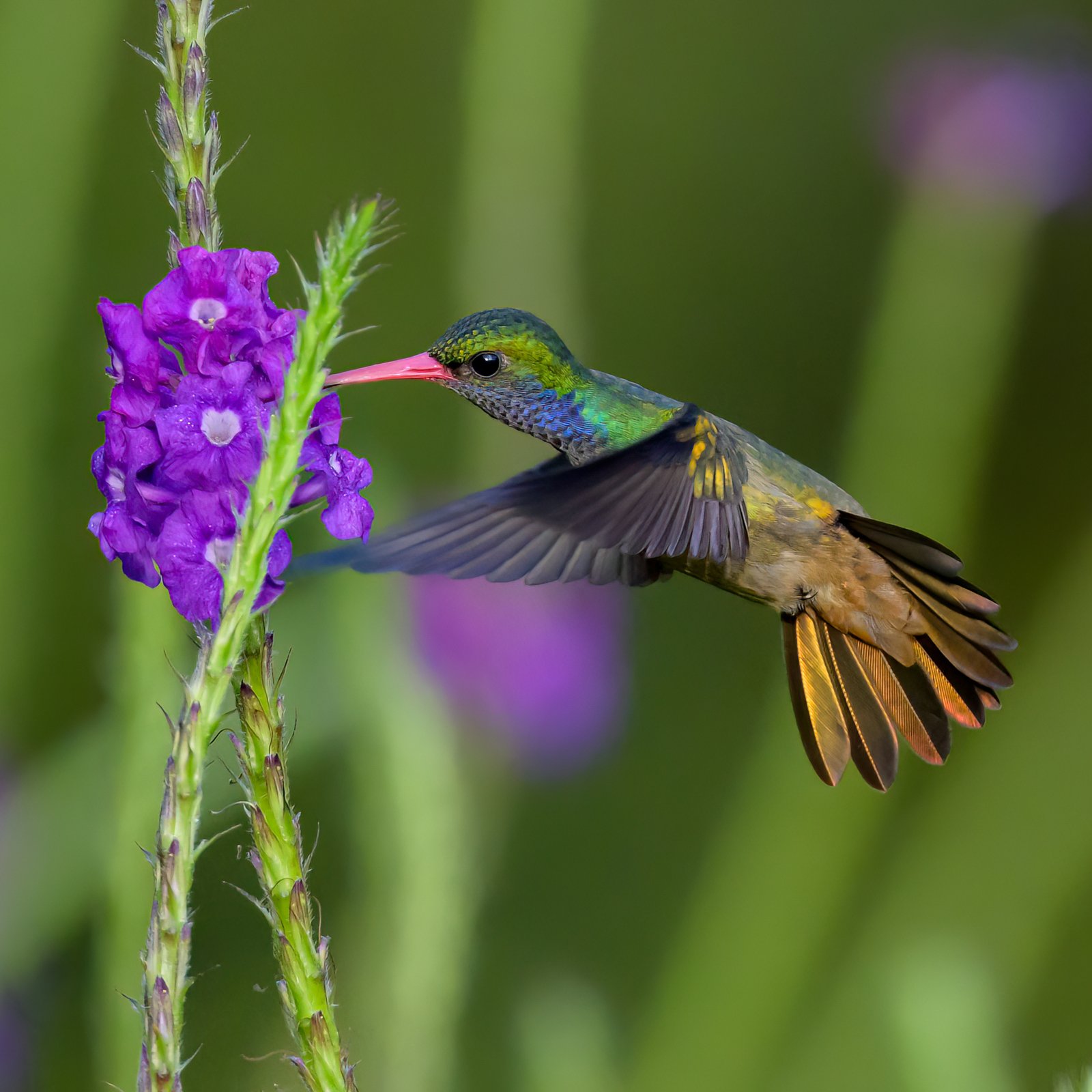
The Blue-throated Sapphire is a small hummingbird with a red bill, a glittering golden-coppery tail and, in the male, a violet-blue throat. It occurs from southern Mexico to Panama and north-western Colombia, mainly along forest edges and in gallery forest in the lowlands. In Costa Rica it is fairly common on the Pacific side.
Voice
A dry chik and a song of high, thin and somewhat scratchy notes, often from a perch in the undergrowth.
Recording: Stephan Risch — CC BY-NC-SA 4.0 · converted to mono · xeno-canto
Identification
8–9 cm, with a straight red bill with a black tip. The male is green above, with a glittering violet-blue chin and throat, a green breast and a greyish belly; the rump and tail are golden-copper to bronze-gold and glitter strongly in good light. The female has a smaller, less blue throat patch and paler, greyish underparts, with the same golden-coppery tail.
Confusion species
Rufous-tailed Hummingbird Amazilia tzacatl is larger, with a green throat and a rufous tail. Humboldt's Sapphire Chrysuronia humboldtii lives only in the mangroves of Darién and also has a blue crown and a bronze-green tail. Sapphire-throated Hummingbird Chrysuronia coeruleogularis has a forked dark tail.
Habitat
Edges of humid and drier lowland forest, gallery forest, secondary forest, scrub and gardens, from sea level to about 1000 m. It feeds mainly at low levels, often at flowering shrubs and herbs in the shade.
Where the bird is most at home, classified by the vegetation units of Mexico and Central America.






Range and movements
From southern Mexico in Chiapas (rare in Tabasco) through Guatemala, Belize (rare), El Salvador, Honduras, Nicaragua and Costa Rica to Panama, on both slopes but most numerous on the Pacific side. In Panama locally east to Darién. Outside the guide area in north-western Colombia.
- Resident
- dark = core range, pale = thinly spread
How and when to look
Along forest edges and gallery forest on the Pacific side of Costa Rica, for example in Carara National Park, at flowering shrubs in partial shade. The golden-coppery tail is most obvious when the bird flies off.
Conservation status
Not threatened. Fairly common in much of its range, scarcer in the north. The species tolerates secondary forest and semi-open country.
Scientific name
Chlorestes eliciae | (Bourcier & Mulsant, 1846)
Bourcier & Mulsant described the species in 1846 as Trochilus Eliciae; because it was later moved to another genus, the author and year stand in brackets. The genus Chlorestes was introduced in 1854 by Reichenbach. Chlorestes is Greek, from khlōros 'green' and esthēs 'clothing': 'clad in green'. eliciae honours Claudine Hélène Elicia Alain, née Bourcier (1821–1902), daughter of the French hummingbird specialist Jules Bourcier. The specimen the first description was based on came from unknown.