All species › Passerines › Cotingas › Blue Cotinga
Position in the tree Birds Aves › Birds with a flexible palate Neognathae › All other modern birds Neoaves › Landbirds Telluraves › Falcons, parrots and passerines Australaves › Falcons and passerines Eufalconimorphae › Parrots and passerines Psittacopasserae
Blue Cotinga | Cotinga nattererii
Zwartbuikcotinga | Cotinga azul
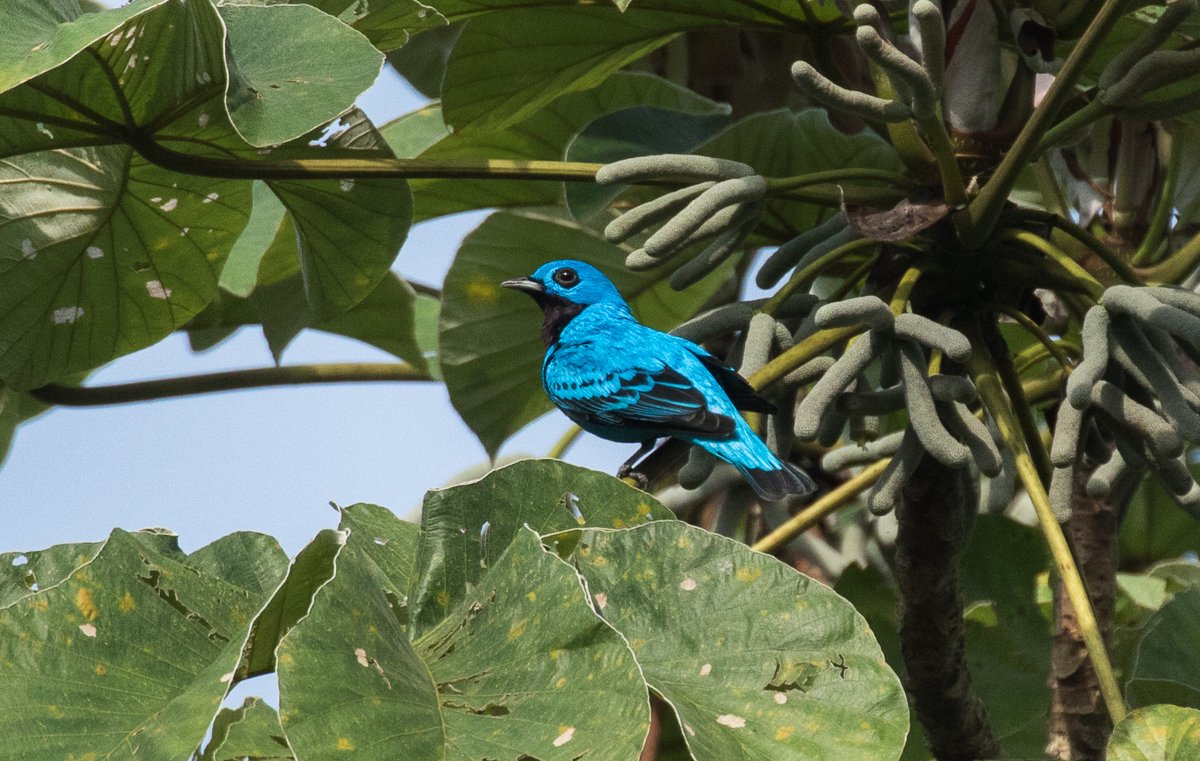
The Blue Cotinga is a blue cotinga of the canopy of humid lowland forest in central and eastern Panama. The male is bright blue with a purple throat and belly patch and stands out when perched on a bare treetop. In the guide area it is the only blue cotinga of Panama east of Chiriquí.
Voice
Usually silent. In flight the male's wings can produce a soft whistling or rattling sound.
Recording: Olaf Jahn — CC BY-NC-SA 4.0 · converted to mono · xeno-canto
Identification
18–19 cm. The male is bright glossy blue, with black spotting on the upperparts where the dark feather bases show through, and black around the eye. Throat purple and a large purple patch in the centre of breast and belly. Wings and tail black with blue edges. The female is dark greyish brown above with pale feather edges, giving a scaled look, and paler buffy brown below with dark spots. Round head, short black bill.
Confusion species
Turquoise Cotinga Cotinga ridgwayi (Pacific side of southern Costa Rica and western Panama) and Lovely Cotinga Cotinga amabilis (Caribbean side from Mexico to Costa Rica) are very similar, but their ranges do not overlap with that of this species.
Habitat
Canopy and edges of humid evergreen lowland and foothill forest, also tall secondary forest and clearings with scattered tall trees. It eats mainly fruit. It often sits motionless for long periods on a bare branch above the canopy.
Where the bird is most at home, classified by the vegetation units of Mexico and Central America.



Range and movements
Central and eastern Panama, from the Panama Canal area east to Darién. Outside the guide area in northern and western Colombia, north-western Ecuador and north-western Venezuela.
- Resident
- dark = core range, pale = thinly spread
How and when to look
Regularly seen from the Canopy Tower and along Pipeline Road (Camino del Oleoducto) in Soberanía National Park in Panama. It often perches at the top of a bare or fruiting tree above the forest.
Conservation status
Not threatened. Rather scarce in the guide area; declines where lowland forest disappears.
Scientific name
Cotinga nattererii | (Boissonneau, 1840)
Boissonneau described the species in 1840 as Ampelis Nattererii; because it was later moved to another genus, the author and year stand in brackets. The genus Cotinga was introduced in 1760 by Brisson. Cotinga comes via French from a Tupi name for these birds, by the usual account meaning 'washed white'. nattererii honours the Austrian naturalist Johann Natterer (1787–1843), who collected in Brazil for eighteen years. The specimen the first description was based on came from 'Bogotá', Colombia (trade skin).