All species › Passerines › Tanagers and allies › Blue-black Grassquit
Position in the tree Birds Aves › Birds with a flexible palate Neognathae › All other modern birds Neoaves › Landbirds Telluraves › Falcons, parrots and passerines Australaves › Falcons and passerines Eufalconimorphae › Parrots and passerines Psittacopasserae
Blue-black Grassquit | Volatinia jacarina
Jacarinagors | Semillero brincador
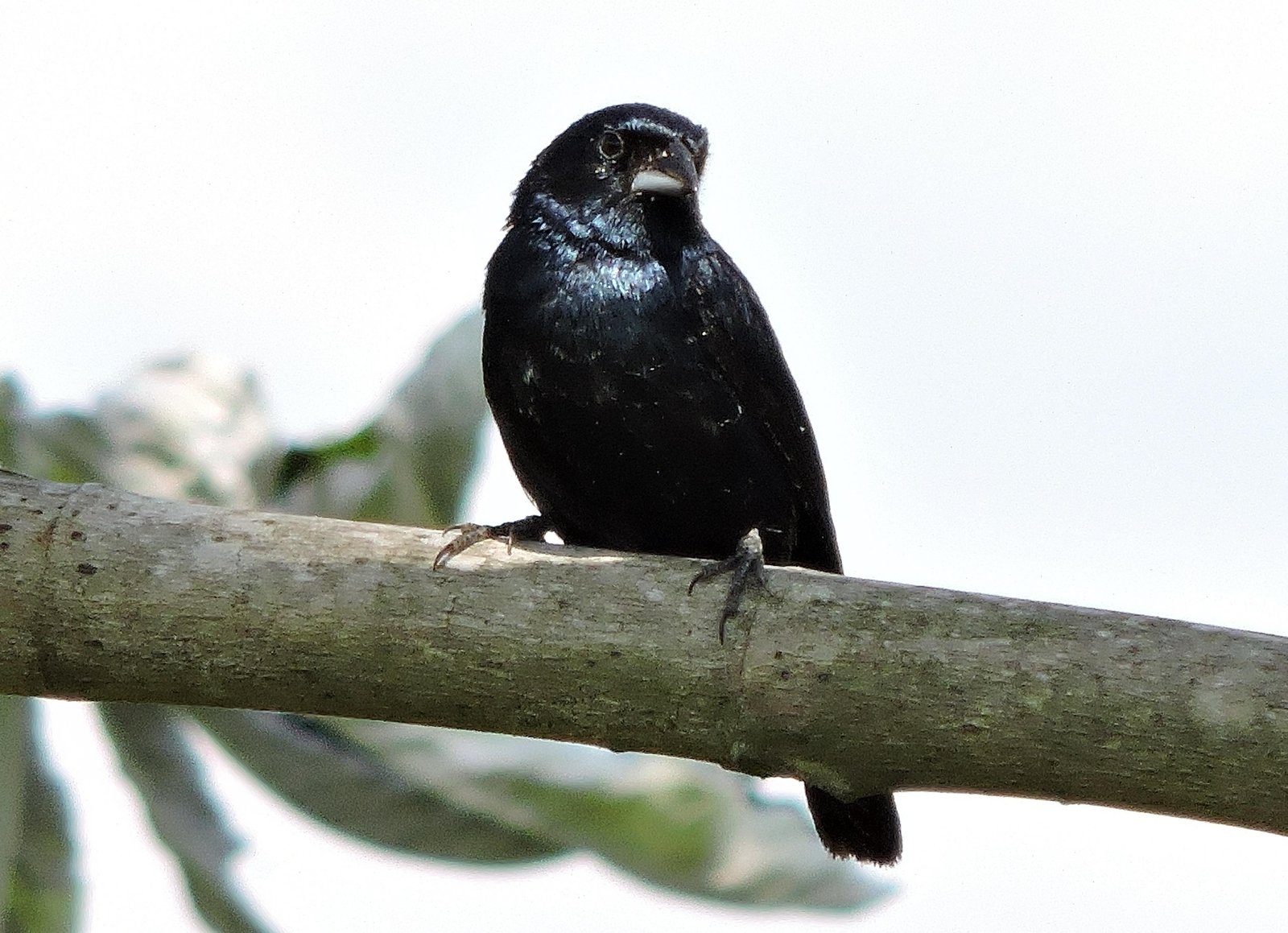
The Blue-black Grassquit is a small seedeater of weedy places, roadsides and grassland. In the breeding season the blue-black male repeatedly jumps straight up from a stem and drops back with a short call. It occurs in almost all lowlands of the guide area and further south to Argentina.
Voice
With each jump the male gives a short, buzzy ee-slick. Also a soft chip.
Recording: Tristan Guillebot de Nerville — CC BY-NC-SA 4.0 · converted to mono · xeno-canto
Identification
10–11 cm. A small, compact bird with a conical, pointed bill. Male in breeding plumage entirely glossy blue-black, with a white spot under the wing visible mainly during the jump display. Female and young birds brown above, buff-brown below with distinct dark streaks on breast and flanks. Moulting and non-breeding males are mottled brown and black.
Confusion species
The male Variable Seedeater Sporophila corvina is black with a shorter, more bulbous bill and often a white wing spot. Thick-billed Seed Finch Sporophila funerea is larger with a heavy bill. Female Sporophila seedeaters are unstreaked and have a short, curved bill. The male Indigo Bunting Passerina cyanea is larger and bright blue.
Habitat
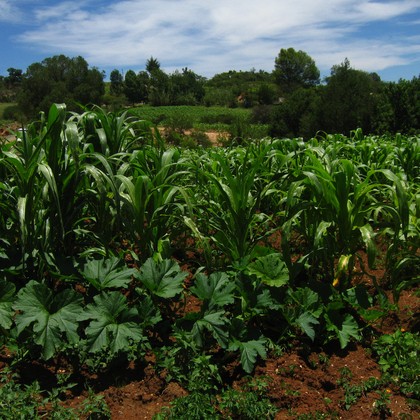
Open, grassy and weedy ground: roadsides, fallow land, fields, pasture, savanna, gardens and clearings in forest, from sea level to about 1500 m, locally higher. It feeds mainly on grass seeds.
Where the bird is most at home, classified by the vegetation units of Mexico and Central America.




Range and movements
In Mexico on the Pacific slope from southern Sonora and on the Gulf slope from Tamaulipas southward, through all of Central America to Panama. Beyond that in almost all of tropical South America to northern Argentina and on Grenada. In northern Mexico it is present mainly in summer.
- Resident
- dark = core range, pale = thinly spread
How and when to look
Found mainly in the rainy season, when males perform their jumps from a post or grass stem along roads and fields.
Conservation status
Not threatened (LC). Very common and benefits from deforestation and roadsides.
Scientific name
Volatinia jacarina | (Linnaeus, 1766)
Linnaeus described the species in 1766 as Tanagra jacarina; because it was later moved to another genus, the author and year stand in brackets. The genus Volatinia was introduced in 1850 by Reichenbach. Volatinia is a diminutive of Latin volatus 'flight, flying', after the male's short leaping display flights. jacarina comes from Tupí, where it was a name for a kind of finch. The specimen the first description was based on came from northeastern Brazil.