All species › Passerines › Thrushes and allies › Black Thrush
Position in the tree Birds Aves › Birds with a flexible palate Neognathae › All other modern birds Neoaves › Landbirds Telluraves › Falcons, parrots and passerines Australaves › Falcons and passerines Eufalconimorphae › Parrots and passerines Psittacopasserae
Black Thrush | Turdus infuscatus
Guatemalalijster | Mirlo negro
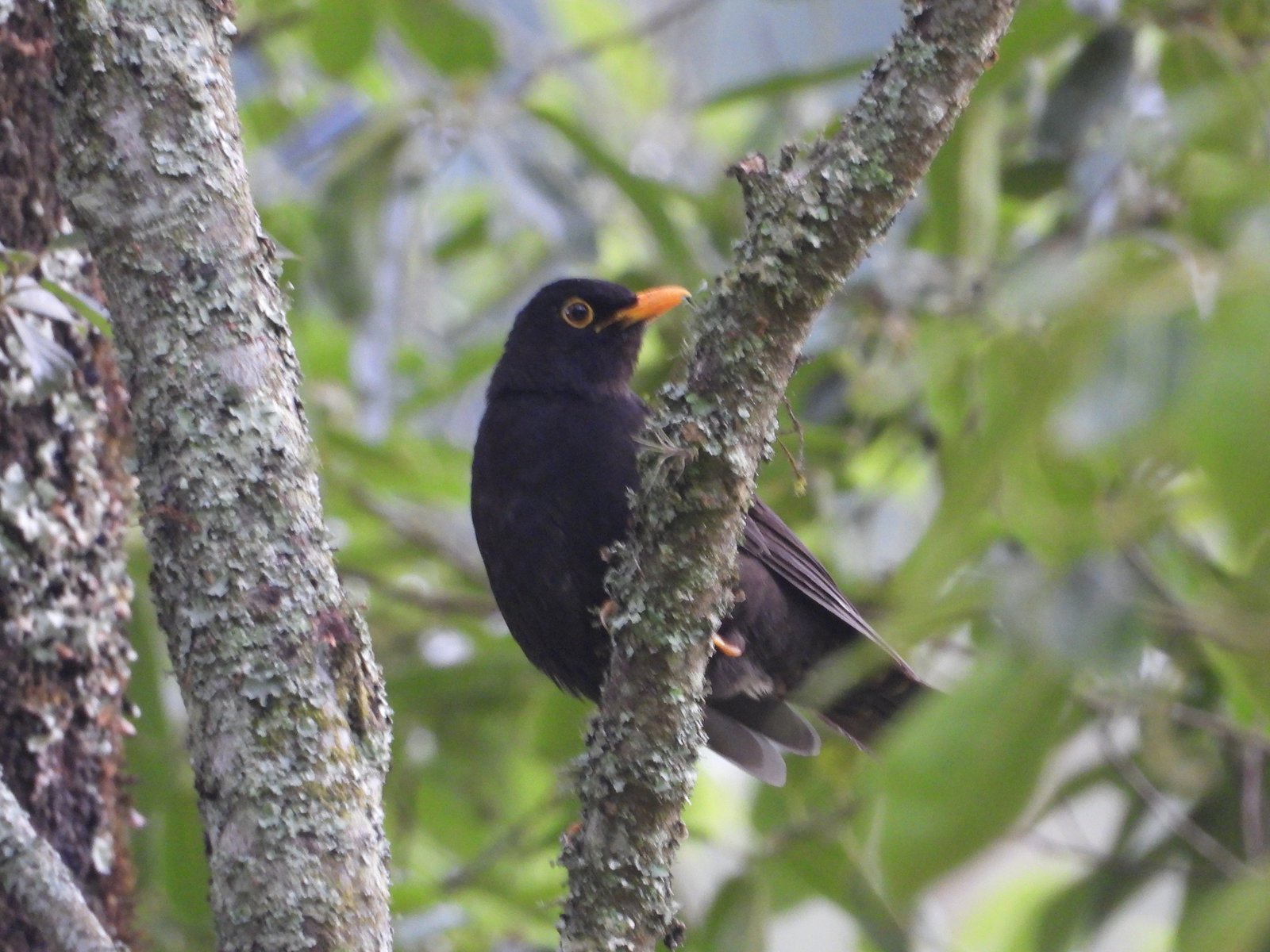
The Black Thrush is a Turdus thrush of cloud forest and humid montane forest, from eastern and southern Mexico to Honduras. The male is entirely glossy black with a yellow bill and yellow legs; the female is olive-brown. It follows the supply of fruit and therefore appears in some areas only for part of the year.
Voice
The song is a varied, powerful series of whistled and somewhat hoarse phrases, often repeated several times before a new phrase follows. Calls include a low chuk, a rolling churrr and a high, thin see.
Recording: Bill Pyle — CC BY-NC-SA 4.0 · shortened to the first 60 s, mono · xeno-canto
Identification
22–24 cm. Male entirely black with a slight gloss; bill and legs bright yellow, iris dark. Female olive-brown to dark buffy brown, slightly paler on belly and flanks, with a pale throat with dark streaks; bill dark to dull yellow, legs yellowish-brown. Juveniles resemble the female, with pale spots on the upperparts and dark spots on the underparts.
Confusion species
The male Rufous-collared Thrush Turdus rufitorques has a rufous collar and breast. Mountain Thrush Turdus plebejus resembles the female Black Thrush but is greyer olive-brown with a black bill and a less streaked throat. The female White-throated Thrush Turdus assimilis has a white collar below the streaked throat and a yellow eye-ring. Melodious Blackbird Dives dives and other black icterids have a black bill and black legs.
Habitat
Cloud forest, humid oak and pine-oak forest and the upper parts of foothill forest; mostly between 1000 and 3000 m, sometimes lower outside the breeding season. It lives mainly in the middle and upper levels of the forest but comes to the ground and to forest edges to feed. It eats much fruit as well as insects and earthworms.
Where the bird is most at home, classified by the vegetation units of Mexico and Central America.



Range and movements
Only in the guide area: the Sierra Madre Oriental from southern San Luis Potosí and Hidalgo through Puebla and Veracruz, the Sierra Madre del Sur in Guerrero and Oaxaca, and Chiapas; further in the highlands of Guatemala, El Salvador and Honduras.
- Resident
- Summer visitor (c. Apr–Sep)
- Winter visitor (c. Oct–Mar)
- Passage (Mar–Apr, Oct–Nov)
- dark = core range, pale = thinly spread
How and when to look
Best found at fruiting trees in cloud forest, where several birds sometimes feed together; in spring males sing from high, exposed perches. Suitable areas lie in the cloud forests of Chiapas, such as El Triunfo, and in the highlands of Guatemala.
Conservation status
Not threatened (LC). Locally common, but dependent on cloud forest, which is being cleared for agriculture and coffee growing in much of the range.
Scientific name
Turdus infuscatus | (de Lafresnaye, 1844)
De Lafresnaye described the species in 1844 as Mer[ula] infuscata; because it was later moved to another genus, the author and year stand in brackets. The genus Turdus was introduced in 1758 by Linnaeus. Turdus is the ordinary Latin word for 'thrush'. infuscatus is Latin for 'darkened, dusky', after the male's largely black plumage. The specimen the first description was based on came from Mexico (not specified).