All species › Passerines › Ovenbirds and woodcreepers › Black-striped Woodcreeper
Position in the tree Birds Aves › Birds with a flexible palate Neognathae › All other modern birds Neoaves › Landbirds Telluraves › Falcons, parrots and passerines Australaves › Falcons and passerines Eufalconimorphae › Parrots and passerines Psittacopasserae
Black-striped Woodcreeper | Xiphorhynchus lachrymosus
Zwartgestreepte muisspecht | Trepatroncos pinto
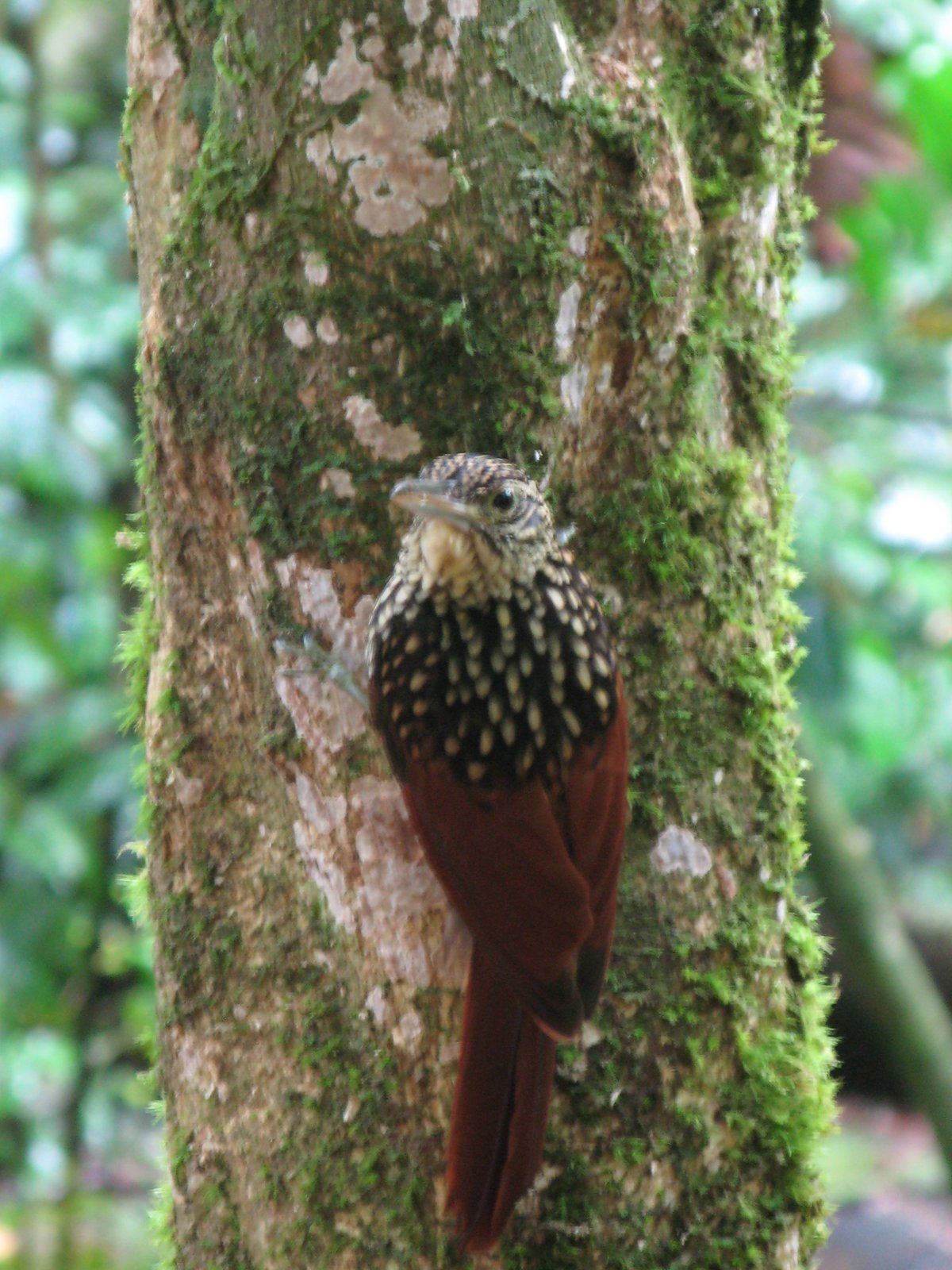
The Black-striped Woodcreeper is a boldly patterned woodcreeper of humid lowland forest in southern Central America, with a black-and-buff striped head, back and underparts. It often forages higher in the trees than related species. In the guide area it lives from Nicaragua to Panama.
Voice
A loud series of whistles that first rises and then falls, often with a laughing quality. Also a sharp, descending call.
Recording: rudy gelis — CC BY-NC-SA 4.0 · converted to mono · xeno-canto
Identification
23–25 cm. Bill fairly long, slightly curved, dark with a paler lower mandible. Head, neck, back and underparts blackish with broad buff to whitish teardrop-shaped streaks, giving a contrasting black-and-buff appearance. Throat buff. Wings and tail rufous. Male and female are alike.
Confusion species
Cocoa Woodcreeper Xiphorhynchus susurrans is browner and less contrasting, with an almost unstreaked back. Spotted Woodcreeper Xiphorhynchus erythropygius has round spots instead of streaks and lives higher in the mountains. Streak-headed Woodcreeper Lepidocolaptes souleyetii is smaller, with a thin, pale bill and an unstreaked back.
Habitat
Humid evergreen lowland and foothill forest, mature secondary forest and forest edges; mostly in the middle and upper levels and in the canopy. It searches trunks and large branches for insects and other invertebrates and often joins mixed flocks. It nests in a tree cavity.
Where the bird is most at home, classified by the vegetation units of Mexico and Central America.




Range and movements
Caribbean slope of south-eastern Nicaragua and of Costa Rica, and the southern Pacific slope of Costa Rica; in Panama on both slopes. Outside the guide area in western Colombia and north-western Ecuador.
- Resident
- dark = core range, pale = thinly spread
How and when to look
Regularly seen at La Selva in Costa Rica and along Pipeline Road (Camino del Oleoducto) in Panama, often in mixed flocks in the upper levels.
Conservation status
Not threatened. Fairly common in humid lowland forest, but dependent on forest and therefore sensitive to deforestation.
Scientific name
Xiphorhynchus lachrymosus | (Lawrence, 1862)
Lawrence described the species in 1862 as Dendrornis lachrymosus; because it was later moved to another genus, the author and year stand in brackets. The genus Xiphorhynchus was introduced in 1827 by Swainson. Xiphorhynchus is Greek, from xiphos 'sword' and rhunkhos 'bill', after the long, straight bill. lachrymosus is Latin for 'tearful', after the teardrop-shaped spots on the plumage. The specimen the first description was based on came from Lion Hill, Panama.