All species › Passerines › Tityras, becards and allies › Black-crowned Tityra
Position in the tree Birds Aves › Birds with a flexible palate Neognathae › All other modern birds Neoaves › Landbirds Telluraves › Falcons, parrots and passerines Australaves › Falcons and passerines Eufalconimorphae › Parrots and passerines Psittacopasserae
Black-crowned Tityra | Tityra inquisitor
Zwartkruintityra | Titira pico negro
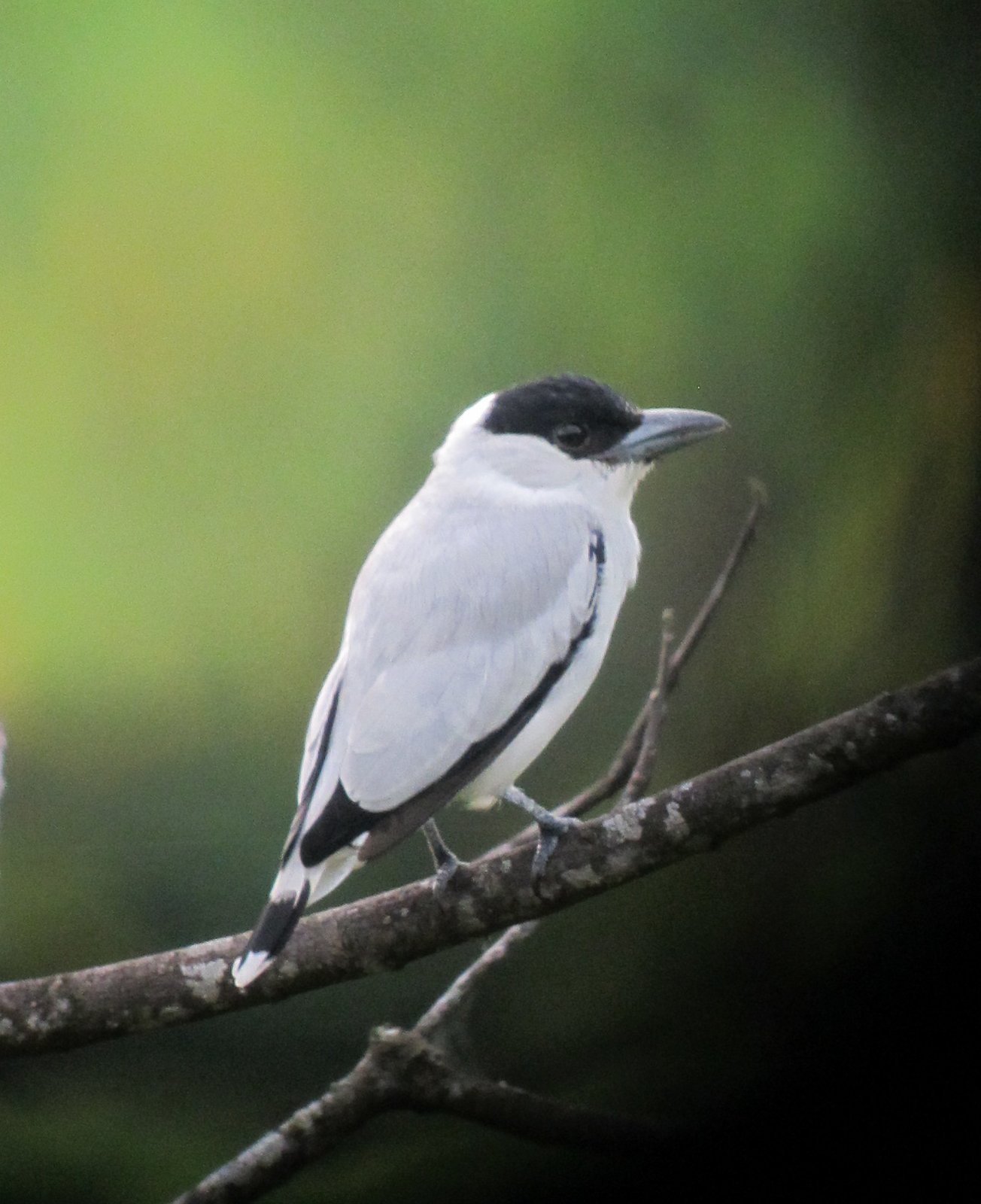
The Black-crowned Tityra is the smallest tityra in the guide area, a grey-and-white bird with a black cap and black wings. Unlike the Masked Tityra it lacks bare red skin around the eye and bill. It lives in the canopy of forest and at forest edges from Mexico to Panama.
Voice
Dry, short, insect-like notes, such as zick or zrrt, often in short series; thinner and softer than the nasal grunting of the Masked Tityra.
Recording: Luis Seko Pradier — CC BY-NC-SA 4.0 · converted to mono · xeno-canto
Identification
18–19 cm. Male pale grey on back and head, underparts almost white; crown black, with no black around the eye. Wings black, tail mostly black. Bill entirely black, without bare red skin. The female also has a black crown, but rufous cheeks and a brownish-grey back with dark streaks.
Confusion species
Masked Tityra Tityra semifasciata is larger and has bare red skin around the eye and a red bill with a black tip; in the male the black extends over the face. Males of Black-and-white Becard Pachyramphus albogriseus and Cinereous Becard Pachyramphus rufus are smaller, with a dark grey to grey back and white edges to the wing feathers.
Habitat
Canopy and edges of humid and semi-humid forest, gallery forest, clearings with tall trees and tall secondary forest, from sea level to about 1200 m. It eats mainly fruit and also large insects. It nests in a cavity high in a tree, often an old woodpecker hole.
Where the bird is most at home, classified by the vegetation units of Mexico and Central America.





Range and movements
From eastern and southern Mexico through the whole of Central America to Panama. Outside the guide area widespread in South America, south to northern Argentina.
- Resident
- dark = core range, pale = thinly spread
How and when to look
At fruiting trees along forest edges look out for tityras and check the face: a black crown without red around the eye points to this species. Like the Masked Tityra, it often perches high on a bare branch.
Conservation status
Not threatened. Fairly common, but less numerous and less conspicuous than the Masked Tityra.
Scientific name
Tityra inquisitor | (Lichtenstein, 1823)
Lichtenstein described the species in 1823 as L[anius] Inquisitor; because it was later moved to another genus, the author and year stand in brackets. The genus Tityra was introduced in 1816 by Vieillot. Tityra probably refers to the tituroi, the satyrs in the train of Pan and Bacchus, after the noisy, quarrelsome behaviour; the origin is not clear-cut. inquisitor is Latin for 'searcher, investigator', perhaps after its watchful searching from a perch. The specimen the first description was based on came from São Paulo, Brazil.