All species › Passerines › Tits, chickadees and titmice › Black-crested Titmouse
Position in the tree Birds Aves › Birds with a flexible palate Neognathae › All other modern birds Neoaves › Landbirds Telluraves › Falcons, parrots and passerines Australaves › Falcons and passerines Eufalconimorphae › Parrots and passerines Psittacopasserae
Black-crested Titmouse | Baeolophus atricristatus
Zwartkuifmees | Carbonero cresta negra
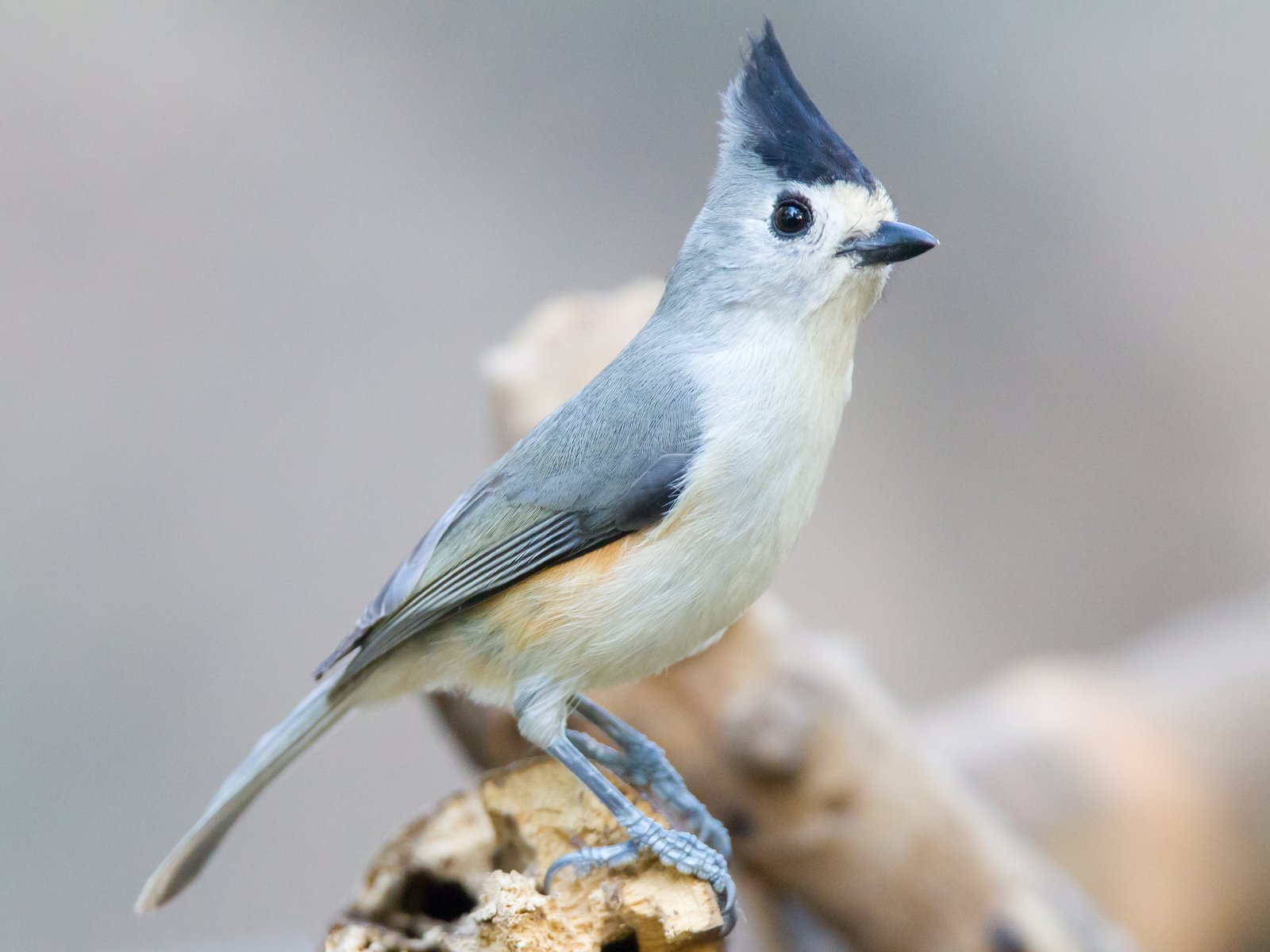
The Black-crested Titmouse is a grey titmouse with a black crest and rusty flanks that lives in north-eastern Mexico and Texas. It is noisy and inquisitive and occurs in oak woodland and thorn scrub as well as in villages and parks.
Voice
A loud, clear, repeated whistled phrase such as pee-ter pee-ter pee-ter. Calls are hoarse, scolding jee-jee-jee series.
Recording: Phoenix Birder — CC BY-NC-SA 4.0 · shortened to the first 60 s, mono · xeno-canto
Identification
14–15 cm. Upperparts grey, underparts greyish white with rusty-brown flanks. Long pointed crest black in adult males; often dark grey in females and grey with at most a dark tinge in young birds. Small white forehead above the bill. Large dark eyes in a plain pale grey face.
Confusion species
Bridled Titmouse Baeolophus wollweberi is smaller, with a grey crest edged black and a black-and-white face with a black throat. Young Black-crested Titmice with a grey crest resemble Tufted Titmouse Baeolophus bicolor, which does not occur in the guide area.
Habitat
Oak woodland, oak savanna, thorn scrub with mesquite, riparian woodland and slope forest in hills and low mountains, also villages, gardens and parks with trees. It eats insects, spiders, seeds and acorns. It nests in a tree cavity, an old woodpecker hole or a nest box.
Where the bird is most at home, classified by the vegetation units of Mexico and Central America.




Range and movements
In the guide area in north-eastern Mexico, from Coahuila, Nuevo León and Tamaulipas south to San Luis Potosí and northern Veracruz. Outside the guide area in central and southern Texas and adjacent Oklahoma.
- Resident
- dark = core range, pale = thinly spread
How and when to look
It often comes close and reacts to the alarm of other birds; the loud pee-ter is a regular sound in villages and city parks in north-eastern Mexico.
Conservation status
Not threatened. Common within its range.
Scientific name
Baeolophus atricristatus | (Cassin, 1850)
Cassin described the species in 1850 as Parus atricristatus; because it was later moved to another genus, the author and year stand in brackets. The genus Baeolophus was introduced in 1851 by Cabanis. Baeolophus is Greek, from baios 'small' and lophos 'crest': 'small crest', after the crest of these tits. atricristatus is Latin, from ater 'black' and cristatus 'crested', after the black crest. The specimen the first description was based on came from Rio Grande between Brownsville and Rio Grande City, Texas, USA.