All species › Passerines › Wrens › Black-bellied Wren
Position in the tree Birds Aves › Birds with a flexible palate Neognathae › All other modern birds Neoaves › Landbirds Telluraves › Falcons, parrots and passerines Australaves › Falcons and passerines Eufalconimorphae › Parrots and passerines Psittacopasserae
Black-bellied Wren | Pheugopedius fasciatoventris
Zwartbuikwinterkoning | Cucarachero ventrinegro
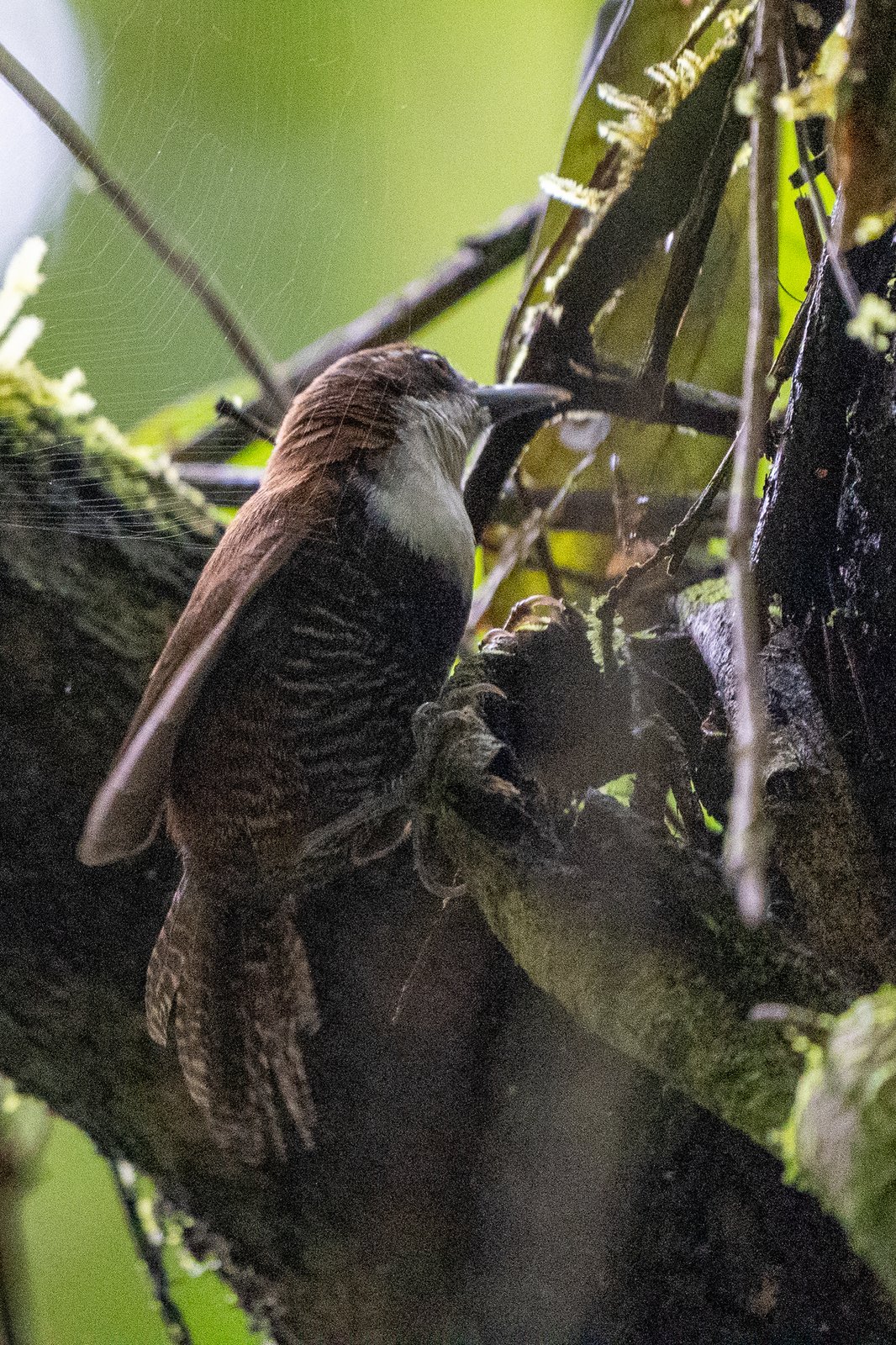
The Black-bellied Wren is a fairly large, rufous-brown wren of the humid lowlands of southern Central America, recognised by the white throat and breast contrasting sharply with the black, finely white-barred belly. It lives hidden in dense vegetation close to the ground, usually in pairs, and is mostly detected by its low, rich whistled song. In the guide area it occurs in Costa Rica and Panama.
Voice
A low, rich song of short, clear whistled phrases, often repeated several times before a new phrase follows. The call is a dry, rattling scold.
Recording: Michael Castaño — CC BY-NC-SA 4.0 · converted to mono · xeno-canto
Identification
14–16 cm. Upperparts warm rufous-brown, tail with narrow black bars. Supercilium white; cheeks and ear-coverts black with fine white streaks. Throat and breast bright white, sharply demarcated from the black belly and flanks with fine white bars. Bill fairly long and dark. Sexes alike; young birds are duller and less sharply marked.
Confusion species
Black-throated Wren Pheugopedius atrogularis (Caribbean slope from Nicaragua to western Panama) has a black throat and breast instead. Bay Wren Cantorchilus nigricapillus has a black head with white markings and chestnut underparts. Riverside Wren Cantorchilus semibadius (south-western Costa Rica and western Panama) is smaller and finely barred black and white on throat, breast and belly, without a plain white breast.
Habitat
Dense undergrowth at the edges and in clearings of humid lowland and foothill forest, mature secondary forest, vine tangles and dense stands of Heliconia, often near streams and in ravines; mainly in the lowlands. It forages close to the ground for insects and spiders.
Where the bird is most at home, classified by the vegetation units of Mexico and Central America.




Range and movements
Lowlands and foothills of Costa Rica and Panama. Outside the guide area in north-western Colombia.
- Resident
- dark = core range, pale = thinly spread
How and when to look
Regularly heard in Carara National Park in Costa Rica, in dense vegetation along trails and streams. It rarely shows for long; a singing bird sometimes comes briefly to the edge of the cover.
Conservation status
Not threatened. Locally fairly common in suitable undergrowth; disappears where forest and dense forest edges are cleared completely.
Scientific name
Pheugopedius fasciatoventris | (de Lafresnaye, 1845)
De Lafresnaye described the species in 1845 as Thriothorus fasciato-ventris; because it was later moved to another genus, the author and year stand in brackets. The genus Pheugopedius was introduced in 1851 by Cabanis. Pheugopedius is Greek, from pheugō 'to shun, flee' and pedion 'plain, open country': a bird that shuns the open ground. fasciatoventris is Latin, from fasciatus 'banded' and venter 'belly', after the black-and-white barred belly. The specimen the first description was based on came from Colombia ('Bogotá' trade skin).