All species › Passerines › Tyrant flycatchers and allies › Belted Flycatcher
Position in the tree Birds Aves › Birds with a flexible palate Neognathae › All other modern birds Neoaves › Landbirds Telluraves › Falcons, parrots and passerines Australaves › Falcons and passerines Eufalconimorphae › Parrots and passerines Psittacopasserae
Belted Flycatcher | Xenotriccus callizonus
Gordeltiran | Mosquero fajado
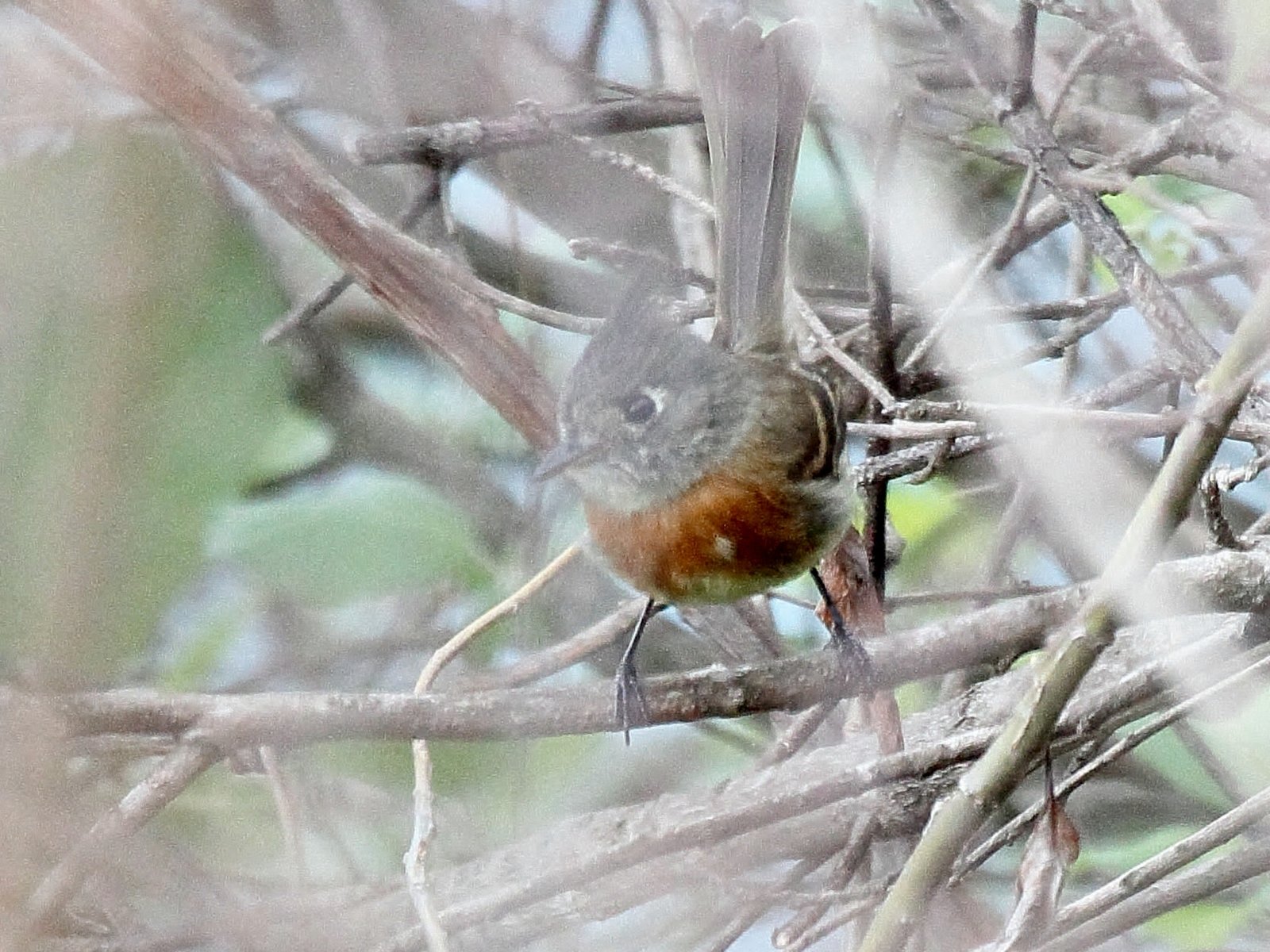
The Belted Flycatcher is a small, crested tyrant flycatcher of dry, scrubby woodland in the highlands of southern Mexico and northern Central America. It is named after the orange-brown band across the breast. It lives hidden in dense thickets and is poorly known.
Voice
Short, dry calls; the song is poorly known.
Recording: Paul van Els — CC BY-NC-SA 3.0 · shortened to the first 60 s, mono · xeno-canto
Identification
12–13 cm, with a short, pointed crest. Head greyish-olive with a conspicuous white eye-ring. Back olive-brown. Wings dark with two ochre wing-bars. Throat pale grey, a broad orange-brown band across the breast, belly pale yellow. Male and female are alike.
Confusion species
Northern Tufted Flycatcher Mitrephanes phaeocercus is also crested but is uniformly ochre below without a defined breast band, and perches conspicuously at forest edges and clearings. Buff-breasted Flycatcher Empidonax fulvifrons is smaller, without a crest, with a uniformly pale buff breast.
Habitat
Dry to semi-arid scrub, dense oak thickets and scrubby slopes and ravines in the highlands, often at the edges of pine-oak forest. It hunts insects low in dense vegetation.
Where the bird is most at home, classified by the vegetation units of Mexico and Central America.



Range and movements
Only in the guide area: locally in the highlands of Chiapas, Guatemala and El Salvador.
- Resident
- dark = core range, pale = thinly spread
How and when to look
Seldom seen; the best chance is on scrubby slopes in the highlands of Chiapas and Guatemala. Listen for movement in low thickets and look for the white eye-ring.
Conservation status
Not threatened according to the global assessment, but scarce and local; sensitive to loss of scrub through agriculture and grazing.
Scientific name
Xenotriccus callizonus | Dwight & Griscom, 1927
Dwight & Griscom described the species in 1927 and placed it straight away in the genus where it still stands. He introduced the genus Xenotriccus in that same work. Xenotriccus is Greek, from xenos 'stranger' and trikkos 'small bird', used in ornithology for tyrant flycatchers: 'strange flycatcher', after its unusual position within the family. callizonus is Greek, from kallos 'beauty' and zōnē 'girdle': 'beautifully banded', after the rufous breast band. The specimen the first description was based on came from Panajachel, Lake Atitlán, Guatemala.