All species › Birds of prey › Kites, Old World vultures, eagles and hawks › Barred Hawk
Position in the tree Birds Aves › Birds with a flexible palate Neognathae › All other modern birds Neoaves › Landbirds Telluraves › Raptors, owls, kingfishers and woodpeckers Afroaves › Hawks and owls Hieraves
Barred Hawk | Morphnarchus princeps
Sclaters buizerd | Busardo azoreño
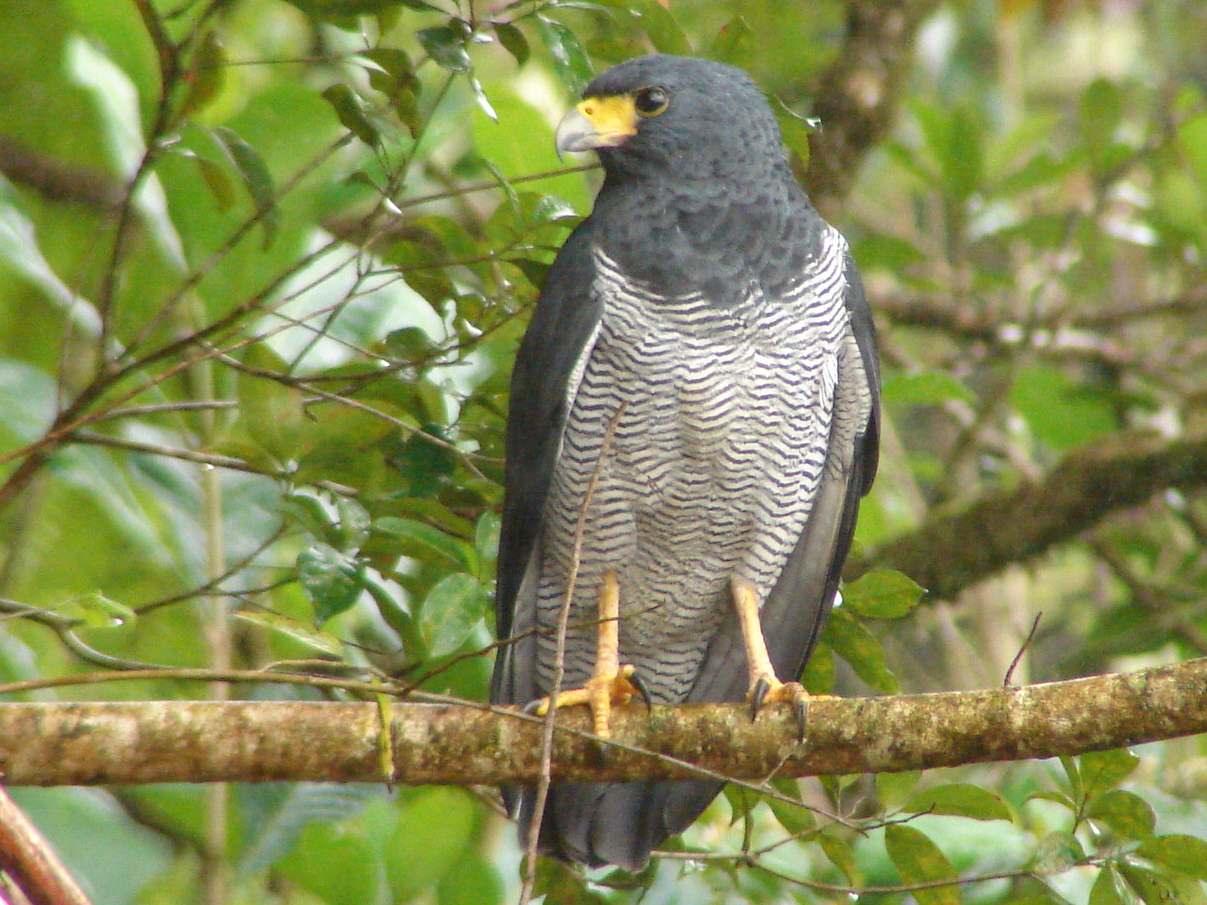
The Barred Hawk is a large, heavy hawk of foothill and montane forest, with a slate-black head, breast and upperparts sharply demarcated from finely black-and-white barred underparts. It often soars high over forested slopes and ravines, calling loudly. In the guide area it is a resident of Costa Rica and Panama.
Voice
A loud, piercing, whistled kleeeeyoo or wheeeeer, especially in flight over the forest and sometimes repeated for a long time.
Recording: Daan van der Hoeven — CC BY-NC-SA 4.0 · converted to mono · xeno-canto
Identification
50–58 cm, heavily built, with very broad, rounded wings and a short tail. Head, neck, breast and upperparts are uniformly dark slate-grey to black, forming a sharply demarcated hood. Belly, flanks and thighs are white with fine black bars. The tail is black with one narrow white band in the middle and a narrow white tip. Cere and legs are yellow-orange, the eye is dark. In flight the underwings are pale grey to whitish with fine dark barring, and the dark breast contrasts with the pale belly and wings. Young birds resemble adults but have pale fringes on the upperparts. Male and female are alike; the female is larger.
Confusion species
The dark hood with its sharp border on the breast makes it clearly recognisable. The Semiplumbeous Hawk Leucopternis semiplumbeus is much smaller, plain white below and lives in the lowlands. The Grey-headed Kite Leptodon cayanensis has a pale grey head, unbarred white underparts, a long, banded tail and smaller feet. The White Hawk Pseudastur albicollis is largely white.
Habitat
Humid foothill and montane forest, especially on steep slopes and in forested ravines, from about 300 to 2000 m; also forest edges and clearings with trees. It hunts from a perch in the forest for snakes, lizards, frogs, crabs and small mammals. It often soars high over the forest during the morning.
Where the bird is most at home, classified by the vegetation units of Mexico and Central America.




Range and movements
Resident in Costa Rica, mainly on the Caribbean slope and in the south also on the Pacific side (the Talamanca and the Cordillera Central), and in Panama on both slopes of the mountains, from Bocas del Toro and Chiriquí through Veraguas and Coclé to Cerro Azul in Panamá province and the mountains of Darién. Otherwise absent from the guide area. Outside the guide area in Colombia, Ecuador and extreme northern Peru.
- Resident
- dark = core range, pale = thinly spread
How and when to look
In mid-morning, as thermals develop, one or two birds often circle calling loudly over forested valleys on the Caribbean slope of Costa Rica, such as at Braulio Carrillo and Tapantí, and in Panama around Fortuna and Cerro Azul.
Conservation status
Not threatened. Dependent on forest on slopes; declining locally through deforestation, but still widespread in the mountains of Costa Rica and Panama.
Scientific name
Morphnarchus princeps | (Sclater, 1865) (GBIF: Leucopternis princeps)
Sclater described the species in 1865 as Leucopternis princeps; because it was later moved to another genus, the author and year stand in brackets. The genus Morphnarchus was introduced in 1920 by Ridgway. Morphnarchus is Greek, from morphnos 'dusky' (also a kind of eagle) and arkhos 'leader, chief'. princeps is Latin for 'prince, chief, leader', after this large, imposing hawk. The specimen the first description was based on came from Costa Rica.