All species › Trogons › Trogons › Baird's Trogon
Position in the tree Birds Aves › Birds with a flexible palate Neognathae › All other modern birds Neoaves › Landbirds Telluraves › Raptors, owls, kingfishers and woodpeckers Afroaves › Mousebirds, rollers and woodpeckers Coraciimorphae › Trogons and cavity nesters Cavitaves
Baird's Trogon | Trogon bairdii
Bairds trogon | Trogón de Baird
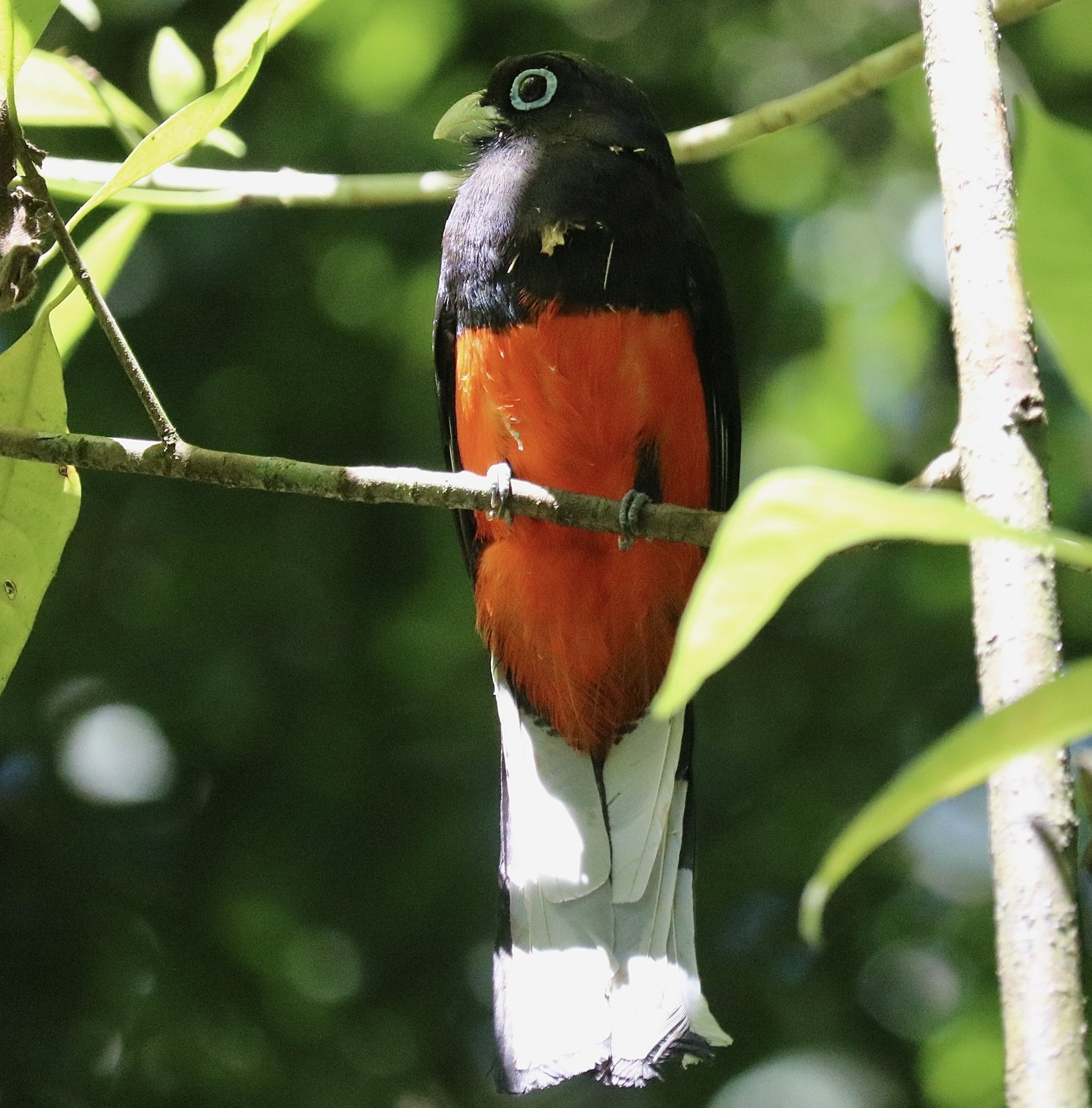
Baird's Trogon is a red-bellied trogon of humid lowland and foothill forest on the Pacific side of southern Costa Rica and western Panama, and does not occur outside the guide area. The male can be recognised by its pale blue eye-ring and the largely white underside of the tail. Its name honours the American naturalist Spencer Fullerton Baird.
Voice
A long series of short, hollow kow notes that starts slowly, accelerates and then slows and fades again at the end; longer than in most other trogons of the guide area. Also a soft cackling.
Recording: Johan Chaves — CC BY-NC-SA 4.0 · shortened to the first 60 s, mono · xeno-canto
Identification
26–28 cm. The male has a dark blue-green head, back and breast with a violet sheen, a blackish face and throat, a red to orange-red belly and undertail coverts and no white breast band. The eye-ring is pale blue, the bill blue-grey and the eye dark. The underside of the tail is largely white. The female is slate grey on the head, back and breast, with a red belly, a broken pale blue eye-ring and a black-and-white barred undertail.
Confusion species
Slaty-tailed Trogon Trogon massena is larger and has an orange-red bill and eye-ring and a plain slate-grey undertail. Collared Trogon Trogon collaris has a white breast band, a yellow bill in the male and a barred undertail with broad white tips. Gartered Trogon Trogon caligatus and Graceful Black-throated Trogon Trogon tenellus are smaller and have a yellow belly.
Habitat
Humid lowland and foothill forest from sea level to about 1200 m, mainly tall, old forest; also tall secondary forest and forest edges. It perches still for long periods in the middle and upper tree layers and eats fruit and large insects. It excavates its nest in an arboreal termite nest or in rotting wood.
Where the bird is most at home, classified by the vegetation units of Mexico and Central America.



Range and movements
Pacific slope of Costa Rica, from the Carara area in the centre of the country south-east through the Térraba valley and the Osa Peninsula to the Panamanian border; in western Panama in Chiriquí, where it has become rare through deforestation. It does not occur elsewhere in the guide area or beyond.
- Resident
- dark = core range, pale = thinly spread
How and when to look
Best seen in Carara National Park and on the Osa Peninsula, for example in Corcovado, in Costa Rica. The long, accelerating series of kow notes is often heard before the bird is seen.
Conservation status
Near Threatened. Its small range is shrinking and becoming fragmented through deforestation, especially in Panama; the largest numbers live in protected forests in south-western Costa Rica.
Scientific name
Trogon bairdii | Lawrence, 1868
Lawrence described the species in 1868 and placed it straight away in the genus where it still stands. The genus Trogon was introduced in 1760 by Brisson. Trogon is Greek, from trōgōn 'gnawing, fruit-eating'. bairdii honours the American ornithologist Spencer Fullerton Baird (1823–1887) of the Smithsonian Institution. The specimen the first description was based on came from San Mateo, Costa Rica.