All species › Passerines › Tit-warblers, bushtits and long-tailed tits › American Bushtit
Position in the tree Birds Aves › Birds with a flexible palate Neognathae › All other modern birds Neoaves › Landbirds Telluraves › Falcons, parrots and passerines Australaves › Falcons and passerines Eufalconimorphae › Parrots and passerines Psittacopasserae
American Bushtit | Psaltriparus minimus
Struikmees | Sastrecillo
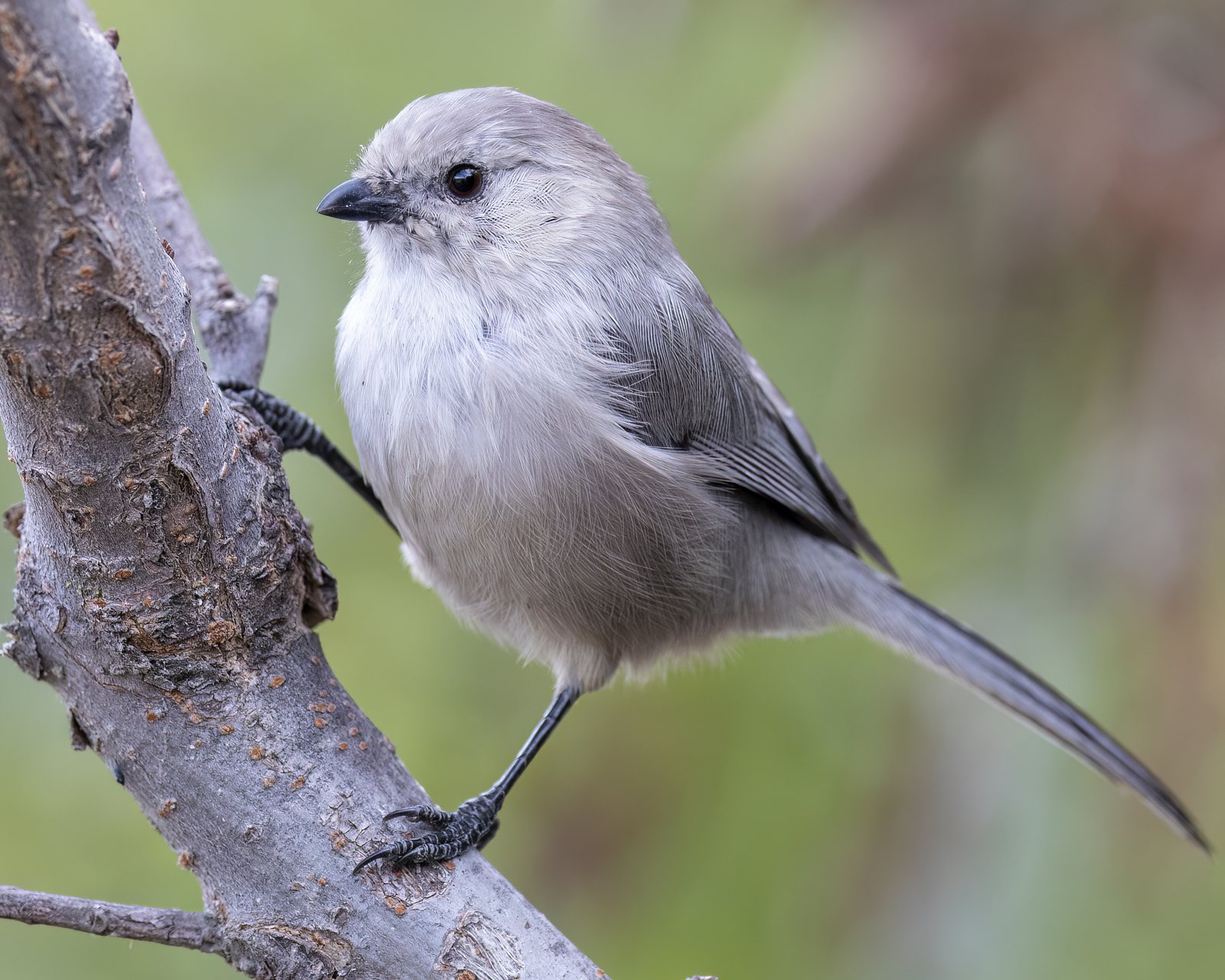
The Bushtit is one of the smallest songbirds in the guide area: a grey-brown bird with a round head, a stubby bill and a long tail. Outside the breeding season it lives in flocks of ten to forty birds that move through bushes and tree crowns, calling constantly. In the guide area it occurs from Baja California and northern Mexico to Guatemala.
Voice
Flocks give constant soft, high tsit and pst notes. When a bird of prey appears, all birds in the flock give a high, trilling alarm together and sit motionless. There is hardly any true song.
Recording: Greg Irving — CC BY-NC-SA 4.0 · converted to mono · xeno-canto
Identification
10–11 cm, of which almost half is tail. Plumage plain grey to grey-brown, underparts paler, without wing bars. Bill very short and black. The male has a dark eye, the female a pale yellow eye. Head and cheek colour vary by region: in Baja California and the north often a brown crown or brown cheeks, greyer further south; in the mountains of Mexico and Guatemala mainly males show a black or black-spotted ear patch.
Confusion species
Blue-grey Gnatcatcher Polioptila caerulea is slimmer and blue-grey, with a white eye-ring and a black-and-white tail. Verdin Auriparus flaviceps lives in desert scrub and has a yellow head as an adult. Ruby-crowned Kinglet Corthylio calendula is olive-green with white wing bars and a short tail. Bushtits nearly always move in flocks, the other species mostly alone or in pairs.
Habitat
Pine-oak, oak and juniper woodland in the mountains, chaparral and other dense scrub, wooded stream banks and also parks and gardens. It eats mainly small insects and spiders picked from leaves and twigs. The nest is a long, hanging pouch of moss, spider silk and plant down.
Where the bird is most at home, classified by the vegetation units of Mexico and Central America.






Range and movements
In the guide area in Baja California, in the mountains and on the plateaus of northern and central Mexico and further south through the highlands of Oaxaca and Chiapas to Guatemala. Outside the guide area in the western United States to south-western Canada.
- Resident
- dark = core range, pale = thinly spread
How and when to look
Quickest to find by ear: a flock moving through the bushes gives itself away by its constant soft twittering. The birds often cross an open space one after another.
Conservation status
Not threatened. Widespread and locally common in scrub and montane forest.
Scientific name
Psaltriparus minimus | (Townsend, 1837)
Townsend described the species in 1837 as Parus minimus; because it was later moved to another genus, the author and year stand in brackets. The genus Psaltriparus was introduced in 1850 by Bonaparte. Psaltriparus combines Psaltria (Greek psaltria 'female harpist', the genus of the Pygmy Bushtit) with Parus 'tit'. minimus is Latin for 'smallest', after the tiny size of this bird. The specimen the first description was based on came from forests along the Columbia River, probably near Fort Vancouver, Washington, USA.