All species › Kingfishers, bee-eaters and rollers › Kingfishers › Amazon Kingfisher
Position in the tree Birds Aves › Birds with a flexible palate Neognathae › All other modern birds Neoaves › Landbirds Telluraves › Raptors, owls, kingfishers and woodpeckers Afroaves › Mousebirds, rollers and woodpeckers Coraciimorphae › Trogons and cavity nesters Cavitaves › Hornbills, kingfishers and woodpeckers Picocoraciae › Kingfishers, bee-eaters and woodpeckers Picodynastornithes
Amazon Kingfisher | Chloroceryle amazona
Amazone-ijsvogel | Martín pescador amazónico
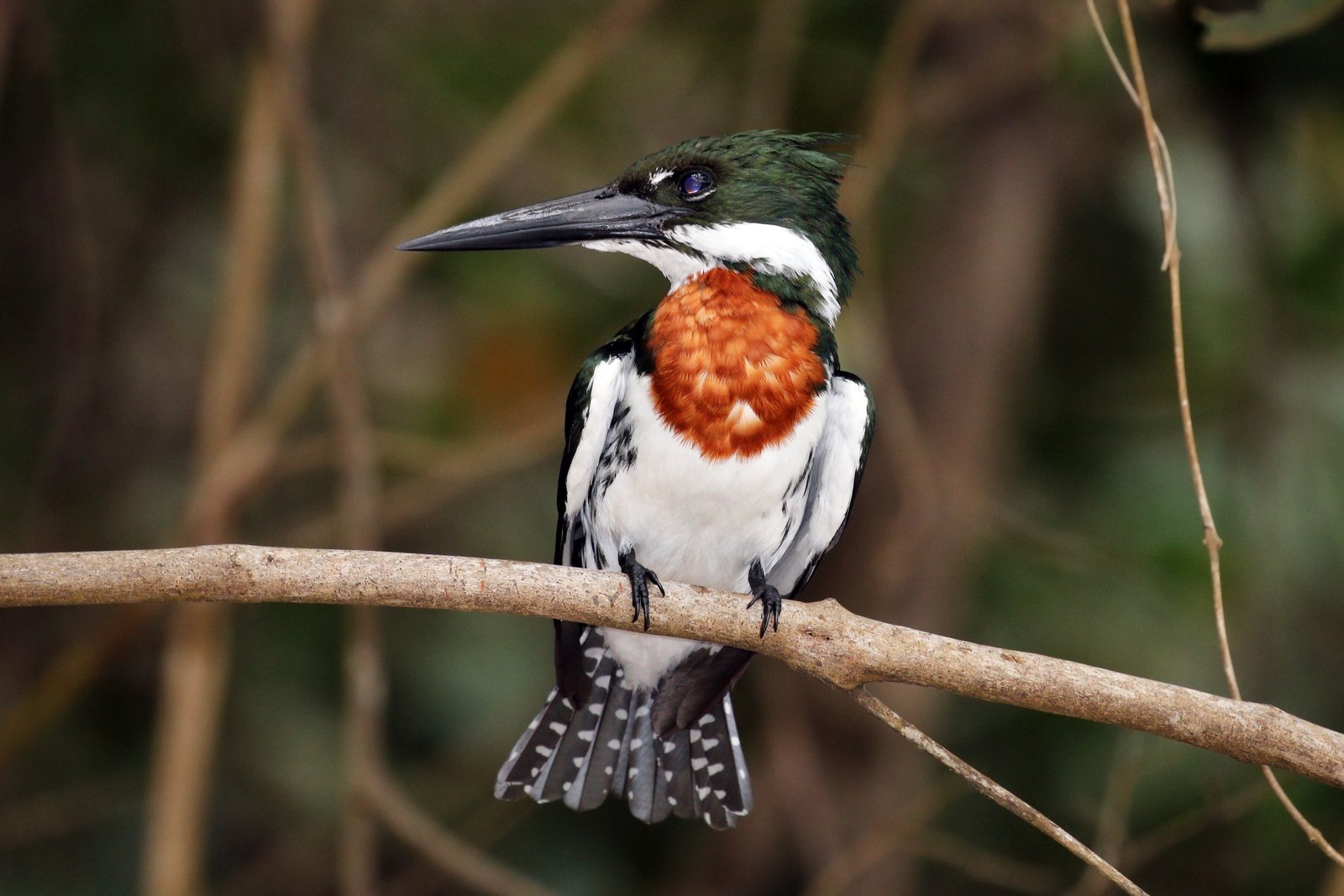
The Amazon Kingfisher is a large, dark green kingfisher of rivers and lagoons in the lowlands from Mexico to Panama. It is the largest of the four green kingfishers of the guide area and closely resembles the much smaller Green Kingfisher in pattern.
Voice
A loud, harsh, repeated tek or klek and a staccato chrit that can run into a rattle.
Recording: Franco Vushurovich — CC BY-NC-SA 4.0 · converted to mono · xeno-canto
Identification
29–30 cm, with a large head, a short crest and a long, heavy, black bill. The upperparts are dark bronze-green, with hardly any white in the wing and tail. A white collar separates head and back; the throat and chin are white. The male has a broad rufous breast band and a white belly with green streaks on the flanks. The female lacks the rufous and has a green, sometimes broken breast band. Young birds are somewhat paler, with pale spots on the wing coverts.
Confusion species
Green Kingfisher Chloroceryle americana has the same pattern but is much smaller, with a slimmer bill, distinct white spots on the wings and white outer tail feathers. Green-and-rufous Kingfisher Chloroceryle inda has entirely rufous underparts. Belted Kingfisher Megaceryle alcyon and Ringed Kingfisher Megaceryle torquata are blue-grey above, not green.
Habitat
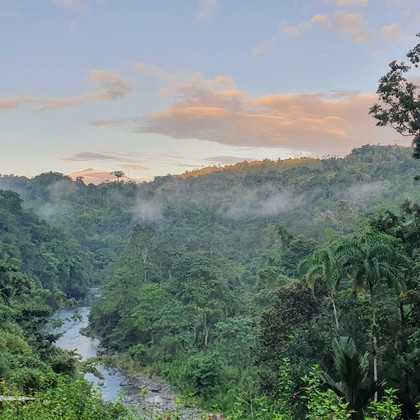
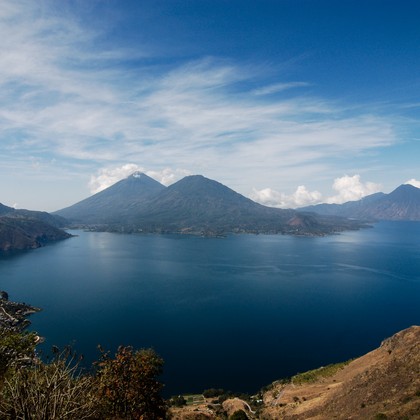
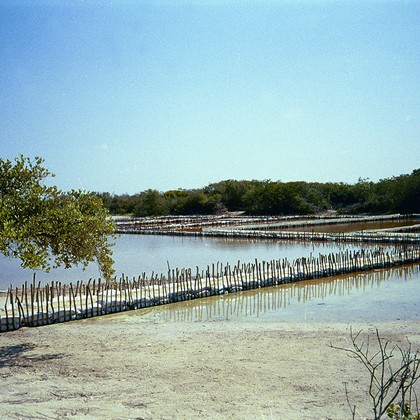
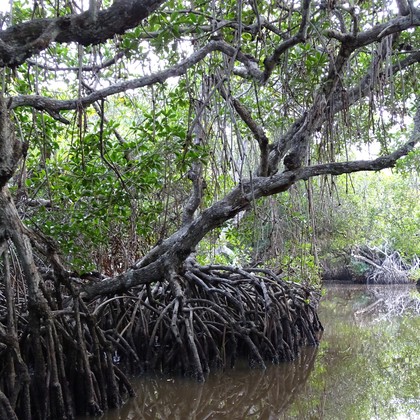
Larger, fairly open rivers, wooded lake shores, freshwater lagoons and reservoirs, sometimes also brackish lagoons and mangroves; mainly in the lowlands up to about 1000 m. It perches on branches or rocks over the water, often higher than the Green Kingfisher, and dives for fish. It nests in a tunnel in an earth bank.
Where the bird is most at home, classified by the vegetation units of Mexico and Central America.

Range and movements
Lowlands on the Gulf slope from southern Tamaulipas and on the Pacific slope from southern Mexico, through Tabasco, Chiapas and the southern Yucatán Peninsula, Belize, Guatemala, El Salvador, Honduras, Nicaragua and Costa Rica to Panama; absent from the dry northern Yucatán. Outside the guide area through much of tropical South America to northern Argentina.
- Resident
- dark = core range, pale = thinly spread
How and when to look
Along large rivers in the east of the guide area, such as in the Pantanos de Centla in Tabasco, on the Río Dulce in Guatemala and along the Chagres River and Gatún Lake in Panama. In a fairly large green kingfisher, the lack of white wing spots is the best distinction from Green Kingfisher.
Conservation status
Not threatened. Fairly common along larger lowland rivers.
Scientific name
Chloroceryle amazona | (Latham, 1790)
Latham described the species in 1790 as Alcedo amazona; because it was later moved to another genus, the author and year stand in brackets. The genus Chloroceryle was introduced in 1848 by Kaup. Chloroceryle combines Greek khlōros 'green' with the genus Ceryle: 'green Ceryle', after the green upperparts. amazona refers to the Amazon, the river basin where the species is widespread. The specimen the first description was based on came from Cayenne, French Guiana.