All species › Passerines › Tyrant flycatchers and allies › Alder Flycatcher
Position in the tree Birds Aves › Birds with a flexible palate Neognathae › All other modern birds Neoaves › Landbirds Telluraves › Falcons, parrots and passerines Australaves › Falcons and passerines Eufalconimorphae › Parrots and passerines Psittacopasserae
Alder Flycatcher | Empidonax alnorum
Elzenfeetiran | Mosquero ailero
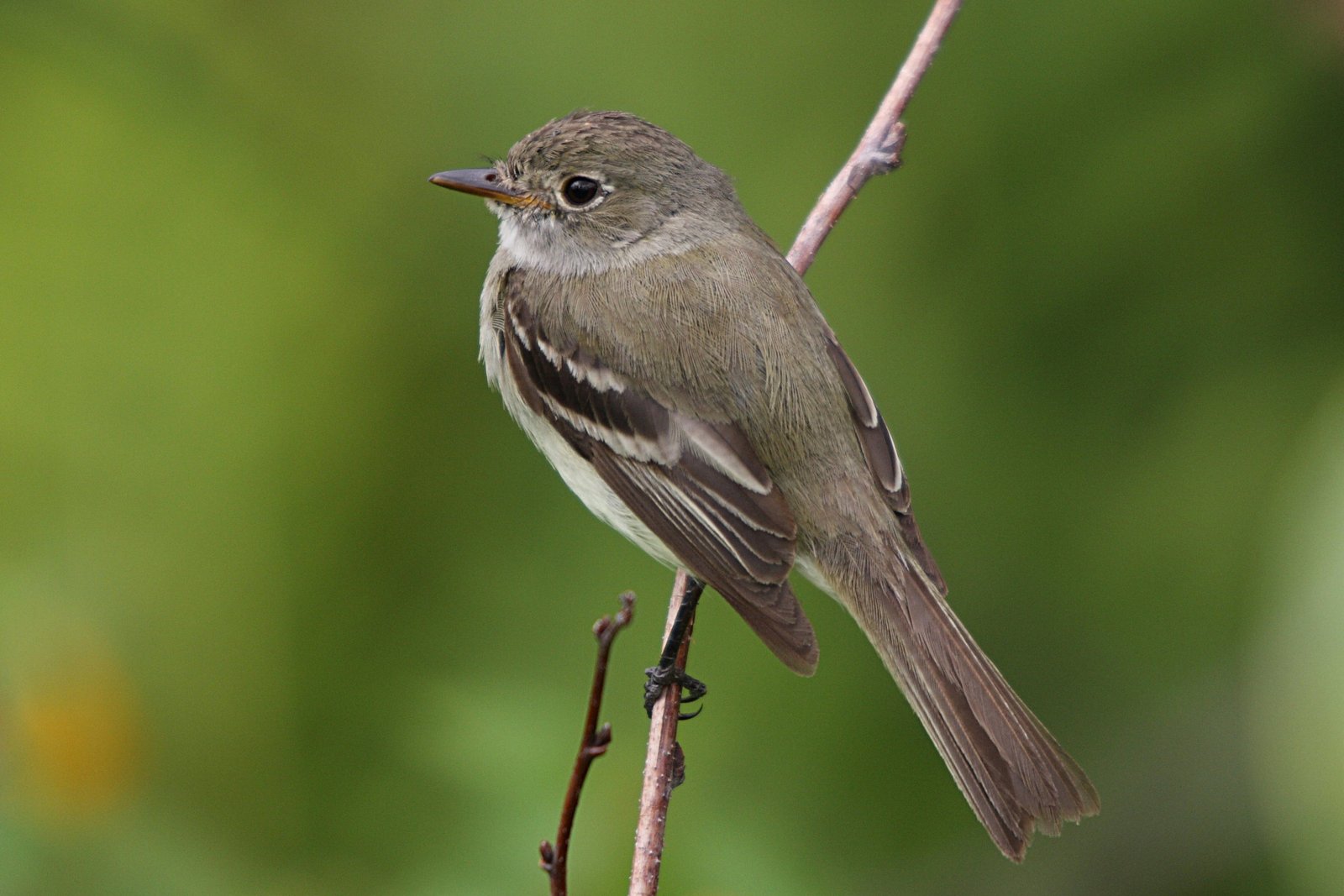
The Alder Flycatcher is an Empidonax that breeds in northern North America and winters in South America. In the guide area it occurs only as a passage migrant, in spring and autumn. In the field it is practically indistinguishable from Willow Flycatcher except by song and call.
Voice
The call is a dry pip or kep. The song, sometimes heard during spring migration, is a hoarse three-part free-BEE-o.
Recording: Benjamin Drillat — CC BY-NC-SA 4.0 · shortened to the first 60 s, mono · xeno-canto
Identification
14–15 cm. Upperparts olive-green to brownish olive, with a narrow, faint whitish eye-ring. Wings dark with two whitish to pale ochre wing bars and a fairly long primary projection. Throat white, breast washed greyish olive, belly pale yellow. Lower mandible entirely pale. Male and female are alike.
Confusion species
Willow Flycatcher Empidonax traillii is on average slightly browner, with a weaker eye-ring, but the two can only be reliably separated by voice. Acadian Flycatcher Empidonax virescens is greener, with a longer bill and a clearer eye-ring. White-throated Flycatcher Empidonax albigularis (resident) is smaller and browner, with cinnamon wing bars. Least Flycatcher Empidonax minimus is smaller and greyer, with a conspicuous eye-ring.
Habitat
On migration in scrub, forest edges, second growth, rank vegetation along water and pastures with shrubs, both in the lowlands and in hill country.
Where the bird is most at home, classified by the vegetation units of Mexico and Central America.




Range and movements
Migrates south through eastern Mexico and Central America. Outside the guide area it breeds in Alaska, Canada and the north-eastern United States and winters in western South America.
- Passage (Mar–Apr, Oct–Nov)
- dark = core range, pale = thinly spread
How and when to look
Migrants are often silent; only calling or singing birds can be identified with certainty.
Conservation status
Not threatened. Common across its large breeding range.
Scientific name
Empidonax alnorum | Brewster, 1895
Brewster described the species in 1895 and placed it straight away in the genus where it still stands. The genus Empidonax was introduced in 1855 by Cabanis. Empidonax is Greek, from empis 'gnat' and anax 'master': 'gnat-king', after its insect hunting. alnorum is Latin for 'of the alders' (alnus 'alder'), after the alder thickets where it breeds. The specimen the first description was based on came from Upton, Maine.