All species › Passerines › Vireos › Yellow-throated Vireo
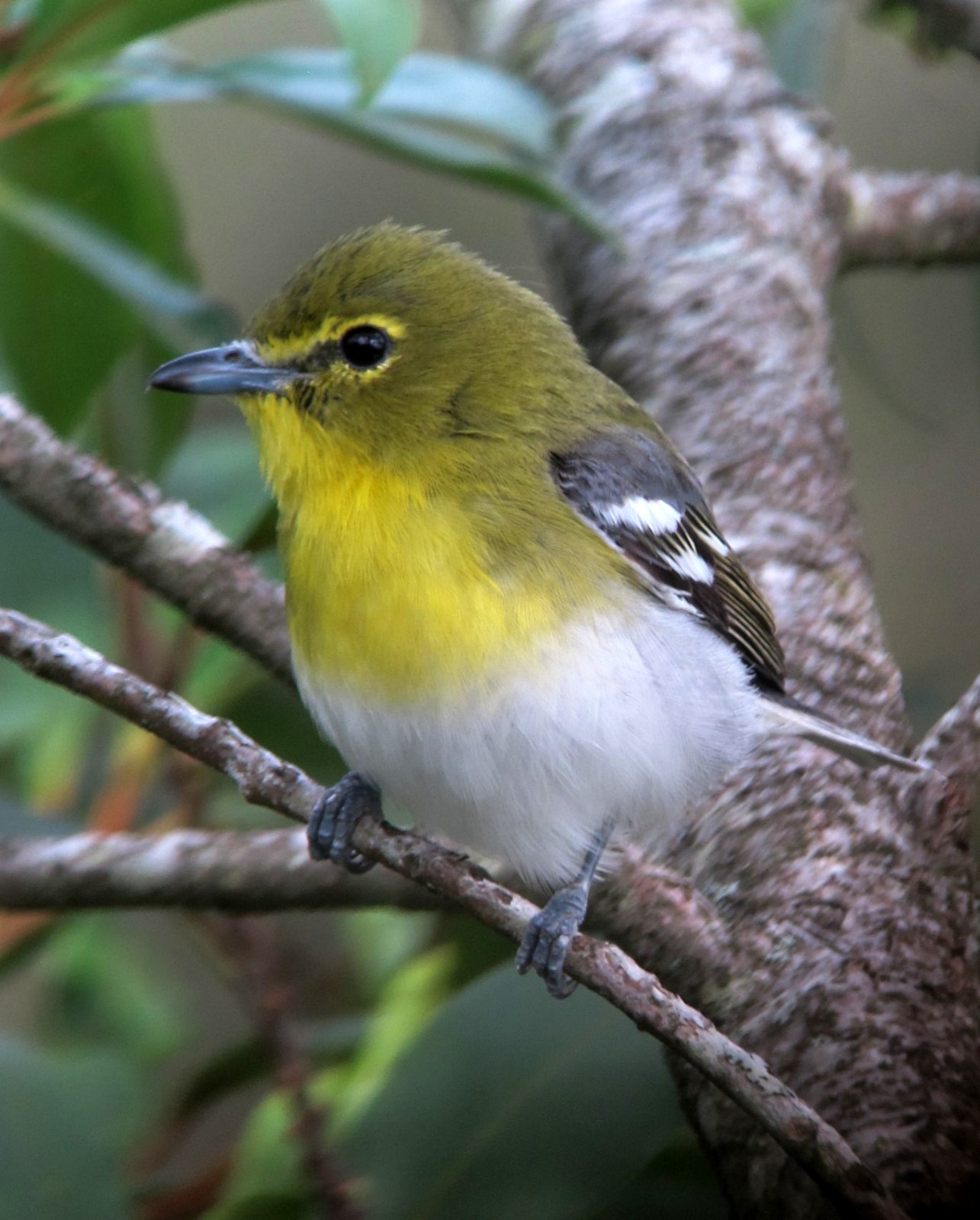
Yellow-throated Vireo | Vireo flavifrons
Geelborstvireo | Vireo gorjiamarillo
The Yellow-throated Vireo is a stocky, contrasting vireo of the deciduous forests of eastern North America. It winters from Mexico to northern South America and in small numbers in the north-western Antilles. In the Caribbean it is an unobtrusive canopy bird that often travels with mixed flocks of warblers.
Voice
In winter mainly a hoarse, rattling scold. The song, sometimes given in spring before departure, consists of slow, burry phrases of two or three notes separated by long pauses, such as ee-yoo... ee-ay.
Recording: Scott Gravette — CC BY-NC-SA 4.0 · converted to mono · xeno-canto
Identification
13–15 cm, sturdily built, with a thick bill. Head and back are olive-green, the rump grey. Throat and breast are bright lemon-yellow and sharply demarcated from the white belly. Yellow spectacles, formed by an eye-ring and a line to the bill, are distinctive. The wings are dark with two broad white wing bars. The iris is dark, the legs blue-grey. The sexes are alike.
Confusion species
Pine Warbler Setophaga pinus has a thinner bill, faint streaks on the breast sides and no clear spectacles. Yellow-throated Warbler Setophaga dominica also has a yellow throat, but a black-and-white face pattern and a grey back. White-eyed Vireo Vireo griseus also shows yellow spectacles and white wing bars, but has a white throat and, in adults, a white iris.
Habitat
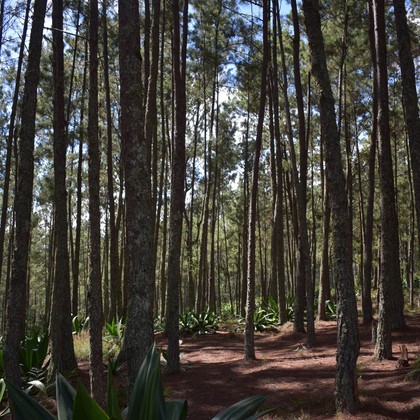
In winter the canopy of dry and moist forest, coastal woodland, forest edge, pine forest and gardens and parks with tall trees; occasionally mangrove. It searches branches and leaves slowly and thoroughly for insects and spiders, and in winter also eats fruit, including that of gumbo-limbo. It often joins mixed flocks of migrants.
Where the bird is most at home, classified by the vegetation types of the Caribbean.




Range and movements
A scarce winter visitor to Cuba, the Bahamas and the Cayman Islands, mostly from September to April. Rarer in Puerto Rico, Hispaniola, Jamaica, the Virgin Islands, the Turks and Caicos Islands and San Andrés; only occasional in the Lesser Antilles, the ABC Islands and Trinidad and Tobago. Breeds in the eastern United States and southern Canada and winters from Mexico through Central America to northern Colombia and Venezuela.
- Resident
- Summer visitor (c. Oct–Mar)
- Winter visitor (c. Apr–Sep)
- Passage (Mar–Apr, Oct–Nov)
- dark = core range, pale = thinly spread
How and when to look
Best looked for in winter in Cuba and on Grand Cayman, in woodland and parks where mixed warbler flocks forage. It moves more slowly than the warblers around it; the yellow breast sharply cut off from the white belly and the yellow spectacles are visible from below as well.
Conservation status
Not threatened. The breeding population is large and appears stable.
Scientific name
Vireo flavifrons | Vieillot, 1808
Vieillot described the species in 1808 and placed it straight away in the genus where it still stands. He introduced the genus Vireo in that same work. Vireo was used by Latin authors for a small, green, migratory bird, probably the Eurasian golden oriole, though the European greenfinch has also been suggested. flavifrons is Latin, from flavus 'yellow' and frons 'forehead', after the yellow forehead and throat. The specimen the first description was based on came from eastern United States.