All species › Passerines › Ovenbirds and woodcreepers › Yellow-chinned Spinetail
Yellow-chinned Spinetail | Certhiaxis cinnamomeus
Geelkinstekelstaart | Curutié colorado
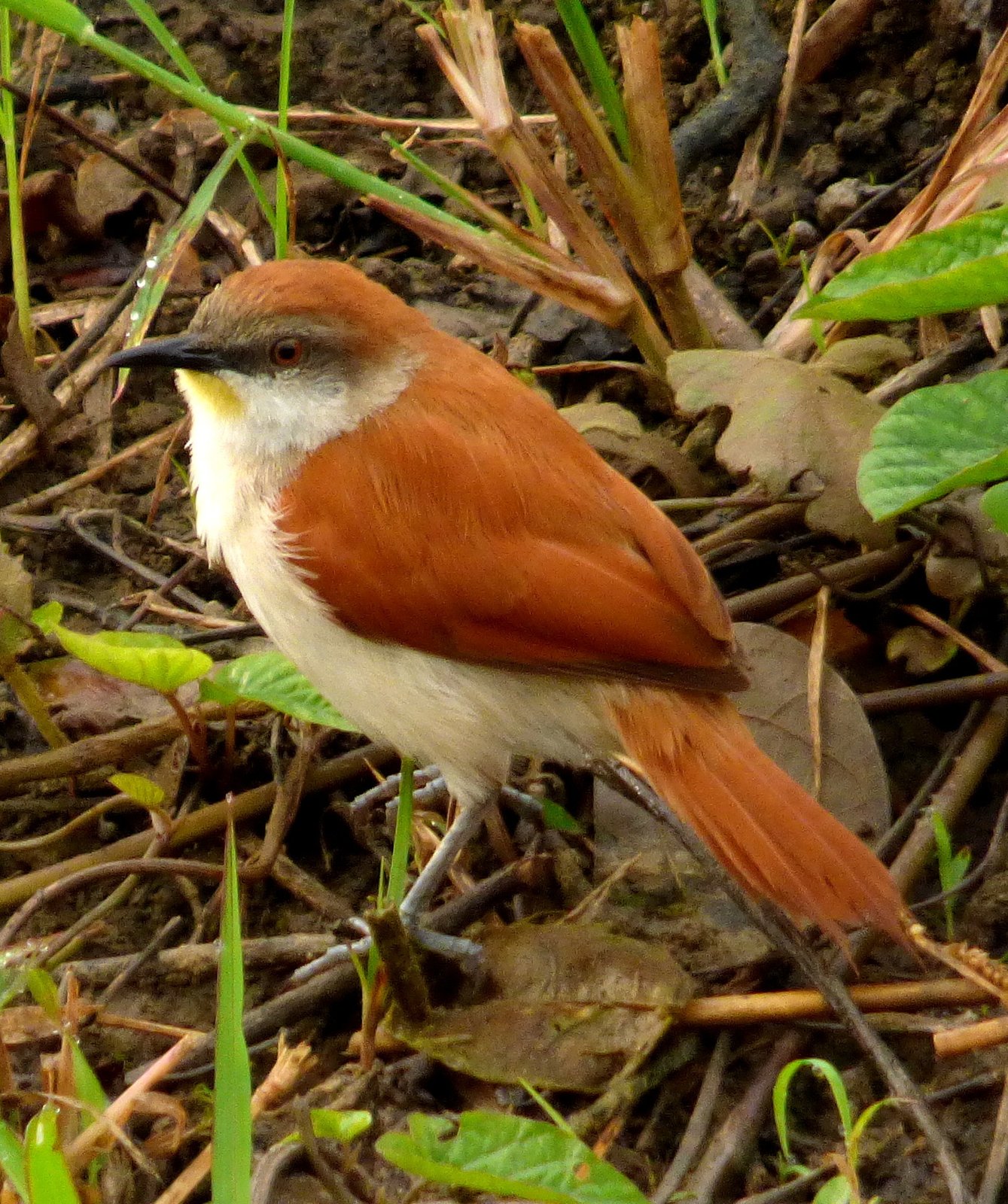
The Yellow-chinned Spinetail is the spinetail of Trinidad's freshwater marshes. Unlike most of its relatives it is not shy: it clambers openly through reeds, grass and shrubs above the water and calls frequently. Its large, globular stick nest is visible from afar in marshes and rice fields.
Voice
A loud, rattling trill that drops in pitch and fades, often given as a duet by the pair, and short, rasping contact calls. Also a rapidly repeated, dry chek.
Recording: JAYRSON ARAUJO DE OLIVEIRA — CC BY-NC-SA 4.0 · shortened to the first 60 s, mono · xeno-canto
Identification
13–16 cm, slender, with a long, graduated tail with spiny feather tips. Crown, back, wings and tail are bright rufous. Lores and eyestripe are dark, the supercilium white. The throat is white with a small, pale yellow chin patch visible only at close range; the rest of the underparts are white to dull buff, slightly warmer on the flanks. The bill is thin and straight, the eye yellowish to orange-brown. The sexes are alike.
Confusion species
Pale-breasted Spinetail Synallaxis albescens has an olive-brown back, rufous only on the crown and bend of the wing, a dark throat patch and a grey-brown tail, and lives in dry grassland, not marsh. Stripe-breasted Spinetail Synallaxis cinnamomea has a black-and-white streaked throat and streaked, dark underparts, and lives in forest.
Habitat
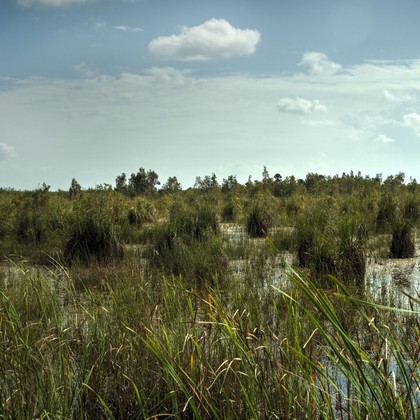
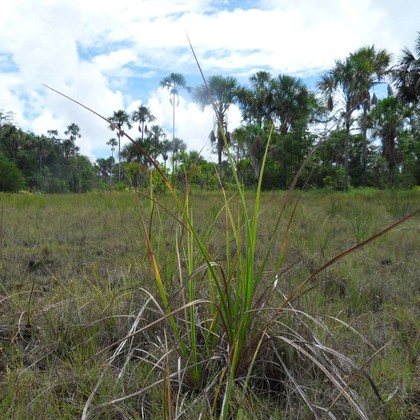
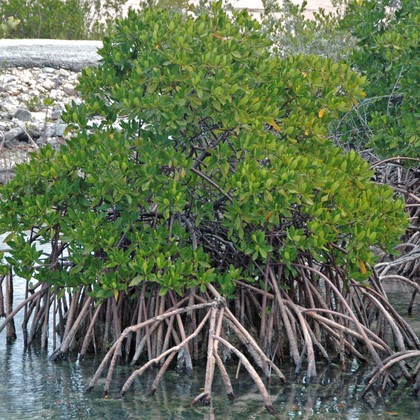
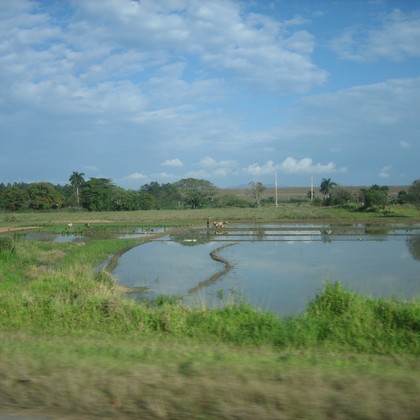
Freshwater marshes with reeds, sedges and scrub, seasonally flooded savanna, mangrove edges, ditches and rice fields, in the lowlands. It lives in pairs and forages in vegetation low above the water for insects and other small invertebrates. The nest is a large ball of twigs low in a shrub, mangrove sapling or marsh vegetation, with a tubular entrance. Spinetail nests are parasitised by Striped Cuckoo Tapera naevia.
Where the bird is most at home, classified by the vegetation types of the Caribbean.
Range and movements
In the region only on Trinidad, where it is common in lowland marshes and rice fields, including the Caroni marshes and Nariva; it is absent from Tobago. Outside the region in tropical South America, from Colombia, Venezuela and the Guianas along the major rivers through Brazil to Paraguay, Uruguay and northern Argentina.
- Resident
- dark = core range, pale = thinly spread
How and when to look
Found along the edges of freshwater marshes and rice fields on Trinidad, such as at Caroni and Nariva. A nest with its tubular entrance reveals the presence of a pair; the birds are most active in the early morning.
Conservation status
Not threatened. Common in its habitat; the loss of freshwater marshes through drainage and development is a local threat.
Scientific name
Certhiaxis cinnamomeus | (Gmelin, 1788)
Gmelin described the species in 1788 as Certhia cinnamomea; because it was later moved to another genus, the author and year stand in brackets. The genus Certhiaxis was introduced in 1844 by Lesson. Certhiaxis is a blend of the genus names Certhia (treecreepers) and Synallaxis (spinetails). cinnamomeus is Latin for 'cinnamon-coloured', after the rufous upperparts. The specimen the first description was based on came from Cayenne, French Guiana (designated).