All species › Passerines › New World blackbirds › Yellow-breasted Chat
Yellow-breasted Chat | Icteria virens
Geelborstzanger | Buscabreña
The Yellow-breasted Chat is a large, thick-billed songbird of dense thickets in North America that was long placed with the wood-warblers. Its position has always been uncertain; it is now usually given a family of its own (Icteriidae), related to the blackbirds and orioles, with which this guide groups it. In the Caribbean it is a rare winter visitor to the northwest.
Voice
In winter mainly a harsh, dry chak and a nasal kyew from dense cover. The song, an irregular series of whistles, clucks, rasping notes and mimicry separated by long pauses, is rarely heard in the region.
Recording: Mario Reyes Jr — CC BY-NC-SA 4.0 · shortened to the first 60 s, mono · xeno-canto
Identification
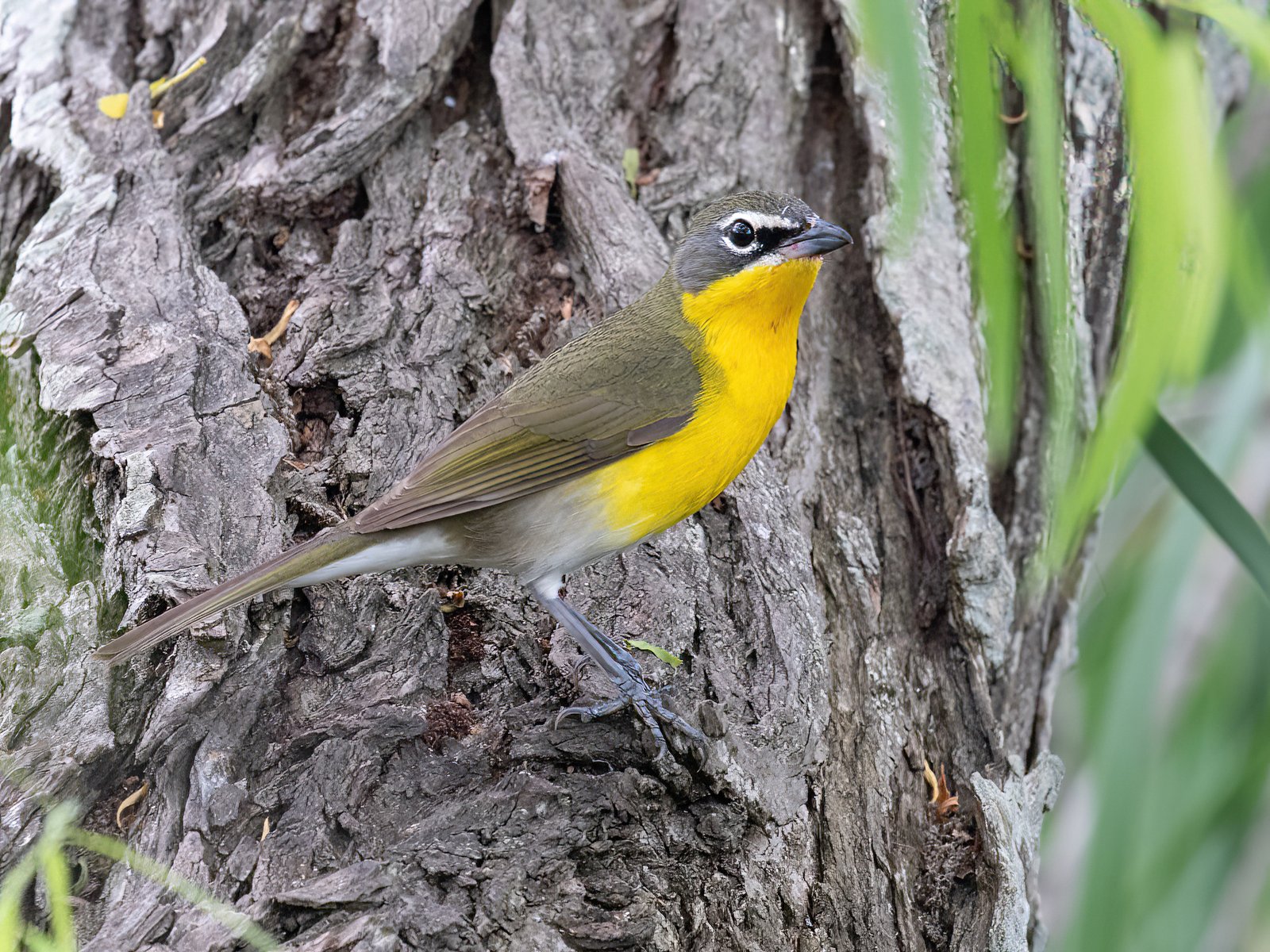
17–19 cm, much larger and heavier than a wood-warbler, with a long tail and a thick, curved black bill. The upperparts are plain olive-green, the throat and breast bright yellow, the belly and undertail white. White spectacles, formed by a supercilium above the eye and a crescent below it, reach the bill; below them a narrow white moustache borders grey to blackish lores. The legs are dark grey. The sexes are similar; females have greyer lores and a slightly duller breast. First-year birds are duller, with a paler bill base.
Confusion species
Common Yellowthroat Geothlypis trichas and Bahama Yellowthroat Geothlypis rostrata are much smaller, with a thin bill, yellow undertail and no white spectacles. Mourning Warbler Geothlypis philadelphia has a grey head and wholly yellow underparts. Yellow-throated Vireo Vireo flavifrons also has a yellow throat and breast, but shows two white wing bars, a grey rump and a shorter tail, and stays higher in the trees.
Habitat
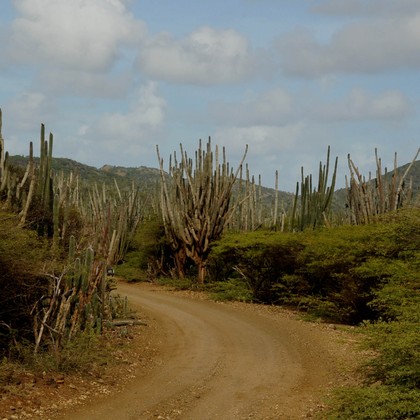
Dense, low growth: coastal scrub, thorn scrub, overgrown field edges and the understorey of open woodland and forest edges. It keeps hidden and moves slowly through the thicket, feeding on insects and, especially in winter, berries and fruit.
Where the bird is most at home, classified by the vegetation types of the Caribbean.



Range and movements
A rare winter visitor to the Bahamas and Cuba, slightly more regular in the Cayman Islands; a vagrant to Jamaica and not recorded elsewhere in the region. It breeds from southern Canada through the United States to northern Mexico and winters mainly in Mexico and Central America.
- Resident
- dark = core range, pale = thinly spread
How and when to look
From November to March in dense scrub in the Bahamas, western Cuba or the Cayman Islands. The bird rarely shows itself and is usually detected by its harsh call; waiting patiently at the edge of a thicket with fruiting shrubs gives the best chance.
Conservation status
Not threatened. The species is widespread in North America, although numbers are falling locally as overgrown land reverts to forest or is cleared. In the Caribbean only a handful of birds are found each year.
Scientific name
Icteria virens | (Linnaeus, 1758)
Linnaeus described the species in 1758 as Turdus virens; because it was later moved to another genus, the author and year stand in brackets. The genus Icteria was introduced in 1808 by Vieillot. Icteria derives from Greek ikteros 'jaundice', also the name of a yellow bird, after the bright yellow breast. virens is Latin for 'green', after the olive-green upperparts. The specimen the first description was based on came from inland South Carolina.