All species › Woodpeckers and allies › Woodpeckers › Yellow-bellied Sapsucker
Yellow-bellied Sapsucker | Sphyrapicus varius
Geelbuiksapspecht | Chupasavia maculado
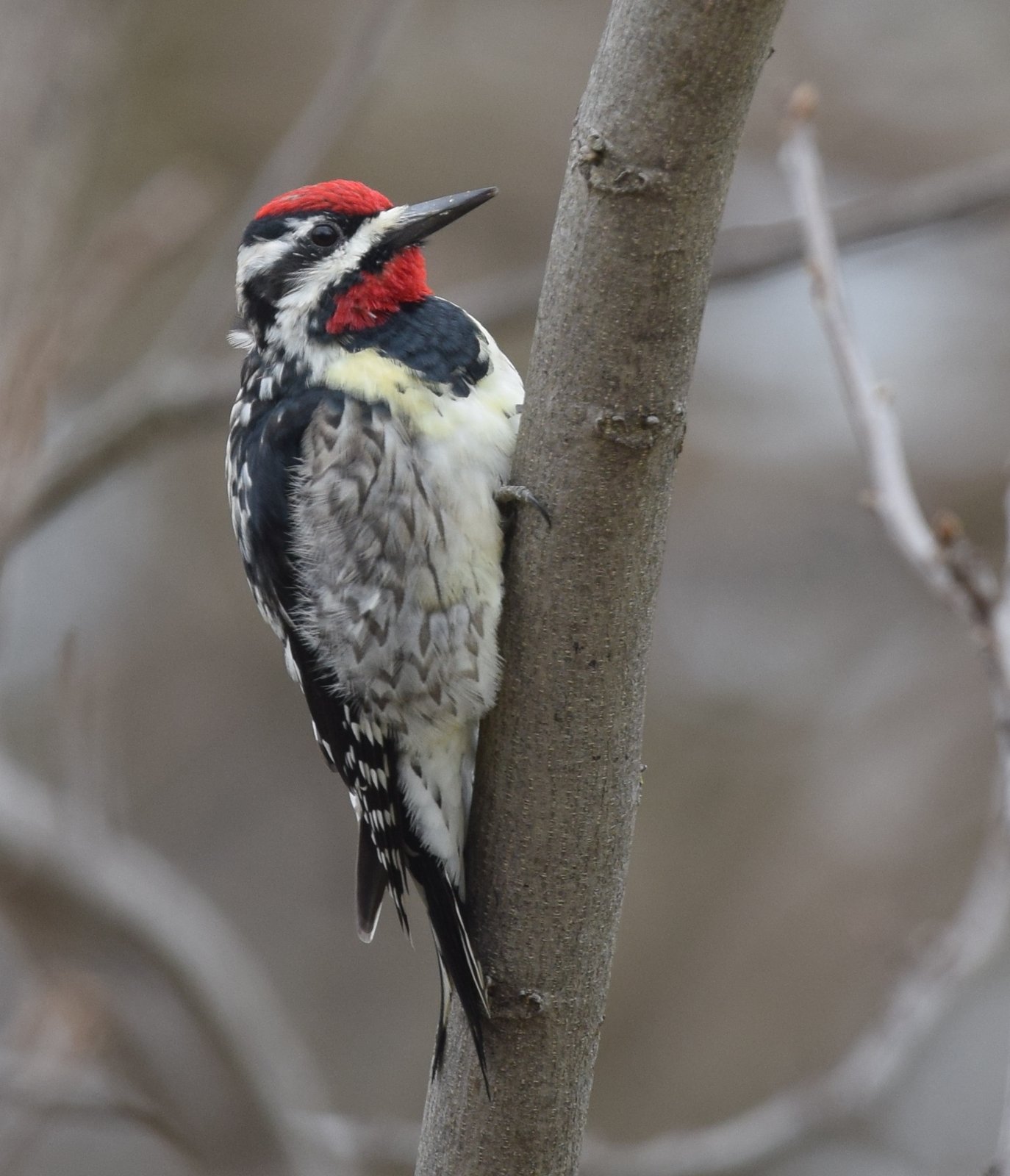
The Yellow-bellied Sapsucker is the only woodpecker that regularly winters in the Caribbean as a migrant from North America. It drills rows of small holes, known as sap wells, in the bark of living trees and returns to them repeatedly to lick up the flowing sap and the insects attracted to it. Other birds, such as hummingbirds and warblers, also use these wells.
Voice
Mostly silent in winter. Occasionally a soft, nasal, mewing neeah. The drum has an irregular rhythm, a fast opening followed by a few separate taps, but is seldom heard in the region.
Recording: Bobby Wilcox — CC BY-NC-SA 4.0 · shortened to the first 60 s, mono · xeno-canto
Identification
19–21 cm, a small, slim woodpecker. In all plumages a long white wing stripe along the coverts is distinctive, visible even on perched birds. Adults have a red crown, a black-and-white head pattern with a white line from the bill to the neck, and a black breast band. The male has a red throat, the female a white one. The back is black with white or buff spotting and barring, the underparts pale yellowish with dark marks on the flanks; the rump is white. First-winter birds, the commonest age in the region in winter, are largely brownish with a faint head pattern and a scaly breast; they moult gradually into adult plumage over the winter.
Confusion species
The white wing stripe separates it from every other woodpecker in the region. Hairy Woodpecker Leuconotopicus villosus of the Bahamas has a white centre to the back and no wing stripe. West Indian Woodpecker Melanerpes superciliaris is larger, with a finely black-and-white barred back and no wing stripe. The endemic woodpeckers of Hispaniola and Puerto Rico are larger and differently coloured.
Habitat
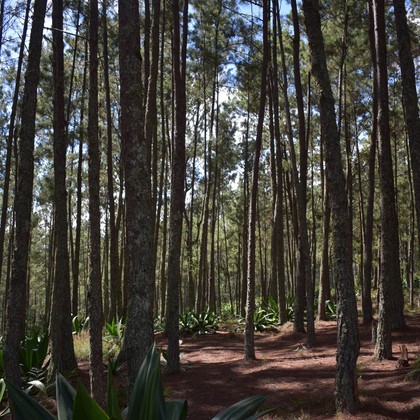
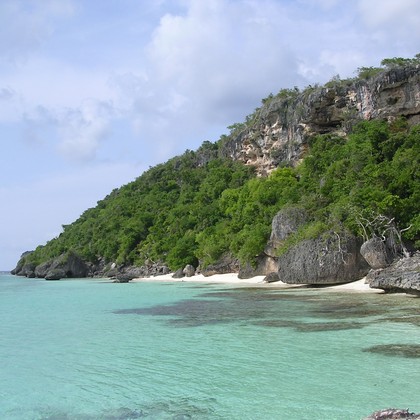
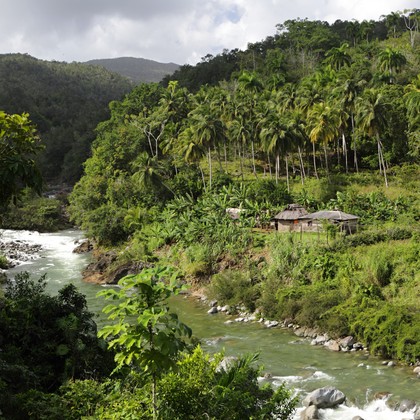
Forest of many kinds, forest edges, pine forest, coastal woodland, citrus and other fruit plantations, parks and gardens with trees, from the lowlands into the mountains. It takes sap and insects from its wells and also eats fruit and berries. In winter it is solitary and holds a particular tree or group of trees with sap wells.
Where the bird is most at home, classified by the vegetation types of the Caribbean.



Range and movements
In winter in the Bahamas, the Turks and Caicos Islands, Cuba, the Cayman Islands, Jamaica, Hispaniola (Haiti and the Dominican Republic) and San Andrés; scarce on Puerto Rico and rare in the Virgin Islands. A very rare vagrant to the Lesser Antilles and the ABC Islands. Breeds in Canada and the north-eastern United States and winters from the south-eastern United States to Central America.
- Winter visitor (c. Apr–Sep)
- Passage (Mar–Apr, Oct–Nov)
- dark = core range, pale = thinly spread
How and when to look
Best looked for in winter on Cuba, the Bahamas and the Cayman Islands. Fresh rows of small holes in bark betray its presence; a tree with wet sap wells is visited again and again by the same bird. Brownish first-winter birds are identified by the white wing stripe.
Conservation status
Not threatened. The species is common in North America and its breeding range has expanded in recent decades.
Scientific name
Sphyrapicus varius | (Linnaeus, 1766)
Linnaeus described the species in 1766 as Picus varius; because it was later moved to another genus, the author and year stand in brackets. The genus Sphyrapicus was introduced in 1858 by Baird. Sphyrapicus combines Greek sphura 'hammer' with Picus 'woodpecker': 'hammer woodpecker'. varius is Latin for 'variegated', after the mottled black-and-white plumage. The specimen the first description was based on came from South Carolina.