All species › Woodpeckers and allies › Woodpeckers › Cuban Green Woodpecker
Cuban Green Woodpecker | Xiphidiopicus percussus
Cubaanse groene specht | Carpintero verde
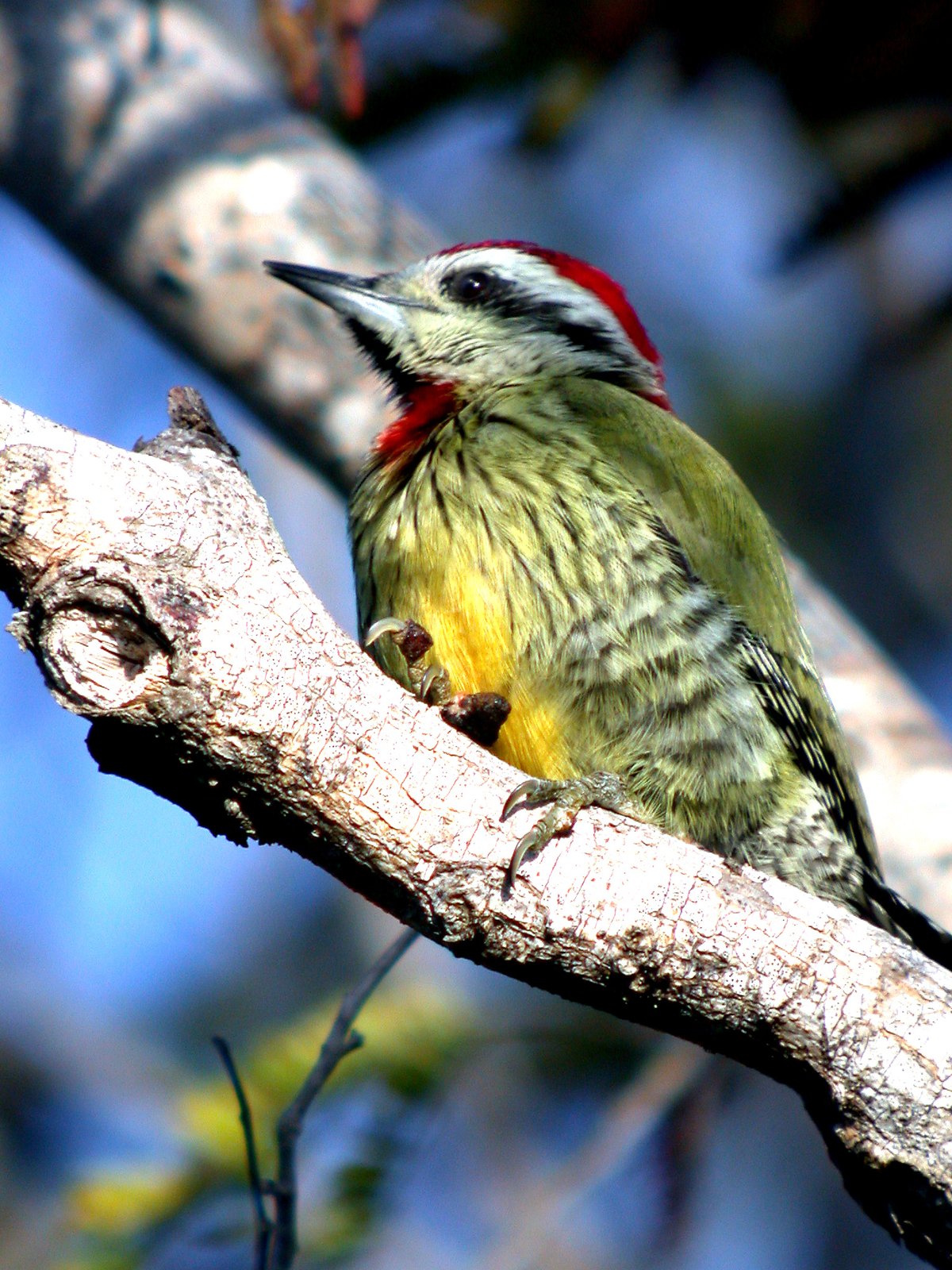
The Cuban Green Woodpecker is the only species in its genus Xiphidiopicus and is found only on Cuba. It is the island's commonest woodpecker and occurs almost anywhere there are trees, from mangroves to pine forest. In Cuba it is called carpintero verde.
Voice
A short, harsh jhorr, jhorr, jhorr and a higher yeh-yeh-yeh. It also drums.
Recording: Nils Navarro — CC BY-NC-SA 4.0 · shortened to the first 60 s, mono · xeno-canto
Identification
21–25 cm, medium-sized, with a fairly long tail. The upperparts are olive-green. The face is white with a black stripe behind the eye; the chin is black. A red patch sits in the centre of the throat and upper breast. The rest of the underparts are yellowish with dark streaks. The male has a red crown and nape; the female has a black crown streaked white and only a red nape. Juveniles are duller, with less red.
Confusion species
No other woodpecker in Cuba is green. West Indian Woodpecker Melanerpes superciliaris is larger, with a black-and-white barred back and a pale buff face. Fernandina's Flicker Colaptes fernandinae and Northern Flicker Colaptes auratus are larger, barred brown and black, and often feed on the ground. Yellow-bellied Sapsucker Sphyrapicus varius, a winter visitor, has a white wing stripe.
Habitat
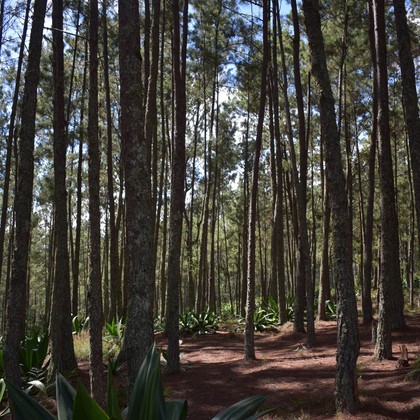
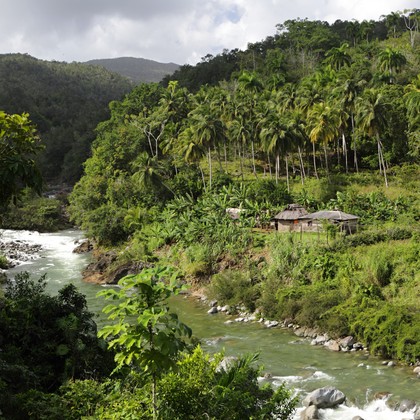
Almost all forest types in Cuba: dry and moist forest, pine forest, limestone forest, coastal woodland, mangroves, open country with palms and heavily degraded secondary forest, also wooded gardens. It searches trunks and branches for insects and their larvae and also eats fruit. The nest is a cavity in a living or dead tree, often 4–5 m up; breeding runs from February to August, peaking in May and June. The clutch is usually 3–4 eggs.
Where the bird is most at home, classified by the vegetation types of the Caribbean.





Range and movements
Only in Cuba: the nominate form on the main island and the larger cays, the subspecies Xiphidiopicus percussus insulaepinorum on the Isla de la Juventud. The species does not occur outside Cuba; records from the Bahamas refer to fossil remains.
- Resident
- dark = core range, pale = thinly spread
How and when to look
In almost any forest in Cuba, for example on the Zapata Peninsula and in the Sierra del Rosario, often in pairs. The harsh call and the red throat patch make it quick to identify.
Conservation status
Not threatened. The species is common and the population stable; it also occurs in degraded forest and farmland with trees.
Scientific name
Xiphidiopicus percussus | (Temminck, 1826)
Temminck described the species in 1826 as Picus percussus; because it was later moved to another genus, the author and year stand in brackets. The genus Xiphidiopicus was introduced in 1854 by Bonaparte. Xiphidiopicus combines Greek xiphidion 'small sword, dagger' with Picus 'woodpecker', presumably after the pointed bill. percussus is Latin for 'struck, beaten', from percutere, presumably after the hammering on wood. The specimen the first description was based on came from Cuba.