All species › Waders, gulls and terns › Sandpipers and snipes › Wilson's Snipe
Wilson's Snipe | Gallinago delicata
Amerikaanse watersnip | Agachadiza de Wilson
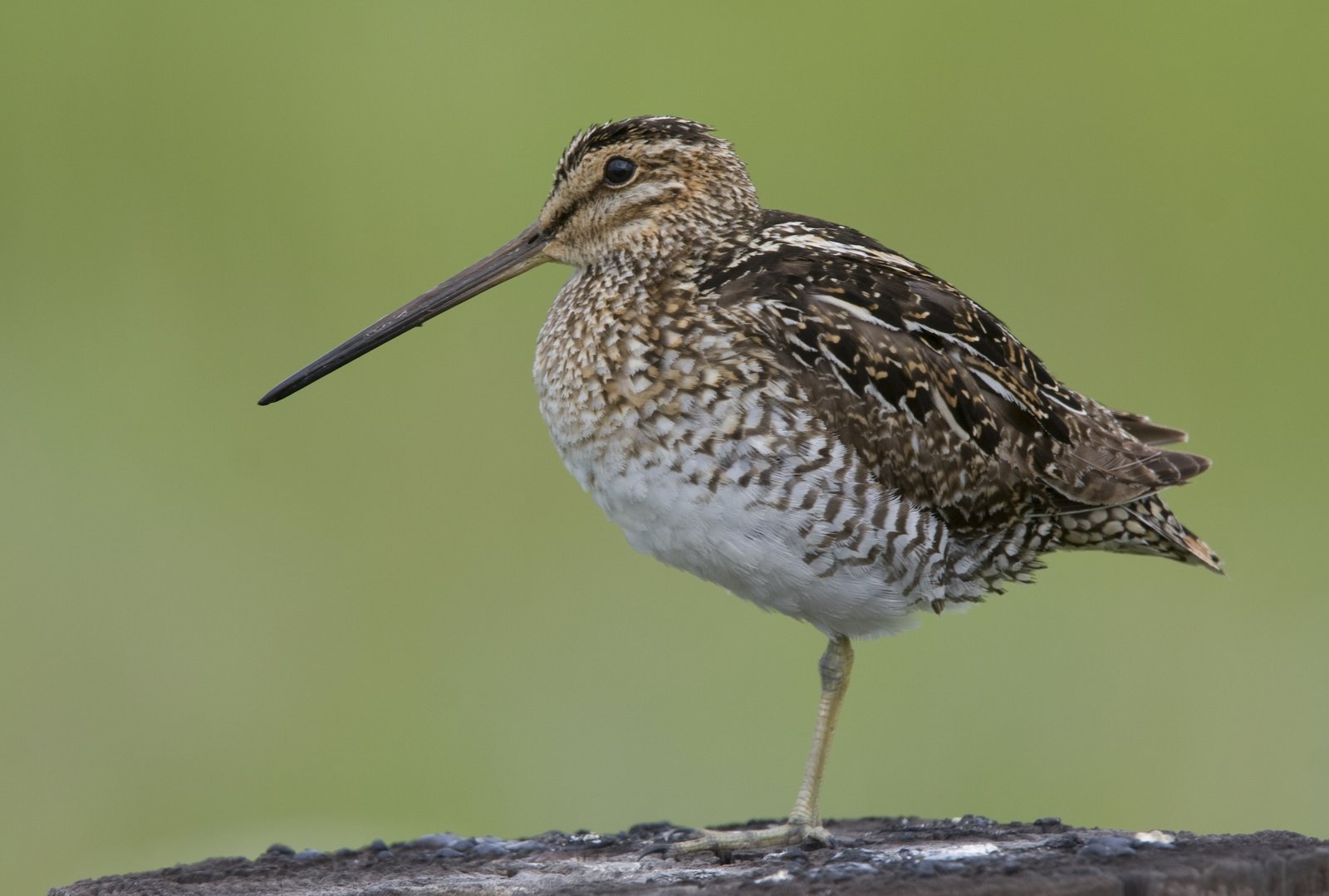
Wilson's Snipe is the North American counterpart of Common Snipe and is now treated as a separate species. In winter it lives hidden in wet grassland, marsh edges and rice fields, where it is usually first noticed when it flushes from underfoot with a hoarse call and flies off in a zigzag.
Voice
On flushing a hoarse, rasping skaip or kretch, often repeated. Display flights with the humming tail sound belong to the breeding grounds.
Recording: Dag Österlund — CC BY-NC-SA 4.0 · converted to mono · xeno-canto
Identification
23–28 cm. Stocky and short-legged, with a very long, straight bill. The head is striped, with a pale central crown stripe, dark lateral crown stripes and a dark eye-stripe. The back is dark brown with distinctive pale longitudinal stripes, the breast spotted brown, the flanks barred black and white and the belly white. The short tail has an orange-brown band. In flight a narrow white trailing edge to the secondaries and a densely barred underwing. The sexes are alike.
Confusion species
Pantanal Snipe Gallinago paraguaiae, on Trinidad, has a broader white trailing edge to the wing and more white in the outer tail feathers; away from Trinidad any snipe in the region is almost certainly Wilson's Snipe. The dowitchers Limnodromus have plainer grey or rufous plumage without a striped head, a white wedge up the back, and feed in open water.
Habitat
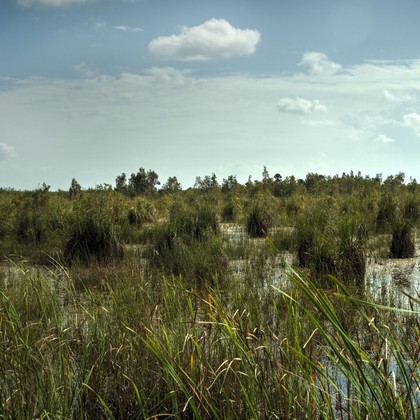
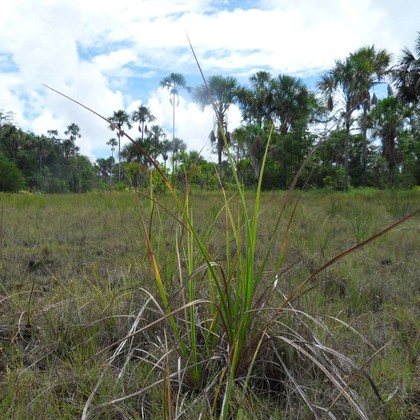
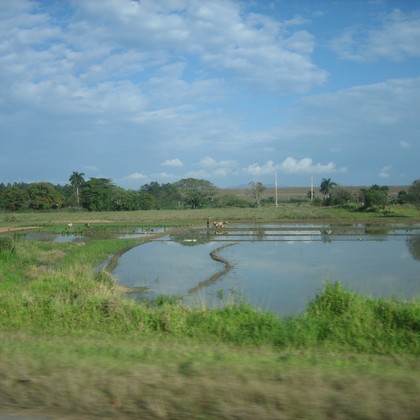
Wet grassland and pastures, the edges of freshwater marshes and ponds, rice fields, flooded savanna, ditches and stream banks with low vegetation and soft mud. It feeds by probing deep into the mud for worms and insect larvae. Often well hidden by day; most active at dusk.
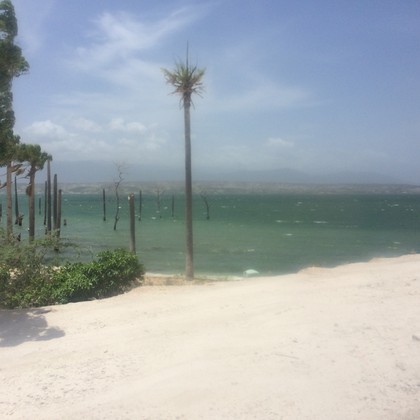
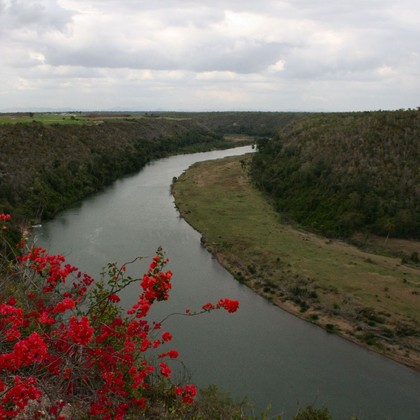
Where the bird is most at home, classified by the vegetation types of the Caribbean.

Range and movements
Winter visitor throughout the region, most frequent on Cuba, the Bahamas, the Cayman Islands, Jamaica, Hispaniola and Puerto Rico. Scarcer and locally irregular on the Virgin Islands, the Lesser Antilles, the ABC Islands, San Andrés and Trinidad and Tobago, depending on the amount of suitable wet ground. Outside the region it breeds in Alaska, Canada and the northern United States and winters from the United States to northern South America.
- Winter visitor (c. Apr–Sep)
- Passage (Mar–Apr, Oct–Nov)
- dark = core range, pale = thinly spread
How and when to look
Rice fields and wet pastures are the best places; walking slowly along the edge often flushes birds. When water levels are low after drought they may be seen in the open at the edge of muddy pools, especially at dusk.
Conservation status
Not threatened. The species is hunted in parts of the region. Loss of wet grassland through drainage affects the wintering range locally, but rice fields provide alternative habitat.
Scientific name
Gallinago delicata | (Ord, 1825)
Ord described the species in 1825 as Scolopax delicata; because it was later moved to another genus, the author and year stand in brackets. The genus Gallinago was introduced in 1760 by Brisson. Gallinago is New Latin for a snipe, from Latin gallina 'hen' and the suffix -ago 'resembling'. delicata is Latin for 'dainty, delicate'. The specimen the first description was based on came from Pennsylvania.