All species › Passerines › Tyrant flycatchers › White-throated Spadebill
White-throated Spadebill | Platyrinchus mystaceus
Witkeelbreedbektiran | Picochato goliblanco
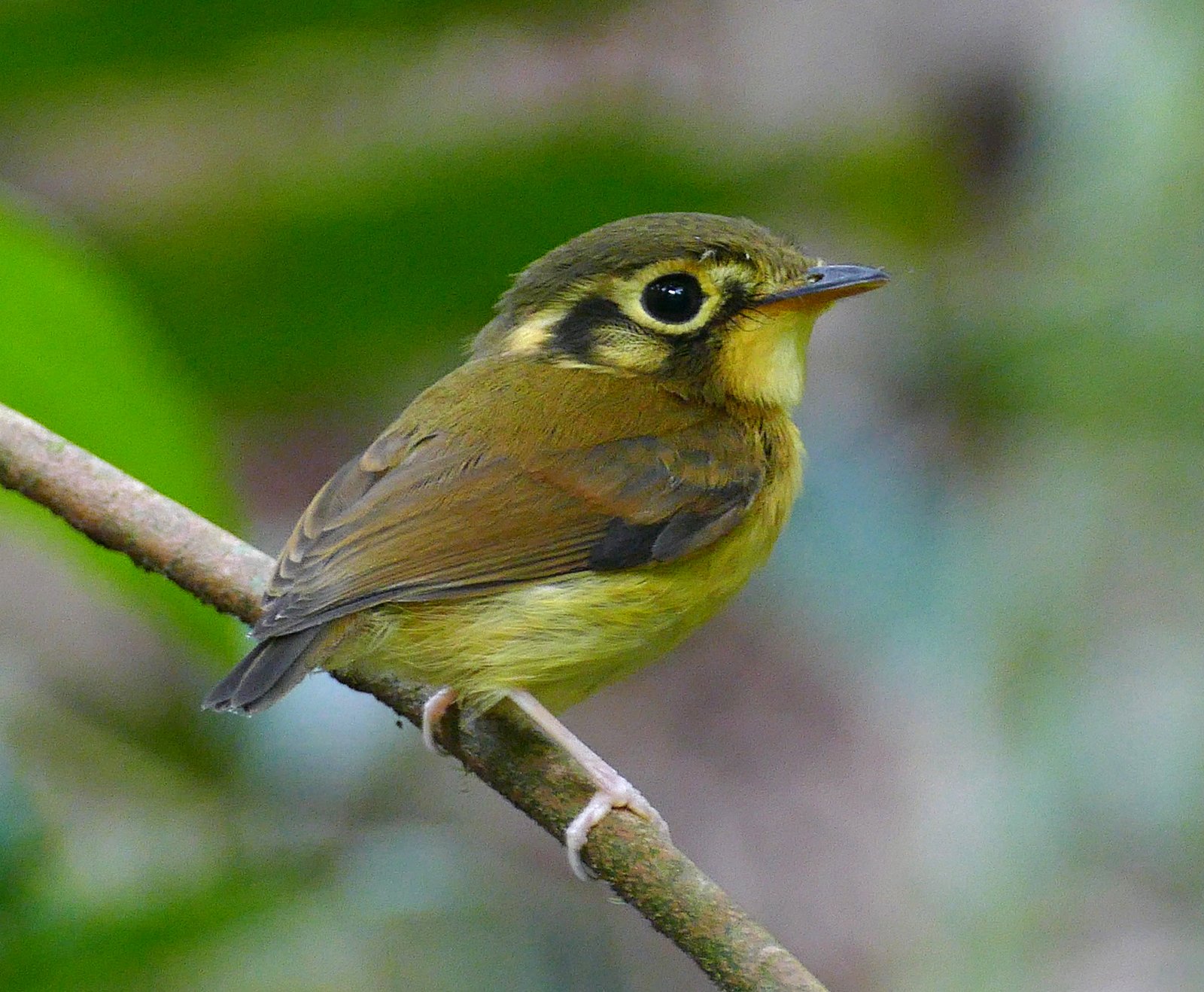
The White-throated Spadebill is one of the smallest tyrant flycatchers in the region: a compact bird with a large head, a stubby tail and a broad, flat bill. It lives hidden in the understorey of humid forest in Trinidad and Tobago and is usually first noticed by its call. The genus Platyrinchus, the spadebills proper, is represented in the region by this species alone.
Voice
The call is a short, sharp squeep, often repeated at intervals. The song is a high, thin, slightly descending trill.
Recording: Juan Freile — CC BY-NC-SA 4.0 · converted to mono · xeno-canto
Identification
9–11 cm. Upperparts olive-brown, the crown slightly darker; males have a largely concealed yellow crown patch, which is smaller or absent in females. The head has a distinctive pattern: pale yellowish lores and eye-ring, a dark line behind the eye and a dark crescent around the ear-coverts, with pale patches between them. The white throat contrasts with the buffy to ochre breast and flanks; the belly is paler. The bill is very broad and flat, dark above and pale below. The tail is short. Otherwise the sexes are alike.
Confusion species
Short-tailed Pygmy Tyrant Myiornis ecaudatus is even smaller, with a grey head, white spectacles and a narrow bill, and lives in the canopy rather than the understorey. Spotted Tody-Flycatcher Todirostrum maculatum has a long flat bill, a yellow iris and a black-streaked breast, and occurs in open, damp vegetation. Ochre-bellied Flycatcher Mionectes oleagineus is larger, with a narrow bill and no face pattern.
Habitat
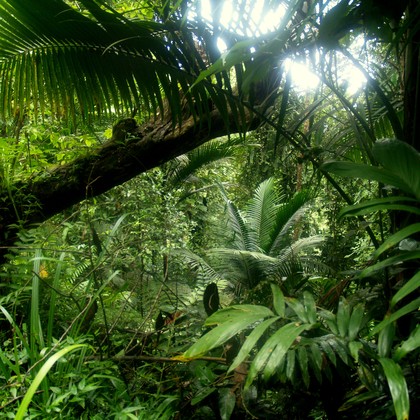
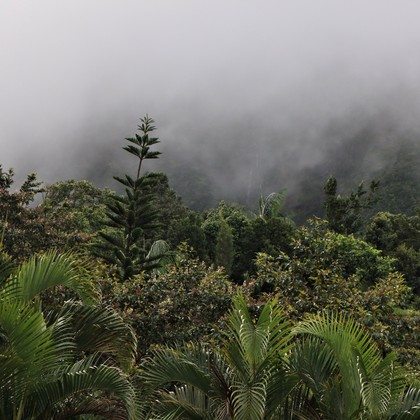
The shady understorey of humid and semi-evergreen forest, including older secondary forest; in Trinidad mainly in the hills and mountains, in Tobago in the forest of the Main Ridge. It sits still on a thin twig up to a few metres above the ground, then flies suddenly upwards to snatch an insect from the underside of a leaf before landing on a new perch.
Where the bird is most at home, classified by the vegetation types of the Caribbean.

Range and movements
Resident in Trinidad, mainly in the forested parts of the Northern Range, and in Tobago in the Main Ridge forest. Absent from the rest of the region. Outside the region from Costa Rica and Panama through the Andes and the coastal mountains of Venezuela to Bolivia, and in eastern Brazil, Paraguay and north-eastern Argentina.
- Resident
- dark = core range, pale = thinly spread
How and when to look
In Tobago known from the Gilpin Trace in the Main Ridge forest; in Trinidad in the forests of the Northern Range. The sharp call is the best clue; then search the understorey at eye level for a small, motionless bird with a pale face and a white throat.
Conservation status
Not threatened. The species has a large range in Central and South America. Being tied to the understorey of closed forest, it is sensitive to deforestation and the opening up of forest.
Scientific name
Platyrinchus mystaceus | Vieillot, 1818
Vieillot described the species in 1818 and placed it straight away in the genus where it still stands. The genus Platyrinchus was introduced in 1805 by Desmarest, A-G. Platyrinchus is Greek, from platus 'broad' and rhunkhos 'bill', after the strikingly broad, flat bill. mystaceus is Modern Latin for 'moustached', from Greek mustax 'moustache', after the dark cheek stripe; Azara called it 'Bigotillos'. The specimen the first description was based on came from San Ignacio Guazú, Paraguay.