All species › Pelicans, herons and ibises › Herons and bitterns › Western Cattle Egret
Western Cattle Egret | Ardea ibis
Koereiger | Garcilla bueyera
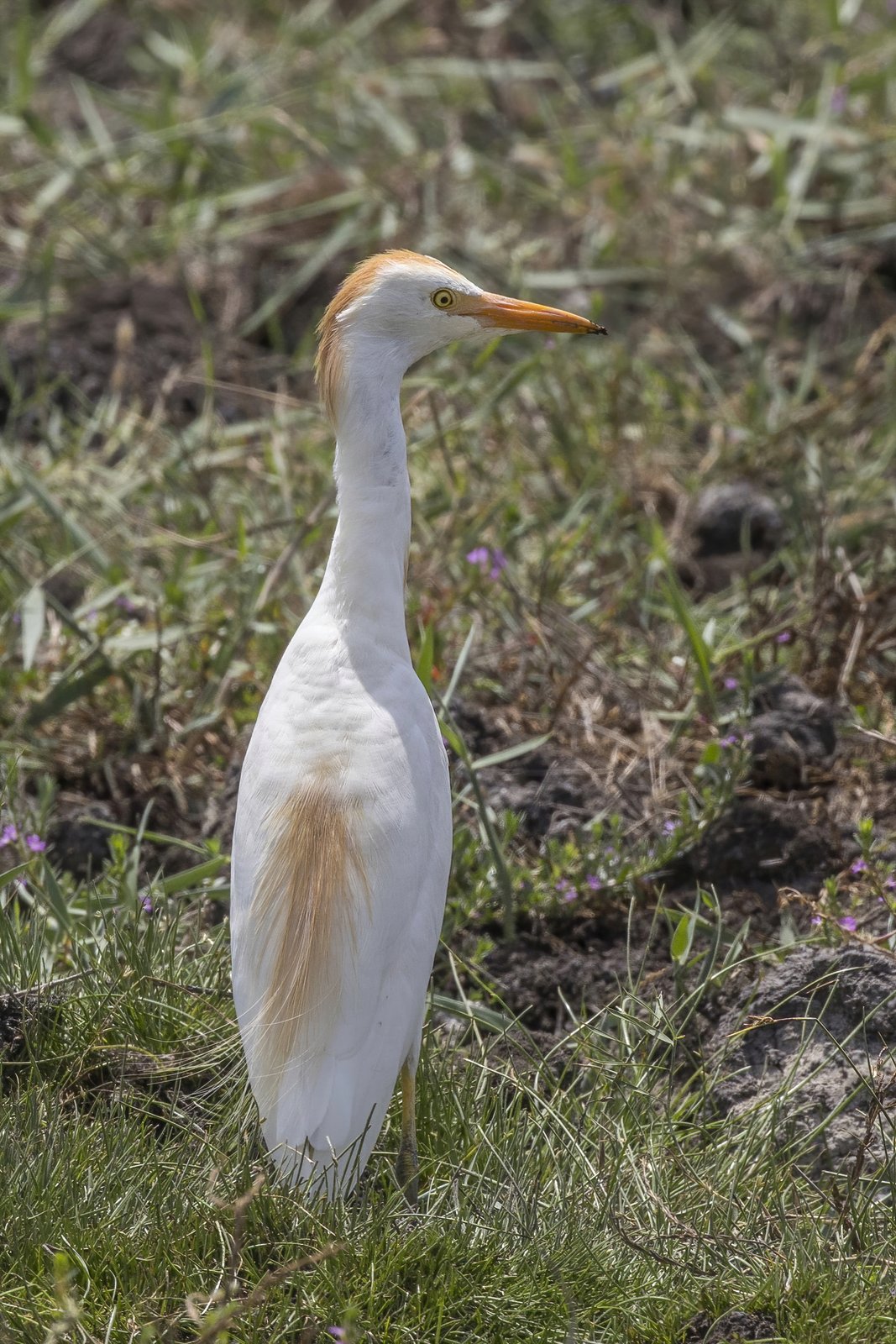
The Western Cattle Egret is a small, stocky white heron that feeds mainly on dry land, among grazing cattle, behind mowers and on lawns and verges. Originally a bird of Africa and southern Europe, it reached the Americas unaided: the first record dates from 1877 on the border of Guyana and Suriname, and by the 1950s it was already breeding in Cuba. It is now the most numerous heron on many islands.
Voice
Usually silent away from colonies. At breeding sites and roosts a dry, throaty rick-rack and other short croaks.
Recording: Paul Coiffard — CC BY-NC-SA 4.0 · converted to mono · xeno-canto
Identification
46–56 cm, stocky, with a short, thick neck, a rounded head with a feathered 'chin' below the bill and fairly short legs. Outside the breeding season all white, with a short, thick yellow bill and yellowish to dark legs. In breeding plumage the crown, breast and back have an orange-buff wash, and bill, lores and legs turn briefly reddish to orange. Juveniles are white with a dark bill that soon turns yellow. It flies with fast wingbeats and the neck withdrawn, often in lines to the roost in the evening.
Confusion species
Snowy Egret Egretta thula and Little Egret Egretta garzetta are slimmer and longer-necked, with a thin black bill and yellow feet. Young Little Blue Herons Egretta caerulea are white but slender, with a longer, greyish, dark-tipped bill. Great Egret Ardea alba is much larger, with a long neck and black legs.
Habitat
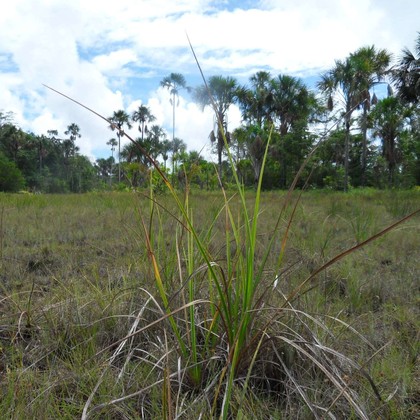
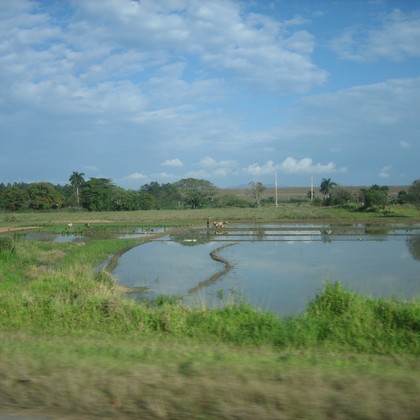
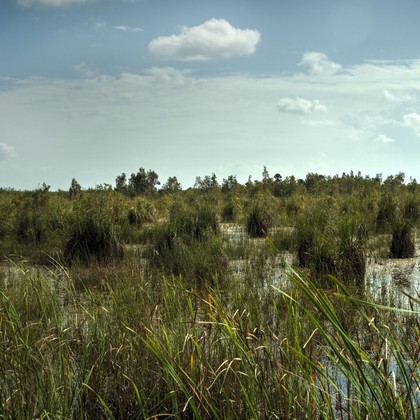
Pastures and smallholder farmland, savanna, cane fields and other crops, rice fields, roadsides, golf courses, playing fields, lawns and rubbish dumps; less often the edges of marshes and ponds. It eats mainly grasshoppers and other insects flushed by livestock or machinery, also frogs, lizards and ticks from cattle. It roosts and breeds in colonies, often with other herons, in mangroves, swamp forest or trees on islets; the nest is a platform of twigs.
Where the bird is most at home, classified by the vegetation types of the Caribbean.



Range and movements
Resident on almost all islands: the Bahamas, the Turks and Caicos Islands, Cuba, the Cayman Islands, Jamaica, Hispaniola (Haiti and the Dominican Republic), Puerto Rico, the Virgin Islands, the islands of the Lesser Antilles, the ABC Islands, San Andrés and Trinidad and Tobago. Birds move between islands and are also seen at sea. Outside the region in the Americas from southern Canada to Argentina, and in Africa, south-western Europe and the Middle East; Eastern Cattle Egret Ardea coromanda of Asia and Australia is treated as a separate species.
- Resident
- Summer visitor (c. Oct–Mar)
- Winter visitor (c. Apr–Sep)
- Passage (Mar–Apr, Oct–Nov)
- dark = core range, pale = thinly spread
How and when to look
Almost anywhere in the countryside near grazing cattle and behind tractors. Towards sunset flocks arrive in lines at communal roosts in mangroves or trees near water, where hundreds of birds may gather.
Conservation status
Not threatened. The species benefits from livestock farming and agriculture. Colonies near airports are locally a hazard to aviation.
Scientific name
Ardea ibis | Linnaeus, 1758 (GBIF: Bubulcus ibis)
Linnaeus described the species in 1758 and placed it straight away in the genus where it still stands. He introduced the genus Ardea in that same work. Ardea is the Latin word for 'heron'. ibis is a Latin and Greek word that originally referred to the sacred ibis and was applied to this egret in error. The specimen the first description was based on came from Egypt.