All species › Passerines › Finches › Violaceous Euphonia
Violaceous Euphonia | Euphonia violacea
Violette organist | Eufonia violácea
The Violaceous Euphonia is the most widespread euphonia of Trinidad and Tobago and a species of forest and plantations in eastern South America. It is known for its varied song, in which it imitates the sounds of other birds. That song is the reason it is trapped and kept as a cage bird.
Voice
A long, varied song of musical notes, squeaks, chatter and imitations of other birds. The call is a short, clear dee-dee.
Recording: JAYRSON ARAUJO DE OLIVEIRA — CC BY-NC-SA 4.0 · converted to mono · xeno-canto
Identification
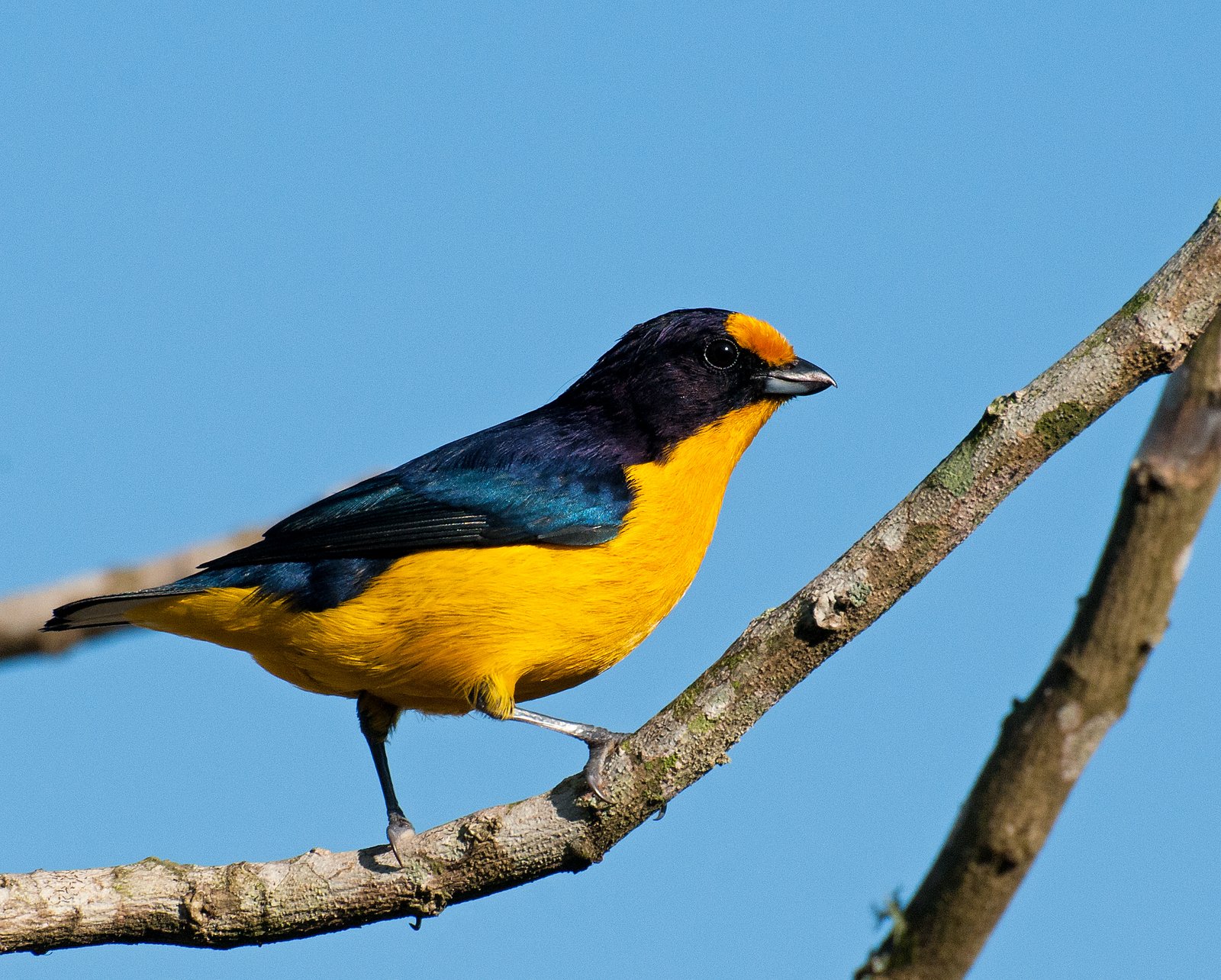
10–12 cm, compact, with a short tail and a short thick bill. The male is glossy blue-black above, with a deep golden-yellow forehead that does not extend behind the eye, and deep golden-yellow throat and underparts. Females and juveniles are olive-green above and greenish yellow below, without clear markings.
Confusion species
Male Trinidad Euphonia Euphonia trinitatis is smaller, with a blue-black throat and a yellow crown extending well behind the eye. The female of that species has a grey band down the breast and belly. Other euphonias are rare on Trinidad and Tobago.
Habitat
Moist forest, forest edges, second growth and cocoa and citrus plantations, also gardens with fruit trees. It feeds mainly on small fruits, especially mistletoe, epiphytic cacti and Cecropia, and only rarely on insects. It lives in pairs or small groups.
Where the bird is most at home, classified by the vegetation types of the Caribbean.






Range and movements
On Trinidad and Tobago a fairly common resident on both islands. Elsewhere in eastern Venezuela, the Guianas and eastern Brazil south to Paraguay and north-eastern Argentina.
- Resident
- dark = core range, pale = thinly spread
How and when to look
On Trinidad in the Northern Range, for example along the road from Arima to Blanchisseuse, and on Tobago in the Main Ridge forest. The male sings from a high, open perch; the varied song with its imitations is the best lead.
Conservation status
Not threatened. On Trinidad and Tobago trapping for the cage-bird trade locally reduces numbers; its relatively inaccessible forest habitat gives the species some protection.
Scientific name
Euphonia violacea | (Linnaeus, 1758)
Linnaeus described the species in 1758 as Fringilla violacea; because it was later moved to another genus, the author and year stand in brackets. The genus Euphonia was introduced in 1806 by Desmarest, A-G. Euphonia is Greek, from eu 'good' and phōnē 'sound': 'sweet-voiced', after the pleasing calls. violacea is Latin for 'violet-coloured', after the glossy violet-blue upperparts of the male. The specimen the first description was based on came from Suriname.