All species › Passerines › Finches › Trinidad Euphonia
Trinidad Euphonia | Euphonia trinitatis
Trinidadorganist | Eufonia de Trinidad
The Trinidad Euphonia is a small euphonia of dry forest and open wooded country in northern Colombia and Venezuela that, within the Caribbean, occurs only on Trinidad. There it is scarce and local, partly because euphonias are trapped for the cage-bird trade. It lives mainly on mistletoe berries.
Voice
Frequently heard: a high, plaintive pee-pee or tee-dee. The song is a short, jumbled mix of musical and scratchy notes.
Recording: Eduardo Freitez Gassán / Fernando Freitez Gassàn — CC BY-NC-SA 4.0 · converted to mono · xeno-canto
Identification
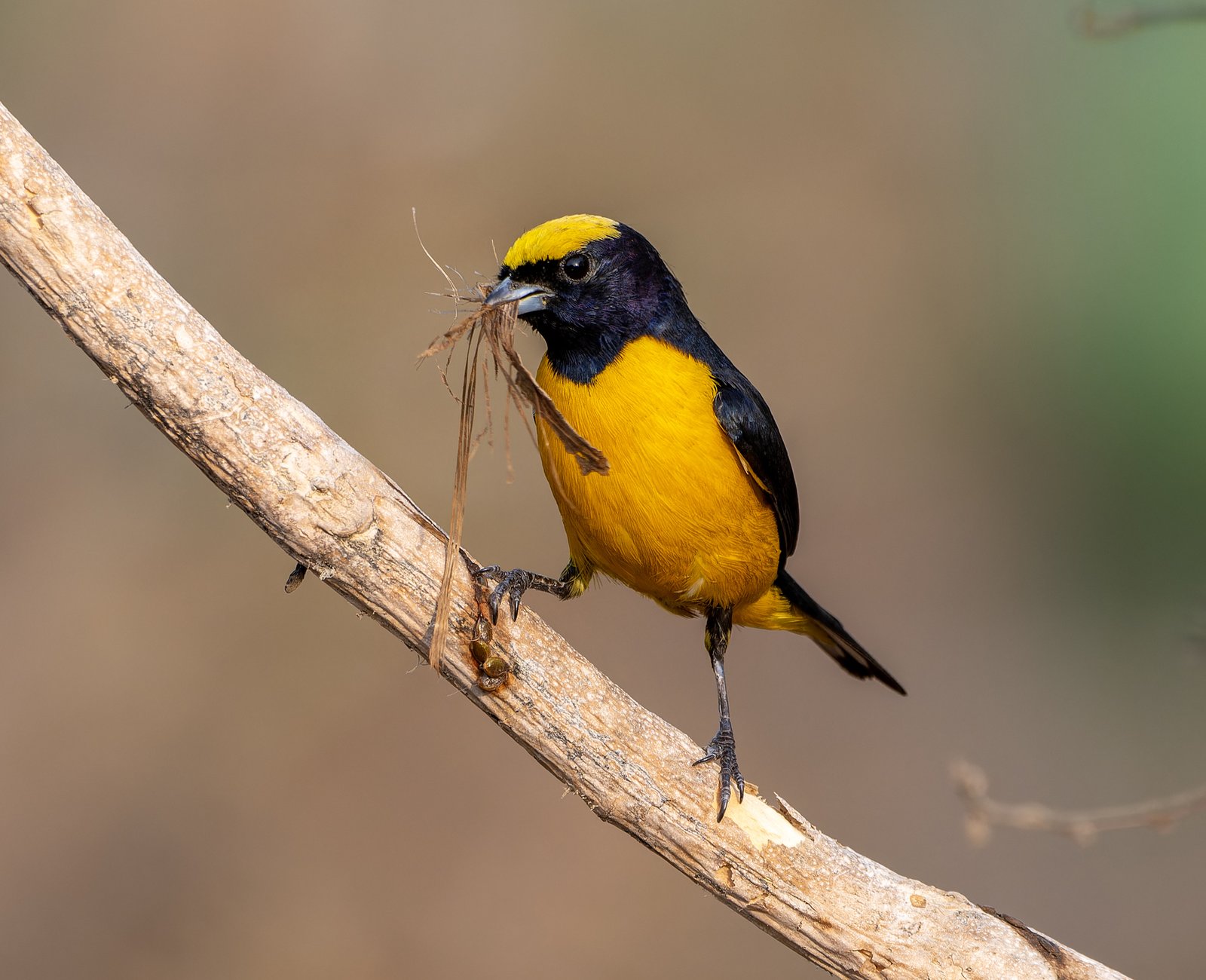
10–11 cm, one of the smallest euphonias in the region, with a short tail and a short thick bill. The male is glossy blue-black on the head, back, throat and upper breast, with a bright yellow crown that runs from the forehead to well behind the eye, and bright yellow underparts. The female is olive-green above and yellowish olive below, with a greyish band down the centre of the breast and belly and bright yellow undertail coverts.
Confusion species
Male Violaceous Euphonia Euphonia violacea is larger, with a yellow throat and yellow only on the forehead. Females are more alike: Violaceous lacks the grey band on the underparts and is more uniformly yellow-olive. Trinidad Euphonia is also more often found in dry and open country, Violaceous in moist forest.
Habitat
On Trinidad in second growth, hill forest and cultivated land with mistletoe, and in mangroves on the west coast. On the mainland in dry forest, the edges of moist forest, open woodland and scrub up to about 1100 m. It feeds mainly on small berries, but also on insects and seeds.
Where the bird is most at home, classified by the vegetation types of the Caribbean.






Range and movements
On Trinidad a scarce, local resident, mainly in the west and the dry north-west. There is one record from Tobago, regarded as an escaped cage bird. Otherwise only in northern Colombia and Venezuela.
- Resident
- dark = core range, pale = thinly spread
How and when to look
The best chance is in open, dry woodland and at trees covered with mistletoe in western Trinidad. Listen for the high, plaintive call; birds often sit high and still in a tree crown.
Conservation status
Not threatened globally. Rare and local on Trinidad, partly because of trapping for the cage-bird trade.
Scientific name
Euphonia trinitatis | Strickland, 1851
Strickland described the species in 1851 and placed it straight away in the genus where it still stands. The genus Euphonia was introduced in 1806 by Desmarest, A-G. Euphonia is Greek, from eu 'good' and phōnē 'sound': 'sweet-voiced', after the pleasing calls. trinitatis is Latin for 'of the Trinity', after Trinidad, the island of the type specimen. The specimen the first description was based on came from Trinidad.